
Is Pickleball Growth in India Just Hype? The Real Gap Between Courts and Professionals
Pickleball is booming in India… but are we truly building professionals—or just more places to play?
Let’s move beyond the hype and look at the reality.
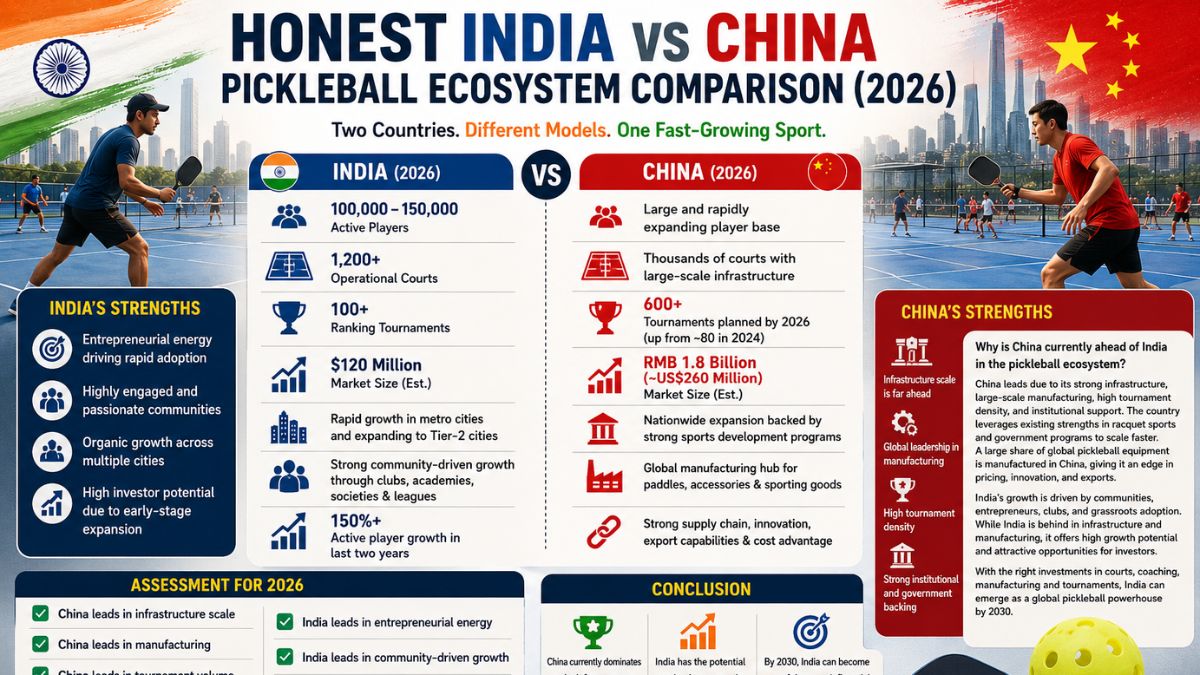
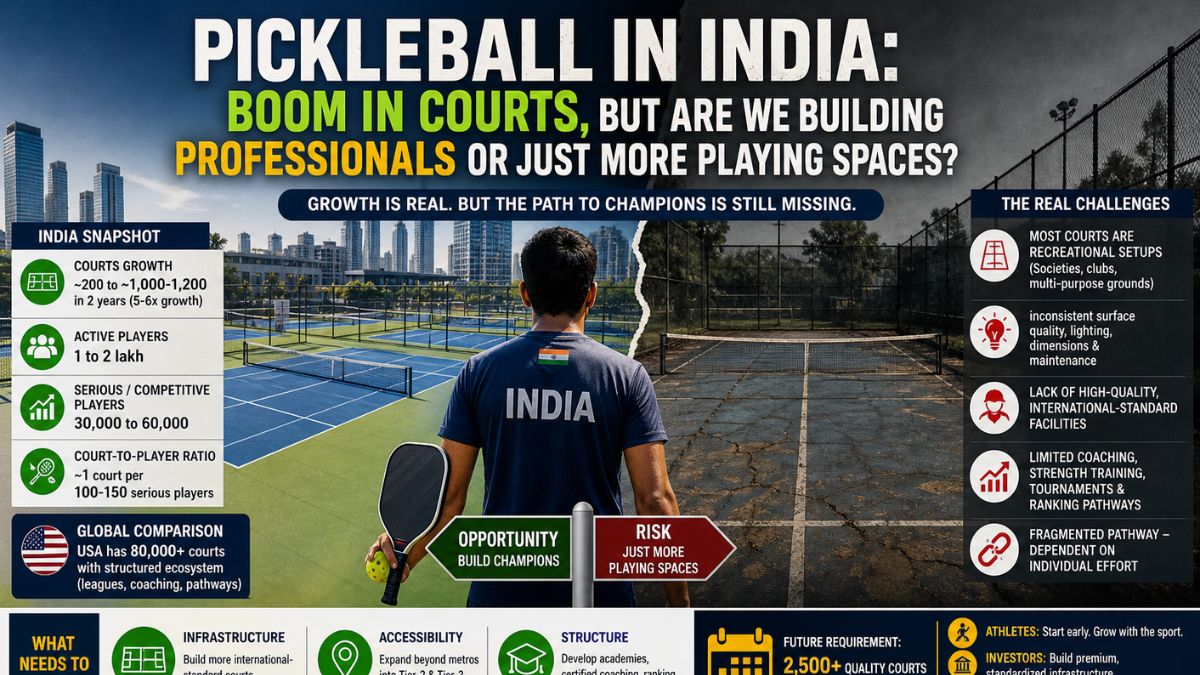
Over the last two years, pickleball in India has witnessed remarkable growth. The number of courts has jumped from roughly 200 to an estimated 1,000–1,200 today. On paper, that’s a 5–6x increase—something any emerging sport would celebrate. New communities are forming, clubs are popping up across metros, and participation is steadily rising.
India today has an estimated 1 to 2 lakh active pickleball players. Within that, around 30,000 to 60,000 players are serious about the sport—training regularly, competing, and aspiring to move up the ranks. Now, if we break this down, the ratio becomes concerning: roughly one court for every 100–150 serious players.
At first glance, that might not sound alarming. But when you compare this with mature sporting ecosystems globally, the gap becomes evident.
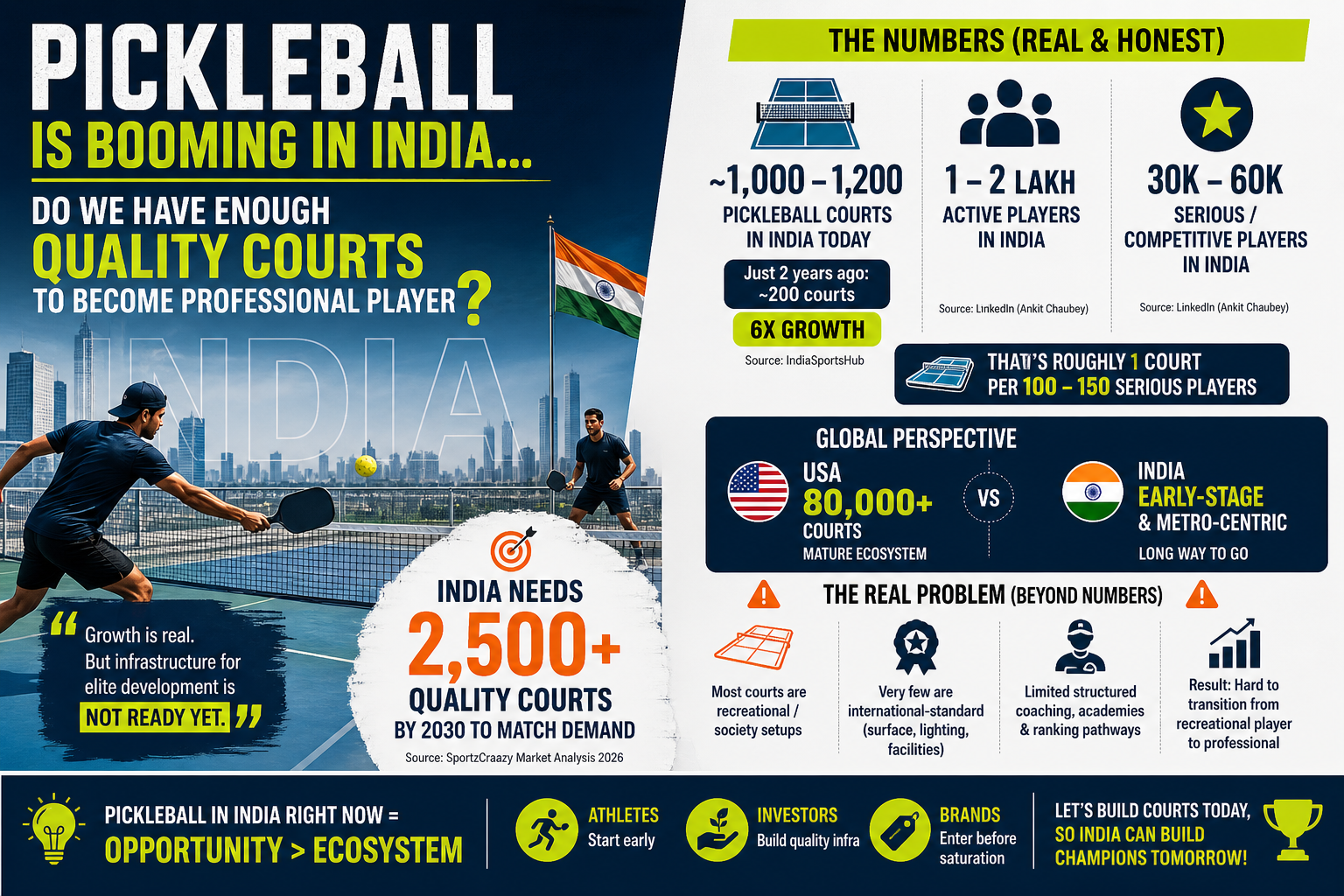
The United States, for example, has over 80,000 courts backed by structured leagues, coaching systems, and competitive pathways. India, in contrast, is still in its early phase—both in terms of infrastructure and ecosystem maturity.
The challenge is not just about the number of courts being built—it’s about the quality, accessibility, and standardization of those courts.
A large percentage of pickleball courts in India today are recreational setups. These are often converted spaces in housing societies, clubs, or multi-purpose grounds.
While they serve as excellent entry points for beginners, they fall short when it comes to high-performance training. Factors like surface quality, lighting conditions, court dimensions, and maintenance standards are inconsistent across locations.
For a sport to produce professional athletes, infrastructure needs to go beyond just availability. It must support performance.
At present, India has very few dedicated, international-standard pickleball facilities that meet competitive requirements. Even fewer offer integrated ecosystems—coaching programs, strength and conditioning support, tournament exposure, and a clear ranking or progression system.
This creates a gap.
On one hand, it’s easier than ever to start playing pickleball in India. On the other hand, transitioning from a casual player to a professional athlete remains a significant challenge. The pathway is unclear, fragmented, and often dependent on individual effort rather than a structured system.
This is why, despite visible growth, India is yet to consistently produce globally competitive pickleball professionals.
So where does that leave us?
The growth story is real—there’s no denying that. Participation is increasing, awareness is spreading, and the sport is finding its place in urban India. But infrastructure development is still largely skewed towards quantity over quality.
If India aims to build a strong pipeline of professional players, the focus needs to shift.
First, there is a clear need for more high-quality courts—facilities built with international standards in mind. This includes proper surfaces, standardized dimensions, adequate lighting, and year-round usability.
| Section | Key Insight |
|---|---|
| Core Question | Pickleball is booming in India… but are we building professionals or just more playing spaces? |
| Growth Snapshot (India) | Courts increased from ~200 to ~1,000–1,200 in 2 years (5–6x growth) |
| Ecosystem Expansion | New communities forming, clubs rising across metros, participation steadily increasing |
| Player Base | 1–2 lakh active players |
| Serious/Competitive Players | 30,000–60,000 players training and competing regularly |
| Court-to-Player Ratio | ~1 court per 100–150 serious players |
| Global Comparison | USA has 80,000+ courts with structured ecosystem (leagues, coaching, pathways) |
| India’s Stage | Early-stage market with developing infrastructure and limited maturity |
| Core Problem | Not just number of courts, but lack of quality, accessibility, and standardization |
| Current Court Reality | Majority are recreational setups (societies, clubs, multi-purpose grounds) |
| Infrastructure Gaps | Inconsistent surface quality, lighting, dimensions, and maintenance |
| Performance Challenge | Existing infrastructure not designed for high-performance training |
| Elite Facilities | Very few international-standard courts and integrated training ecosystems |
| Missing Ecosystem Elements | Limited coaching programs, strength training, tournaments, and ranking pathways |
| Key Gap | Easy entry into sport, but difficult transition to professional level |
| System Issue | Fragmented pathway, dependent on individual effort rather than structured system |
| Current Outcome | India not yet producing consistent globally competitive pickleball professionals |
| Reality Check | Growth is real, but infrastructure focus is more on quantity than quality |
| What Needs to Change | Shift focus from expansion to performance-driven infrastructure |
| Solution 1: Infrastructure | Build more international-standard courts (surface, lighting, usability) |
| Solution 2: Accessibility | Expand beyond metros into Tier-2 and Tier-3 cities |
| Solution 3: Structure | Develop academies, certified coaching, ranking systems, tournament calendar |
| Future Requirement | 2,500+ quality courts needed by 2030 (minimum estimate) |
| Critical Need | More performance-oriented facilities vs just recreational spaces |
| Opportunity for Athletes | Start early and grow with the sport |
| Opportunity for Investors | Build premium, standardized infrastructure |
| Opportunity for Brands | Enter early before market saturation |
| Final Insight | Pickleball in India = Opportunity > Ecosystem |
| Closing Thought | Are we building champions or just increasing playing spaces? |
Second, accessibility must improve. Currently, most quality setups are concentrated in metro cities, making it difficult for talent from Tier-2 and Tier-3 regions to access proper training environments.
Third, and perhaps most importantly, the ecosystem needs structure. Academies, certified coaching programs, ranking systems, and consistent tournament calendars are essential to nurture talent and provide direction to aspiring athletes.
Looking ahead, India may need upwards of 2,500 well-developed courts by 2030 just to meet the growing demand—and that’s a conservative estimate. But more importantly, a significant portion of these must be performance-oriented facilities, not just recreational spaces.
The opportunity is massive.
For athletes, this is the best time to start early and grow with the sport. For investors, there is a clear gap in building premium, standardized infrastructure. For brands, this is still a relatively untapped space with first-mover advantage.
In simple terms, pickleball in India today is a story where opportunity outweighs the ecosystem.
The foundation is being laid—but it’s not complete yet.
The bigger question remains: Are we building a system that creates champions, or are we just expanding the number of places where people can play?
Because the answer to that will define the future of pickleball in India.
| Section | Key Insight |
|---|---|
| Core Question | Pickleball is booming in India… but are we building professionals or just more playing spaces? |
| Growth Snapshot (India) | Courts increased from ~200 to ~1,000–1,200 in 2 years (5–6x growth) |
| Ecosystem Expansion | New communities forming, clubs rising across metros, participation steadily increasing |
| Player Base | 1–2 lakh active players |
| Serious/Competitive Players | 30,000–60,000 players training and competing regularly |
| Court-to-Player Ratio | ~1 court per 100–150 serious players |
| Global Comparison | USA has 80,000+ courts with structured ecosystem (leagues, coaching, pathways) |
| India’s Stage | Early-stage market with developing infrastructure and limited maturity |
| Core Problem | Not just number of courts, but lack of quality, accessibility, and standardization |
| Current Court Reality | Majority are recreational setups (societies, clubs, multi-purpose grounds) |
| Infrastructure Gaps | Inconsistent surface quality, lighting, dimensions, and maintenance |
| Performance Challenge | Existing infrastructure not designed for high-performance training |
| Elite Facilities | Very few international-standard courts and integrated training ecosystems |
| Missing Ecosystem Elements | Limited coaching programs, strength training, tournaments, and ranking pathways |
| Key Gap | Easy entry into sport, but difficult transition to professional level |
| System Issue | Fragmented pathway, dependent on individual effort rather than structured system |
| Current Outcome | India not yet producing consistent globally competitive pickleball professionals |
| Reality Check | Growth is real, but infrastructure focus is more on quantity than quality |
| What Needs to Change | Shift focus from expansion to performance-driven infrastructure |
| Solution 1: Infrastructure | Build more international-standard courts (surface, lighting, usability) |
| Solution 2: Accessibility | Expand beyond metros into Tier-2 and Tier-3 cities |
| Solution 3: Structure | Develop academies, certified coaching, ranking systems, tournament calendar |
| Future Requirement | 2,500+ quality courts needed by 2030 (minimum estimate) |
| Critical Need | More performance-oriented facilities vs just recreational spaces |
| Opportunity for Athletes | Start early and grow with the sport |
| Opportunity for Investors | Build premium, standardized infrastructure |
| Opportunity for Brands | Enter early before market saturation |
| Final Insight | Pickleball in India = Opportunity > Ecosystem |
| Closing Thought | Are we building champions or just increasing playing spaces? |
Frequently Asked Questions(FAQ):
FAQ 1: Why is India struggling to produce professional pickleball players despite rapid growth?
India’s pickleball growth story is largely participation-driven rather than performance-driven. While the number of courts and players has increased significantly, the supporting ecosystem required to produce professional athletes is still underdeveloped. Most available courts are recreational in nature—built for accessibility rather than high-performance training. This creates an environment where players can start easily but struggle to progress beyond an intermediate level.
Another major issue is the absence of a structured pathway. Unlike mature sports ecosystems, India lacks a clear progression system that guides a player from grassroots to elite competition. There are limited certified coaches, inconsistent training methodologies, and very few academies focused on long-term athlete development. Additionally, access to regular, high-quality tournaments is still limited, which restricts competitive exposure.
Fitness, recovery, and sports science—critical components of modern professional sports—are also largely missing from the current pickleball ecosystem. As a result, even talented players often rely on personal effort and self-funding to advance, which is not sustainable at scale.
In simple terms, India has built an entry point into pickleball, but not yet a pathway to excellence. Until infrastructure, coaching, and competition systems evolve together, producing globally competitive professionals will remain a challenge.
FAQ 2: What needs to change for India to become a global force in pickleball?
For India to emerge as a serious contender in global pickleball, the focus must shift from expansion to ecosystem-building. The first priority should be developing high-quality, performance-oriented infrastructure. This means building courts that meet international standards in terms of surface, dimensions, lighting, and maintenance—facilities that can support professional training and competitive play.
Equally important is the creation of a structured development pathway. Players need clarity on how to progress—from beginner to intermediate to elite levels. This requires certified coaching programs, standardized training curriculums, and academies that focus on long-term athlete development rather than short-term engagement.
Competitive exposure is another critical piece. A consistent tournament calendar—ranging from grassroots competitions to national-level events—will help players gain experience, improve rankings, and stay motivated. Integration of ranking systems and talent identification programs will further strengthen this pipeline.
Accessibility must also expand beyond metro cities. Talent exists across Tier-2 and Tier-3 regions, but without access to quality infrastructure and coaching, it remains untapped.
Finally, collaboration between federations, private investors, brands, and academies is essential. If these elements come together strategically, India has the potential not just to grow pickleball participation—but to build a system that consistently produces world-class athletes.