Honest India vs China Pickleball Ecosystem Comparison (2026)
Pickleball is one of the fastest-growing sports globally, and Asia is emerging as a major growth hub. While India and China are both experiencing rapid expansion in the sport, their growth stories are remarkably different. One country is building a participation-driven ecosystem, while the other is leveraging scale, infrastructure, and manufacturing to accelerate its dominance.
1. India: Building a Participation-Led Ecosystem
Everyone talks about how fast pickleball is growing in India, and the numbers certainly support that narrative.
According to industry estimates, India now has approximately 100,000–150,000 active pickleball players, more than 1,200 operational courts, and over 100 ranking tournaments being conducted through organized structures.
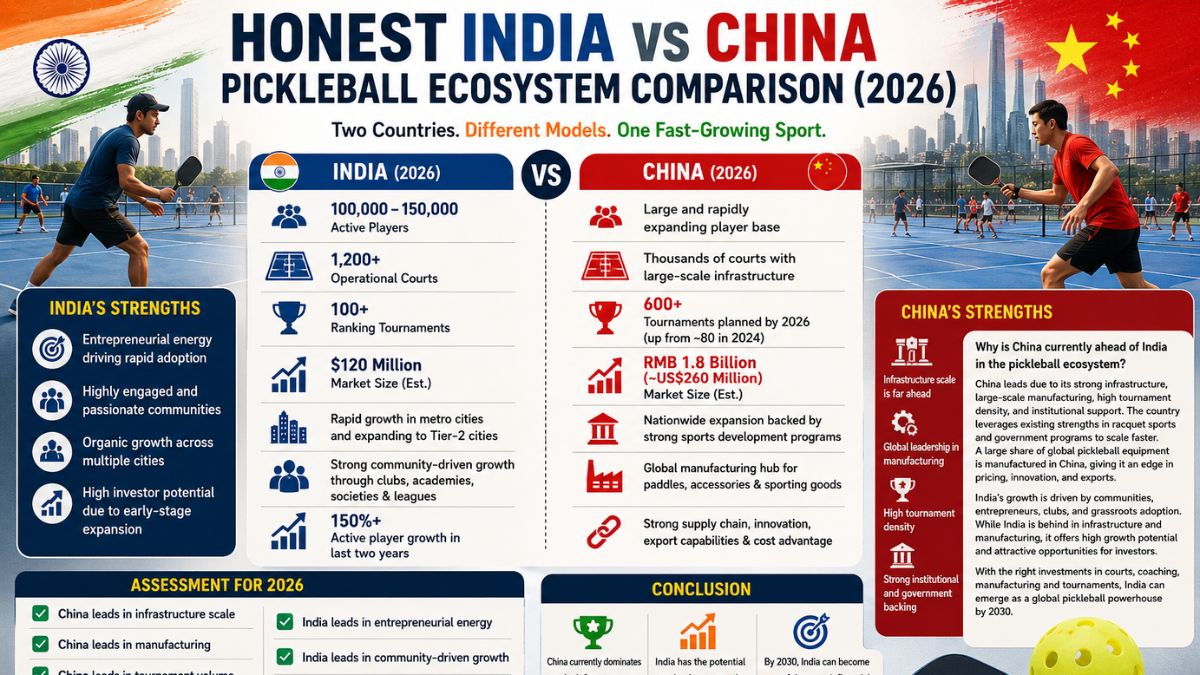
The sport is witnessing rapid adoption across major metropolitan cities such as Mumbai, Delhi NCR, Bengaluru, Hyderabad, Pune, and Ahmedabad. More importantly, pickleball is gradually making its way into Tier-2 cities, indicating that the sport’s reach is extending beyond traditional urban centers.
The commercial side of the sport is also gaining momentum. Recent estimates value India’s pickleball market at nearly $120 million by the end of 2026. Active player growth has reportedly crossed 150% over the last two years, making India one of the fastest-growing pickleball markets in the world.
However, participation growth alone does not create a complete sports ecosystem. To become a global powerhouse, India will need stronger infrastructure, manufacturing capabilities, coaching pathways, and long-term institutional support.
2. China: Building a Scale-Led Ecosystem
China is playing an entirely different game.
The Chinese pickleball economy is projected to reach approximately RMB 1.8 billion (around US$260 million), making it more than double the size of India’s current market. Rather than relying solely on participation growth, China is leveraging its existing strengths in table tennis, badminton, tennis infrastructure, sports manufacturing, and government-backed sports development programs.
One of the most striking indicators of China’s growth is tournament expansion. China’s annual pickleball circuit reportedly grew from around 80 events in 2024 to more than 600 planned events by 2026. This tournament density creates a stronger pathway for talent identification, coaching development, sponsorship acquisition, professional competition, and long-term athlete development.
When it comes to manufacturing, China remains significantly ahead of India. A large percentage of global pickleball paddles, accessories, and sporting goods are manufactured in China. This provides Chinese companies with substantial advantages in pricing, innovation, export capabilities, and supply-chain control.
In contrast, India continues to rely heavily on imported equipment and has only recently started developing domestic manufacturing capabilities. While the country has immense potential, it is still in the early stages of creating a self-sustaining pickleball supply chain.
One area where India holds a distinct advantage is community-driven growth.
Most of India’s pickleball expansion has been driven by local clubs, private academies, housing societies, leagues, fitness communities, and passionate players. This grassroots model has created highly engaged communities and remarkable organic adoption, which is often difficult to replicate through institutional efforts alone.
Assessment for 2026
A- China leads in infrastructure scale.
B- China leads in manufacturing.
C- China leads in tournament volume.
D- China leads in institutional backing.
E- India leads in entrepreneurial energy.
F- India leads in community-driven growth.
G- India offers stronger opportunities for investors because the ecosystem is still in its early expansion phase.
Conclusion
The real question is not whether India can catch China in 2026. At present, China clearly holds the advantage in terms of infrastructure, manufacturing capabilities, and ecosystem maturity.
The more important question is whether India can build a self-sustaining pickleball ecosystem by 2030. If the country can develop thousands of courts, establish domestic manufacturing, create structured coaching pathways, introduce school and university competitions, and attract greater commercial investment, India could emerge as one of the most influential pickleball markets in the world.
China currently dominates scale.
India, however, may have the potential to dominate growth.
| Category | India (2026) | China (2026) |
|---|---|---|
| Ecosystem Model | Participation-led ecosystem driven by players, entrepreneurs, academies, and private investments. | Scale-led ecosystem driven by infrastructure, manufacturing, and institutional support. |
| Active Players | Approximately 100,000–150,000 active players. | Significantly larger player base supported by large-scale development programs. |
| Operational Courts | More than 1,200 operational courts. | Thousands of courts supported by rapid infrastructure expansion. |
| Tournament Structure | Over 100 ranking tournaments conducted through organized structures. | More than 600 planned annual tournaments by 2026. |
| Market Size | Estimated at nearly US$120 million by the end of 2026. | Approximately RMB 1.8 billion (around US$260 million). |
| Growth Rate | Active player growth has reportedly crossed 150% in the last two years. | Rapid ecosystem growth supported by infrastructure and manufacturing capabilities. |
| Major Growth Centers | Mumbai, Delhi NCR, Bengaluru, Hyderabad, Pune, Ahmedabad, and emerging Tier-2 cities. | Nationwide expansion supported by sports development initiatives. |
| Infrastructure Development | Growing rapidly but still developing. | Well-established and expanding at a much larger scale. |
| Sports Foundation | Emerging pickleball-specific ecosystem. | Benefits from existing table tennis, badminton, and tennis infrastructure. |
| Manufacturing Strength | Limited domestic production; heavily dependent on imports. | Global manufacturing hub for pickleball paddles, accessories, and sporting goods. |
| Supply Chain Advantage | Still developing local supply chains. | Strong supply-chain control and export capabilities. |
| Innovation Capacity | Early-stage innovation driven by startups and entrepreneurs. | Large-scale innovation supported by manufacturing ecosystem. |
| Government Support | Primarily driven by private participation and community initiatives. | Supported by government-backed sports development programs. |
| Talent Development Pathway | Growing through academies and tournaments. | Strong talent identification system through extensive tournament network. |
| Coaching Development | Expanding but still evolving. | Supported by larger competition and development ecosystem. |
| Sponsorship Opportunities | Increasing as participation grows. | Higher due to larger tournament volume and ecosystem maturity. |
| Community Engagement | Strong grassroots participation through clubs, societies, and fitness communities. | More institutionally driven growth model. |
| Entrepreneurial Activity | One of the strongest aspects of the Indian ecosystem. | Comparatively less entrepreneur-led than India. |
| Investor Potential | High-growth market with significant future opportunities. | More mature market with established commercial structures. |
| Biggest Strength | Community-driven growth and entrepreneurial energy. | Infrastructure, manufacturing, and ecosystem scale. |
| Biggest Challenge | Need for stronger infrastructure, manufacturing, and institutional support. | Maintaining growth while expanding participation across all levels. |
Assessment for 2026
| Area | Leader |
|---|---|
| Infrastructure Scale | China |
| Manufacturing | China |
| Tournament Volume | China |
| Institutional Backing | China |
| Entrepreneurial Energy | India |
| Community-Driven Growth | India |
| Investor Growth Potential | India |
Conclusion
| Key Observation | Analysis |
|---|---|
| Current Ecosystem Leader | China currently holds the advantage in infrastructure, manufacturing capabilities, tournament density, and ecosystem maturity. |
| Fastest Growing Market | India remains one of the fastest-growing pickleball markets globally. |
| India’s Opportunity by 2030 | Build thousands of courts, establish domestic manufacturing, develop coaching pathways, expand school and university competitions, and attract commercial investments. |
| Future Outlook | China dominates scale today, while India has the potential to dominate growth over the next decade. |
| Final Verdict | China leads the present; India could shape the future of pickleball growth in Asia if it continues its current trajectory. |
Frequently ask questions
Why is China currently ahead of India in the pickleball ecosystem despite India’s rapid growth?
China is currently ahead of India in the pickleball ecosystem because it possesses several structural advantages that extend far beyond player participation. While India has emerged as one of the fastest-growing pickleball markets in the world, China’s ecosystem is more mature and diversified across infrastructure, manufacturing, tournament organization, and institutional support.
One of China’s biggest strengths is its existing sports infrastructure. The country has already developed world-class systems for sports such as table tennis, badminton, and tennis. These facilities, coaching networks, and administrative structures can be leveraged to accelerate pickleball’s growth. As a result, China has been able to scale the sport much faster than most emerging markets.
Manufacturing is another major differentiator. A significant portion of the world’s pickleball paddles, balls, and accessories are manufactured in China. This provides Chinese companies with advantages in production costs, innovation, supply-chain management, and global exports. India, on the other hand, still relies heavily on imported equipment and is only beginning to develop domestic manufacturing capabilities.
Tournament volume also plays a crucial role. China’s pickleball circuit has expanded rapidly, creating hundreds of competitive opportunities for players every year. A larger tournament ecosystem helps identify talent, attract sponsorships, develop coaches, and build professional pathways for athletes. India is making progress in this area, but the scale remains considerably smaller.
However, India has strengths of its own. The sport’s growth in India is largely community-driven, fueled by entrepreneurs, private academies, housing societies, sports clubs, and fitness enthusiasts. This grassroots momentum has created strong engagement and organic adoption across multiple cities. Additionally, India’s ecosystem remains in an early-growth phase, making it an attractive destination for investors seeking long-term opportunities.
In summary, China currently leads due to infrastructure, manufacturing strength, tournament density, and institutional backing. India, meanwhile, leads in entrepreneurial energy, community participation, and future growth potential. If India successfully develops domestic manufacturing, expands court infrastructure, and creates structured player development pathways, it could become one of the world’s most influential pickleball markets by 2030.