
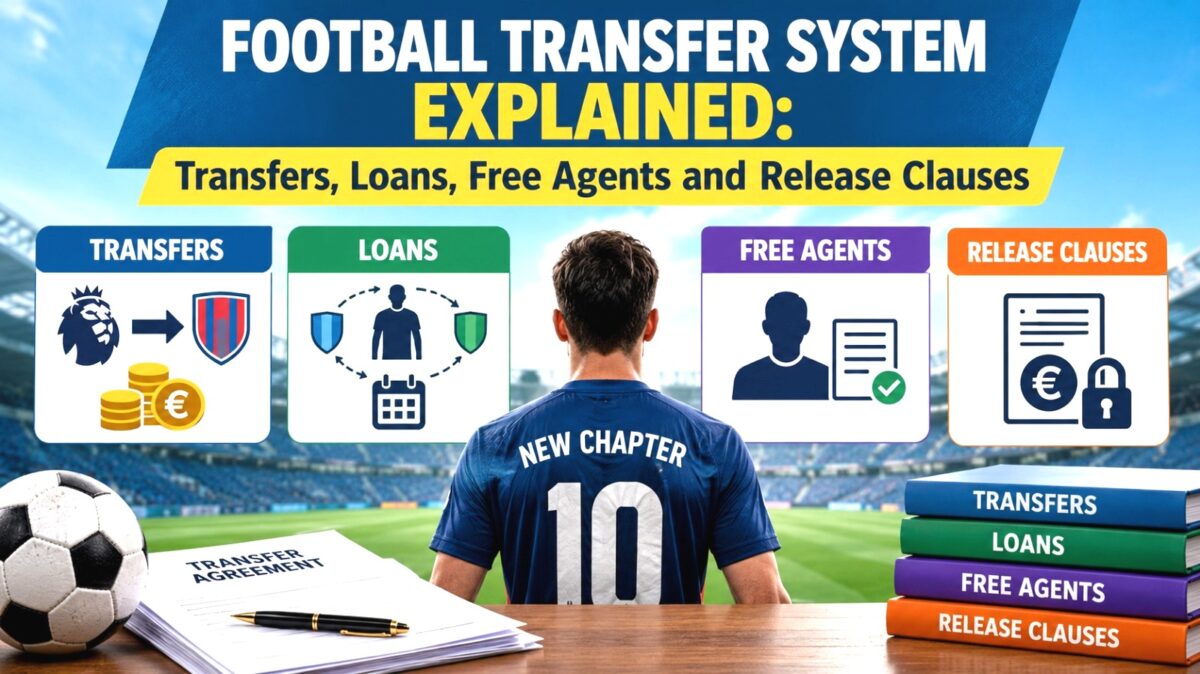
Football Transfer System Explained: Transfers, Loans, Free Agents and Release Clauses
Football transfers are an important part of how professional clubs build their squads. Every season, clubs sign new players, sell existing players, send young talents out on loan and allow some contracts to expire. These moves help teams manage their squads, balance their budgets and plan for upcoming competitions.
However, the football transfer system can sometimes be confusing for people who are new to the sport. A club might pay millions to sign a player, while another club may sign a player without paying a transfer fee. Similarly, a player can join a team on loan for a season without permanently leaving their original club.
There are also special rules related to transfer windows, player contracts, release clauses and registration. Understanding these rules makes it easier to follow transfer news and understand how clubs complete deals during the football season.
In this guide, we explain the football transfer system, permanent transfers, loan deals, free agents, release clauses, transfer windows and other important terms in simple English.
What Is the Football Transfer System?
The football transfer system is the process through which players move between clubs. It includes permanent transfers, temporary loan deals, moves by players whose contracts have expired and other arrangements agreed upon by clubs and players. The process is controlled by football regulations, player contracts and registration rules.
In a normal permanent transfer, one club agrees to let a player leave, another club agrees to sign the player, and the player agrees to join the new team. The two clubs usually negotiate a transfer fee, while the player negotiates personal terms and signs an employment contract with the new club. The move must also meet the applicable registration requirements before the player becomes eligible to play.
International transfers involve additional steps because the clubs belong to different national football associations. FIFA’s Regulations on the Status and Transfer of Players provide the main international framework, while national associations and individual leagues apply their own rules to domestic transfers and player registrations.
For example, if a footballer moves from Real Madrid in Spain to Manchester City in England, the clubs must agree on the transfer, the player must agree to the move, and the required international documentation must be completed. Once the transfer and registration process is approved, the player can represent the new club in competitions for which they are eligible.
How Does a Football Transfer Work?
A football transfer usually involves several steps, although the exact process can differ depending on the player, the clubs and the type of deal.
First, a club identifies a player who could improve its squad. The recruitment team may study the player’s performances, fitness, age, position and contract situation before contacting the player’s representatives or current club. Once the club decides to proceed, discussions begin.
The buying club then negotiates with the selling club over the transfer fee and other conditions. These discussions may cover when the money will be paid, whether extra payments will depend on appearances or team results, and whether the selling club will receive a share of a future transfer fee.
At the same time, the buying club negotiates personal terms with the player. These can include salary, contract length, bonuses and other agreed conditions. The player must agree to the contract before the move can be completed.
Medical checks and paperwork are also important parts of many transfers. A club may arrange a medical examination to assess the player’s fitness, but passing a medical alone does not complete a transfer. The necessary agreements and registration requirements must still be fulfilled.
Finally, the clubs submit the required documents to the relevant football authorities. For an international move, the International Transfer Certificate and FIFA’s transfer processes may also be required, depending on the circumstances. A club announcement is therefore not the only factor: the player must complete the applicable registration process to become eligible to play.
What Is a Permanent Transfer in Football?
A permanent transfer happens when a player moves from one club to another under an agreement intended to make the move permanent. The player’s former club agrees to the transfer, while the new club signs the player under a new employment contract. If the deal includes a transfer fee, the buying club pays the agreed amount to the selling club.
Suppose Arsenal want to sign a striker who is under contract with another club. Arsenal may offer £40 million, while the selling club may ask for £50 million. Both clubs negotiate until they reach an agreement, or the discussions end without a deal.
The transfer fee can be paid in different ways. Some agreements require a large payment at the start, while others allow payments to be made in instalments over several years. A deal may also include extra payments based on appearances, goals, trophies or other agreed conditions.
For example, a club might agree to pay £30 million initially and another £5 million if the player reaches a certain number of appearances. These additional payments are commonly called add-ons. The final cost of the transfer may therefore be higher than the amount announced when the deal is first reported.
Permanent transfers can happen during a transfer window, subject to the relevant registration rules. In most cases, a buying club needs the current club’s agreement when the player still has a valid contract. However, free-agent moves, release clauses and other special situations work differently.
What Is a Football Transfer Fee?
A transfer fee is the amount agreed between clubs for a player’s permanent move. It is separate from the salary that the player receives under the employment contract with the new club. In a normal paid transfer, the fee goes from the buying club to the selling club rather than directly to the player.
The transfer fee can depend on several factors, including the player’s age, performance, contract length, position and demand from other clubs. A player with several years remaining on a contract may cost more to sign than a similar player whose contract is close to ending. However, the final amount always depends on the terms the clubs are willing and able to accept.
Clubs may also agree on a sell-on clause. This clause gives the selling club a share of a future transfer fee if the player is sold again. For instance, a club selling a young player for £10 million might negotiate a 15% share of the profit from a future sale, depending on the exact wording of the agreement.
It is also useful to separate a player’s transfer fee from the total cost of signing them. A buying club may have to account for wages, signing bonuses, agent fees and other contract-related costs in addition to the transfer fee. Therefore, a transfer worth £50 million does not necessarily mean that £50 million covers every expense linked to the player.
What Is a Loan Deal in Football?
A loan deal allows a player to represent another club temporarily without making a permanent move. The player normally remains under an employment contract with the original club, often called the parent club, while joining the loan club for an agreed period. When the loan ends, the player generally returns to the parent club unless a permanent transfer or another arrangement has been agreed.
Loan deals are common when young players need regular playing time to develop their game. A large club might have a talented midfielder who is not yet a regular starter, so it sends the player to another team where more playing opportunities are available. The player gains experience while the parent club retains the contractual relationship.
For example, a 19-year-old goalkeeper at a Premier League club may join a Championship team on loan for one season. If the goalkeeper plays regularly, the loan club benefits from having a new player, while the parent club can review the player’s progress during the season. At the end of the loan, the goalkeeper may return and compete for a place in the first team.
FIFA treats international loans as temporary player engagements and has introduced rules covering loan agreements and the number of players clubs can loan. Domestic leagues can have additional restrictions. For this reason, loan conditions should always be checked against the applicable regulations.
Types of Loan Deals in Football
Not all loan agreements have the same conditions. The length of the loan, financial arrangements and any option to buy can change from one deal to another.
- Season-long loan
A season-long loan usually allows a player to join another club for most or all of a football season. The loan club can use the player during the agreed period, while the parent club retains the player’s contract. At the end of the arrangement, the player normally returns unless another deal is completed.
- Short-term loan
A short-term loan lasts for a smaller part of a season or another agreed period. The availability and permitted duration of such moves depend on the relevant regulations and competition rules. Clubs may use temporary deals to fill a gap in their squads or provide a player with playing time.
- Loan with an option to buy
A loan with an option to buy gives the loan club the right to purchase the player permanently under agreed conditions. However, the buying club is generally not required to complete the permanent transfer unless the agreement says otherwise or another contractual condition applies. The option’s fee, deadline and other terms are set out in the deal.
- Loan with an obligation to buy
A loan with an obligation to buy includes a commitment to complete a permanent transfer when specified contractual conditions are met. The conditions can relate to dates, appearances or other agreed events. The exact wording matters because an obligation is different from an optional choice to buy.
- Paid and unpaid loans
In some loan deals, the loan club pays a loan fee to the parent club. The loan club may also agree to cover all or part of the player’s wages, while another deal could divide those salary costs between both clubs. These financial terms are negotiated separately and are not the same as a permanent transfer fee.
What Is the Difference Between a Loan and a Permanent Transfer?
The main difference is that a loan is temporary, while a permanent transfer is intended to move the player permanently to a new club. A loan player generally returns to the parent club when the agreed period ends, unless another move is arranged. A player who completes a permanent transfer instead joins the new club under the agreed permanent arrangement.
| Feature | Permanent transfer | Loan deal |
| Length of move | Permanent move | Temporary period |
| Original club’s role | Agrees to the permanent move | Usually retains the player’s contract |
| Transfer fee | May be paid for the permanent move | A loan fee may be agreed |
| Salary | Paid by the new club under its contract | May be paid by one or both clubs |
| What happens at the end? | Player remains with the new club under contract | Player normally returns to the parent club |
| Option to buy | Not usually needed after a permanent move | May be included in the loan agreement |
A loan can help a club assess a player before deciding whether to sign them permanently. However, the player, both clubs and the relevant rules still need to be considered when a permanent move is discussed. A successful loan does not automatically guarantee that the player will be bought.
What Is a Free Agent in Football?
A free agent is a player who is not currently bound by an active employment contract with a club that prevents them from joining another team. A player can usually sign for a new club without the new club paying a transfer fee to the former club once the previous contract has expired. However, the player must still meet the applicable registration and eligibility requirements.
For example, if a midfielder’s contract expires at the end of June and the player does not sign a new deal, another club may be able to sign them as a free agent. The new club will still need to agree on wages, contract length and other personal terms with the player. It may also pay a signing bonus or other agreed costs, even though no transfer fee is due to the former club.
Premier League guidance explains that players become free agents when their contracts expire, allowing them to join a new club without a transfer fee. The league also notes that a player listed for release may remain at the same club if a new contract is later agreed.
A free transfer does not mean that a player has no value or that signing them costs nothing. A club may still spend money on wages, bonuses, agent services and other expenses. It simply means that the deal does not require a transfer fee to be paid to the former club for the player’s move.
Can a Player Leave Before Their Contract Expires?
A player with a valid contract generally cannot simply leave for another club without dealing with the existing contractual position. Usually, the current club must agree to a transfer, or a valid contractual or legal route must allow the player to move. A player may request a transfer, but submitting a request does not automatically end their contract or force the club to accept a bid.
Clubs can sometimes agree to terminate a player’s contract early. In that situation, the player may become available to sign elsewhere, depending on the terms of the termination and any rules that apply. The player and club may negotiate compensation or other conditions as part of the agreement.
Another possibility is a release clause written into the player’s contract. If the clause applies and its requirements are properly met, it may allow a move under specific conditions. However, not every player has such a clause, and the exact legal effect depends on the contract and the relevant country’s rules.
What Is a Release Clause in Football?
A release clause is a term in a player’s contract that sets out a specific condition under which the player can leave, often linked to a fixed amount of money. Depending on how the clause is written and the law that applies, meeting the conditions may require the current club to allow the transfer or may trigger a defined process for ending the contract. This is different from a normal transfer, where the selling club can negotiate or reject an offer.
For example, imagine that a midfielder has a release clause of €60 million. If the clause is valid and an interested club meets all its conditions, the current club may have limited or no ability to block the move, depending on the clause’s terms. However, the buying club must still complete the required steps, and the player must agree to the move and personal contract terms.
Release clauses can include conditions that are easy to overlook. Some may apply only during a particular transfer window, while others may relate to specific competitions, clubs or situations. The amount reported in a news story is not enough by itself to determine whether a transfer can happen.
Release clauses also work differently across football countries. In Spain, buy-out clauses have a special role under Spanish law, while in other leagues the terms and effects depend on the contract and applicable rules. Therefore, a reported clause should not be treated as a universal rule that works identically everywhere.
What Happens When a Club Triggers a Release Clause?
When a club is said to have triggered a release clause, it means the club has taken steps to meet the clause’s stated conditions. This does not always mean that the transfer is complete. The player may still need to agree on wages, contract length and other personal terms, while the required legal and registration steps must also be completed.
Consider a player whose reported release clause is €80 million. A club willing to pay that amount may still need to check the clause’s exact wording, payment terms and deadline. If the player does not want to join the interested club, the transfer may not happen even when the financial condition is met.
The difference between a release clause and a normal transfer fee is straightforward. With a normal transfer, clubs negotiate the price and the selling club can refuse an offer. With an applicable release clause, the current club’s freedom to refuse may be restricted if the contractual conditions have been satisfied.
What Are Transfer Windows in Football?
A transfer window is a period during which clubs can generally register players who are moving from one club to another. Most major leagues have a summer window before the main season and a winter window during the season. The dates and times are set under the rules of the relevant football association or competition, so they can differ between countries and leagues.
The summer window is usually the main period for squad changes. Clubs often use it to sign players before the new season starts, replace players who have left and make long-term changes to their squads. It can also include loans, permanent sales and moves by free agents.
The winter window normally takes place around January in many European leagues. Clubs may use this period to strengthen positions where they have injuries or other squad gaps, although they must still follow the rules and deadlines in place. The length of the window and its closing time are not identical across all competitions.
For example, the Premier League’s summer 2026 transfer window opened on 15 June and closed at 23:00 BST on 1 September. Its published dates illustrate how a league sets a specific registration period, but those dates should not be assumed to apply to every league worldwide.
Can a Player Join a Club Outside the Transfer Window?
Closing the transfer window does not mean that every type of player movement becomes impossible. Certain moves, including some free-agent signings, may still be permitted subject to the rules of the league and football association. However, a player cannot assume that signing a contract outside the window automatically makes them eligible to play.
A club may also complete a transfer agreement before a window closes but still need to submit the required documents and obtain the necessary registration. Some competitions set separate deadlines for registering a player to take part in a match. The Premier League, for example, publishes rules covering when new signings need to be registered to play in league matches.
International moves can involve additional requirements. A move may need to be processed through FIFA’s Transfer Matching System, and an International Transfer Certificate may be required for the player to be registered in the new country. The relevant authorities decide whether the documents and eligibility requirements have been met.
What Is a Transfer Deadline Day?
Transfer Deadline Day is the final day of a transfer window. It attracts attention because clubs have limited time to finish negotiations, agree fees, complete player contracts and submit their paperwork before the deadline. A move that has been discussed for weeks may therefore reach its final stage on this day.
Some clubs complete deals early, while others continue negotiations until the final hours. If the buying club and selling club are still far apart on the transfer fee or other conditions, the deal may fail. A player may also decide against a move even when the two clubs have reached an agreement.
Completing the paperwork on time is as important as agreeing the main terms. Some leagues have special procedures for deals that are close to the deadline, but such procedures do not remove every registration requirement. International transfers may also be subject to separate deadlines and documentation rules.
What Are Buy-Back Clauses and Sell-On Clauses?
Not every important clause in football is designed to help a player leave their current club. Buy-back clauses and sell-on clauses are often included in transfer agreements to set conditions for what may happen if the player moves again in the future. These terms can influence the relationship between the selling club and the buying club long after the first deal has been completed.
A buy-back clause gives a former club the right to bring a player back under conditions agreed in the original transfer. For example, a club selling a young midfielder might agree on a future price at which it can sign the player again. The clause may have a deadline, a set fee or other conditions that must be met.
A sell-on clause gives the former club a share of a future transfer fee when the player is sold again. The exact amount depends on the contract, as clubs can agree to different percentages and ways of calculating the payment. Some clauses apply to the full future fee, while others apply only to the profit from the sale.
These clauses are not the same as release clauses. A release clause concerns the conditions under which a player can leave their current club, while buy-back and sell-on clauses set out rights or payments linked to a previous transfer. Football clubs may negotiate several types of clauses within one deal.
What Is a Medical in a Football Transfer?
A football medical is an assessment of a player’s health and physical condition carried out during the signing process. It can include checks on previous injuries, current fitness, movement and other aspects of physical health. The exact tests depend on the club, the player’s circumstances and the medical team’s judgment.
A medical is an important step because the buying club wants to understand any health issues that could affect the player. However, passing a medical does not automatically complete the transfer, just as a club announcement alone does not necessarily mean that every registration step has been completed. The contractual agreement and the competition’s registration requirements still apply.
In some circumstances, a club may decide not to proceed after a medical or may seek further information before finalising the deal. Other transfers may be completed with agreed conditions, depending on the clubs’ decisions and contractual arrangements. The outcome depends on the specific deal rather than one universal medical process.
Do Football Agents Take Part in Transfers?
Football agents can help players and clubs negotiate contracts and transfers. They may communicate with club officials, discuss personal terms, explain contract conditions and help the parties reach an agreement. The extent of an agent’s role depends on the player’s representation agreement and the details of the transfer.
An agent may represent a player who wants to move to another country or help a club identify potential signings. The agent can support negotiations over salary, bonuses, contract length and other personal terms. However, the agent does not replace the need for the player and clubs to agree to the relevant parts of the deal.
Football agents must also follow the rules that apply to their work. FIFA has regulations covering football agents, while national associations and other relevant bodies may have additional requirements. Clubs and players should check that their arrangements meet the applicable rules.
What Are Training Compensation and Solidarity Payments?
A transfer can involve payments to clubs that helped train and develop a player earlier in their career. These payments are separate from the main transfer fee and are intended to recognise the role of training clubs in developing footballers. FIFA’s regulations include systems known as training compensation and the solidarity mechanism.
Training compensation can be payable in certain circumstances when a player becomes a professional or moves between clubs, according to the applicable rules. The purpose is to reward clubs that invested in the player’s training and development. Eligibility and the amount depend on factors such as the player’s age, registration history and the regulations governing the move.
Solidarity contributions can provide a share of certain future transfer fees to clubs that trained the player during specific years of their development. These payments can apply when the conditions set out in the rules are met. They are calculated separately from the main transfer fee and depend on the player’s training history and the relevant regulations.
FIFA’s Clearing House system supports the calculation and distribution of training rewards through a structured process. The precise payments depend on the player’s record and the rules applicable to the transfer, so they cannot be assumed to apply identically to every deal.
Difference Between a Transfer Fee, Salary and Signing Bonus
These three financial terms are often mentioned together in football transfer reports, but they refer to different payments. Understanding the difference helps explain how a club can spend a large amount on a player even when the transfer fee is relatively low.
| Term | What it means | Who generally receives it? |
| Transfer fee | The agreed payment for a player’s move between clubs | The selling club |
| Salary | Regular payment under the player’s employment contract | The player |
| Signing bonus | An agreed payment linked to signing a contract | The player |
| Loan fee | Payment agreed for a temporary move | Usually the parent club |
| Add-ons | Extra payments that depend on agreed conditions | Usually the selling club |
| Sell-on payment | A share of a later transfer fee under an earlier agreement | The former club entitled to the payment |
For instance, a club could agree to a £25 million transfer fee and offer the player a four-year contract with a salary of £100,000 per week. It may also agree to a signing bonus and additional payments linked to performances. The transfer fee and the player’s earnings are therefore separate parts of the overall deal.
A free-agent signing can have no transfer fee but still involve significant costs. The new club may offer a high salary, bonuses and other payments to convince the player to sign. That is why the term free transfer refers to the absence of a transfer fee to the former club, rather than a completely free signing.
Common Football Transfer Terms Explained
Several other terms appear regularly in transfer reports. Although they may sound similar, each has a different meaning within the transfer system.
| Term | Simple explanation |
| Transfer request | A formal or informal request by a player to leave their current club |
| Personal terms | The salary, contract length and other employment conditions discussed with a new club |
| Transfer fee | The fee agreed between clubs for a player’s move |
| Loan recall | The return of a loan player to their parent club under the agreed terms and applicable rules |
| Contract extension | An agreement that adds time to a player’s existing contract |
| Sell-on clause | An agreement giving a former club a share of a future transfer fee |
| Buy-back clause | An agreed right for a former club to sign a player again under set conditions |
| Release clause | A contract provision linked to a player’s departure under specified conditions |
| Free agent | A player able to sign for another club without a transfer fee to a former club, subject to the relevant rules |
| Transfer window | The period during which clubs can generally register incoming players |
| Add-ons | Extra payments linked to conditions agreed by the clubs |
| International Transfer Certificate | A document used in the process of registering a player moving between national associations |
The terms are useful, but the exact details can change from one contract or league to another. For example, a transfer request does not force a club to sell a player, and a buy-back clause does not necessarily allow a former club to bring the player back at any time. The wording of the relevant agreement and the applicable regulations determine how each arrangement works.
Frequently Asked Questions About the Football Transfer System
1. Can a football club reject a transfer offer?
Yes. If a player is under contract and no applicable clause or other legal condition requires the club to allow the move, the current club can generally reject an offer. The buying club may increase its bid, continue negotiations or end its interest in the player.
2. Can a footballer refuse to join another club?
Yes. The player must normally agree to the personal contract terms and the move. Even if two clubs agree on a transfer fee, the deal may not be completed if the player does not want to join the buying club.
3. Does a free transfer mean a player is signed without any cost?
No. A free transfer normally means the new club does not pay a transfer fee to the player’s former club. The new club may still pay the player’s salary, signing bonus, agent fees and other agreed expenses.
4. Can a loan player be bought permanently?
Yes. A loan agreement may include an option to buy or an obligation to buy under specified conditions. If no permanent purchase is completed, the player normally returns to the parent club when the loan ends, subject to the agreement and applicable rules.
5. Can a player be transferred after the transfer window closes?
Some moves may still be possible outside the usual window, including certain signings of players who are out of contract. However, eligibility depends on the league’s regulations, the player’s status and the applicable registration requirements. A contract signing outside the window does not automatically make a player eligible for a match.
6. Is a release clause the same as a transfer fee?
No. A transfer fee is negotiated between clubs as part of a transfer agreement. A release clause is a provision in a player’s contract that sets out conditions linked to their departure, often involving a specific amount of money.
7. Who pays a football player’s wages during a loan?
The parent club and loan club agree on the financial arrangements. The loan club may pay all the wages, the parent club may continue paying them, or both clubs may share the cost. The answer depends on the terms of the loan agreement.
8. Can a football club loan a player to any team it chooses?
No. The player and clubs must meet the applicable loan rules, registration requirements and competition restrictions. Some leagues limit the number of loan players a club can register or place conditions on transfers between particular clubs.
9. What happens when a football player’s contract expires?
When the contract expires, the player can generally negotiate with and sign for another club without the former club receiving a transfer fee. However, registration requirements and other applicable rules still need to be satisfied. The player may also agree to extend the contract with the existing club instead.
10. Are football transfer rules the same in every country?
No. FIFA sets the main international framework, but national associations and leagues have their own regulations for domestic transfers, registration periods and competition eligibility. Contract terms, release clauses and loan restrictions can also vary according to the country and league involved. FIFA has approved revised Regulations on the Status and Transfer of Players that are scheduled to take effect on 1 January 2027, so the applicable edition should be checked when reviewing a deal after that date.