

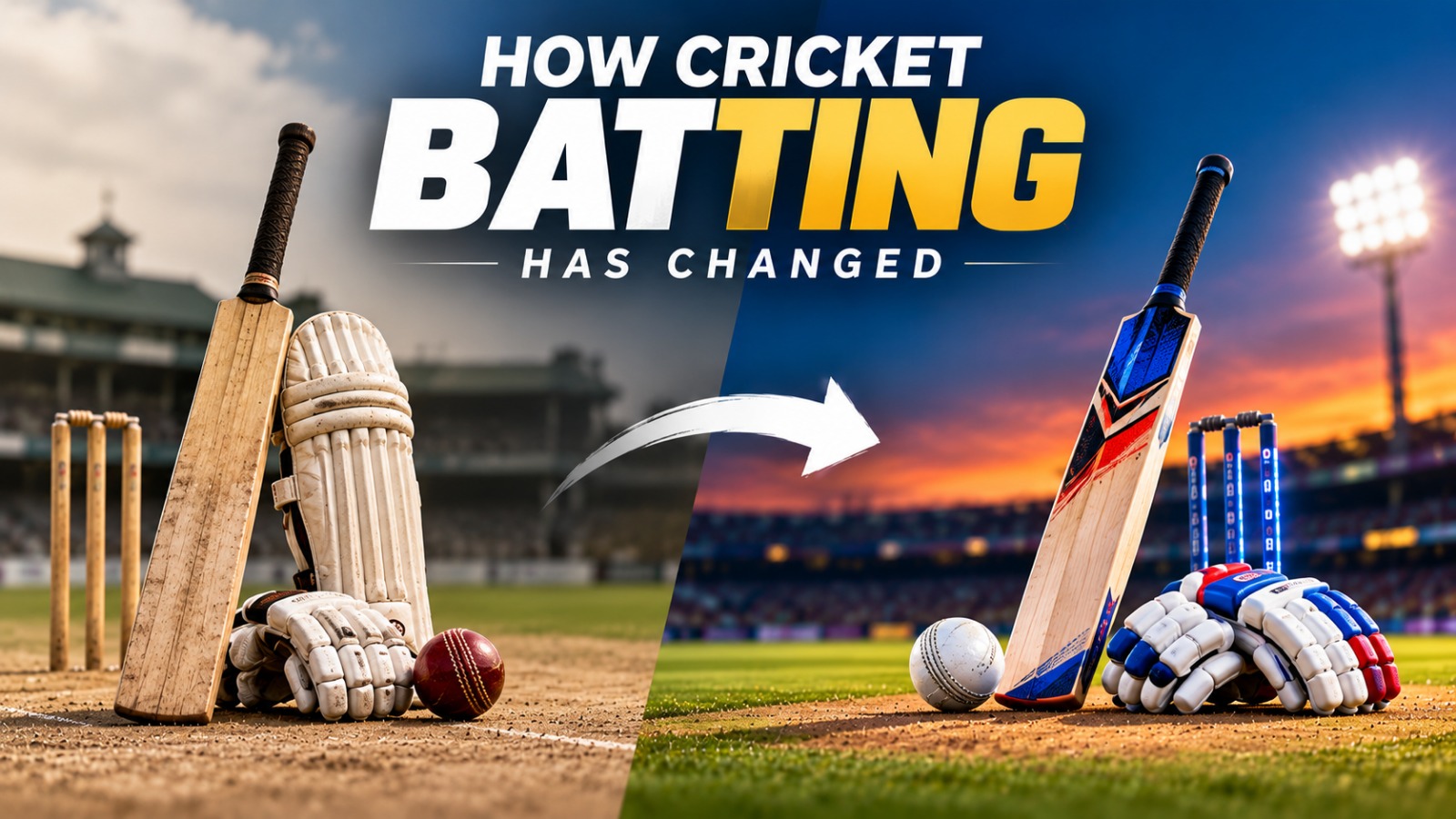
How Cricket Batting Has Changed: From Traditional Technique to T20 Hitting
Batting is another important component in Gentlemen’s Game and currently the era we are living and technological advancement gone by, it would be interesting to witness, how much bats and technique around it has too changed.
Here in this article we will reveal that how batting has changed from Traditional to T20I cricket to be shared in the below format :
1. Traditional Batting Technique:
The Traditional Batting Technique primary goal revolves around- preserving wicket and playing long innings, when it comes to stance the batters plays deliveries close to their body.
There is wonderful amalgamation of front and back foot movement.
The Key Shots batters would play under these scenarios include- Straight Drive, Cover Drive, Defensive Block and check drive.
When they approach spin they approach innings in the form of forward defense, reading turn of the pitch.
The Core Metrics revolve around Traditional Batting Techniques should rely on focusing on batting average and time spent on the crease.
Overall Traditional batting approach is all about crafting innings where they certainly don’t play any risk taking shots, rely more on ground shots most importantly the moment they play those shots they look crafty for good.
2. T20 Modern Batting:
The current form of Bating rely mostly on T20 Cricket, where the player approaching their batting should focus on rapid run accumulation and High strike rate.
The stance in T20 Cricket relies mostly on Open Stance, standing upright with bat raised where they can generate bat speed.
The key shots included in T2O Modern Bating relies on- Reverse Shot, Scoop, Switch hit and lofted shots.
The approach when it comes to T20 Cricket Bating should Taking length of bowlers, advancing down the track or using reverse sweep as attacking tools.
The Core Metrics when it comes to T20 Cricket is heavily relied on Strike Rate, Boundary Percentage and expected runs they will score in penultimate round of the game.
3. Major Driver behind the Evolution:
A- Batting Intent and Mindset: If you closely observe batting intent and mindset have changed completely, where batters no longer measure success based on amount of runs they have scored instead they focus on how they can change the momentum of the game, where they ensure to maintain aggressive intent even after losing early wickets.
B- 360 Degree Motivation: There are variety of unorthodox shots that any batter plays in these criteria which include- scoop, ramps and reverse sweep which are also known as high risk taking shots, against death over and mystery spinners.
C- Physical Conditioning and Bating Technology: When it comes to Modern Day T20 Cricket it is totally emphasized around batters explosive bat strength rather than focusing on endurance.
That is possible based on sweet spots and lighter profile distributions in modern day T20 Cricket allows batter to react in much better way and make choices which matters the most.
D- Data and Biomechanics: Franchise leagues and analytical tools used techniques like video tracking and machine learning to map bowler matchups, release points and optimal swing planes.
Overall , Batter needs to balance traditional and modern day approach to emerge the winner of contest. In Order to make that happen they need to apply themselves really well.
| Aspect | Traditional Batting Technique | Modern T20 Batting |
|---|---|---|
| Primary Goal | Preserve the wicket and build long innings. | Accumulate runs rapidly and maintain a high strike rate. |
| Batting Stance | Batters play deliveries close to their bodies. | Batters often use an open stance, stand upright and raise the bat to generate speed. |
| Footwork | A combination of front-foot and back-foot movements. | Dynamic footwork, including advancing down the track to attack bowlers. |
| Key Shots | Straight drive, cover drive, defensive block and check drive. | Reverse shot, scoop, switch hit and lofted shots. |
| Approach Against Spin | Use forward defence and read the turn of the pitch. | Take on the bowler’s length, advance down the track and use the reverse sweep as an attacking option. |
| Core Metrics | Batting average and time spent at the crease. | Strike rate, boundary percentage and expected runs in the penultimate phase of the game. |
| Batting Intent and Mindset | Focus on building an innings and preserving the wicket. | Focus on changing the momentum of the game and maintaining aggressive intent, even after losing early wickets. |
| 360-Degree Batting | Greater emphasis on conventional shots and ground strokes. | Greater use of unorthodox shots, including scoops, ramps and reverse sweeps, particularly against death-over bowling and mystery spinners. |
| Physical Conditioning | A traditional approach that prioritises constructing an innings over time. | Greater emphasis on explosive strength and generating power. |
| Batting Technology | Focus on conventional batting technique and shot execution. | Modern bats feature sweet spots and lighter profile distributions that help batters react and make decisions. |
| Data and Biomechanics | Greater emphasis on conventional batting skills and reading the game. | Franchise leagues and analytical tools use video tracking and machine learning to study bowler matchups, release points and optimal swing planes. |
| Overall Approach | Craft an innings through calculated shot selection, patience and controlled risk-taking. | Maximise scoring opportunities through aggressive intent, innovative shots and rapid run accumulation. |
| Batting Intent and Mindset | Batters increasingly focus on changing the game’s momentum rather than measuring success only by the number of runs scored. |
| 360-Degree Motivation | Unorthodox shots, such as scoops, ramps and reverse sweeps, expand scoring options but involve greater risk. |
| Physical Conditioning and Batting Technology | Explosive strength, bat speed, sweet spots and lighter bat profiles support modern attacking techniques. |
| Data and Biomechanics | Video tracking and machine learning help analyse matchups, bowling release points and swing mechanics. |
Frequently Asked Questions About Cricket Batting (FAQ):
Q-1: What are important factors behind Traditional Batting in Cricket?
Answer: The Important factors behind traditional Bating in cricket involves- Straight Drive, Cover Drive, Close stance, playing traditional shots and most importantly developing those shots which allows them to play down the ground and build innings during long junctures of game.
Q-2: What are important factors behind T20I Batting in Cricket?
Answer: The important factors behind T2OI Bating in Cricket which involves- reverse shot, sweep shot, playing 360 degree and focus on creating impact rather than building long innings.
T20I cricket these days is more about innovation and most importantly, the ones who plays those shots they need to apply themselves really well in Physical and Mental Ability to play quality Cricket?
Q-3: Talk a little bit about additional Technology used in Batting especially in reference to Cricket?
Answer: The additional Technology used in Bating in reference to Cricket, which include- Data and Biomechanics, 360 degree rotation and most importantly charts to depict curve through which they can play wonderful knocks.
Q-4: Talk a little bit about Aesthetic view related to Traditional and T20I Cricket Batting?
Answer: The Aesthetics view related to Traditional Cricket where players executing shots should look eye pleasing and they have an ability to make an impact rather than focusing on playing prolong ones.
When it comes to T20I Cricket, the focus when it comes to bating is relied mostly on creating impact rather than focusing on playing longer knocks and aesthetically they rely mostly on unorthodox shots where they can smash bowlers all over the park.
Q-5: Overall what’s your opinion on Batting challenges and ease in 21st century?
Answer: The bating challenges in 21st century would prolong as the technology keeps evolving also bat these days are powerful.
Its high time we should focus on developing new methodology but the basics remains the same.
My Perspective:
Batting sits at the heart of cricket’s cultural and tactical split.
While the mechanics of striking a leather ball with a willow blade remain fundamentally the same, the mental framework, technical execution, risk assessment, and physical demands required for batting in Test cricket versus T20 cricket could not be more divergent.
To excel in traditional Test batting is to master the craft of defense, patience, and prolonged concentration. To succeed in T20 batting is to master power, innovation, rapid processing, and spatial awareness.
Understanding the distinction between these two disciplines reveals how cricket has evolved from a game of patience to a contest of explosive momentum.
The primary difference between traditional and short-form batting stems from how each format values a batter’s wicket relative to time and deliveries.
A Test batter views their wicket as an irreplaceable resource. With unlimited overs available across up to five days, time is on the batter’s side.
The tactical goal is to outlast the opposition’s fast bowlers, absorb physical and psychological pressure, and exhaust the fielding side.
A score of 40 runs from 120 balls is considered a solid, highly valuable contribution if it neutralizes a fresh bowling attack and blunts the new leather ball.
In a 20-over match, time is an extreme luxury. Each team has only 120 legal deliveries to score as many runs as possible.
Because a team rarely loses all 10 wickets within 120 balls, individual wickets carry far less individual weight. A batter who scores 30 runs off 12 balls makes a far more transformative impact on the match outcome than one who scores 40 runs off 40 balls.
The goal is not survival, but maximizing run output per delivery, which is measured by strike rate.
The structural demands of each format directly shape how batters position their bodies, move their feet, and select which shots to play.
Traditional batters adopt a classic side-on stance. This alignment protects the stumps, allows for crisp alignment down the pitch, and helps the batter judge movement late.
The head is held still over the front knee, and the bat comes down straight in a clean arc. Precise forward or backward movement is non-negotiable.
Batters either commit fully forward to the pitch of the ball or rock back onto the back foot to cut or pull. Half-way footwork is punished by slips and catchers.
Play is concentrated heavily in the V, which is the region between mid-off and mid-on where risk is minimized. Crucially, deliberately letting the ball pass through to the wicketkeeper without playing a shot is considered an elite batting skill used to tire out bowlers.
In stark contrast, T20 batters often adopt an open or semi-open stance with a wide base. This gives them a clear, unobstructed line of sight to the bowler’s release point and opens up 360-degree scoring arcs around the ground without needing complex foot movements.
T20 batting relies heavily on bottom-hand power, core rotation, and hip clearing.
Batters frequently clear their front leg toward the leg side to create space, allowing them to swing the bat with full rotational force to launch full-pitched deliveries over the boundary.
Traditional shot execution is often inadequate against modern defensive bowling, forcing T20 batters to routinely employ unconventional strokes.
They frequently use the ramp or scoop shot to flick high-speed deliveries directly over the wicketkeeper’s head.
They also execute the reverse sweep or switch hit, changing their grip or stance mid-bowling stride to transform into an opposite-handed batter and exploit vacant field gaps.
The slog sweep, where a batter kneels down to hit turning spin deliveries with high elevation over deep mid-wicket, has become another standard weapon.
Risk management reflects another deep philosophical divide. In Test cricket, a batter builds an innings in distinct phases.
They begin by defending cautiously during the first hour to adjust to the pitch conditions, movement, and bounce. Only after settling in do they expand their shot selection to score more freely.
In T20 cricket, there is no setup period. A batter is expected to demonstrate immediate aggressive intent from their very first delivery.
Taking high-risk options on ball one is not considered reckless; it is an essential requirement of the format. Leaving a ball or playing a non-scoring defensive stroke
The physical conditioning required for both batting styles has also diverged significantly.
Test batting demands long-haul cardiovascular endurance, isometric core stability, and the ability to maintain unwavering mental focus over four to six hours in extreme temperatures.
To play Test cricket successfully, a modern player must still possess the grit and technical discipline required by past generations, respecting good bowling, riding out difficult atmospheric conditions, and batting through long periods of low scoring.
However, when transitioning to short-form franchise leagues, that same player must instantly suppress defensive instincts, clear their front leg, and manipulate field settings with high-speed innovation.
The relationship between the formats is ultimately dynamic: T20 cricket has introduced unprecedented power, fearlessness, and stroke-play to Test cricket, while traditional technical mastery remains the foundation that allows batters to consistently make solid contact under extreme pressure.
Overall Cricket Batting would change in terms of technology and newer version will be added into it however, all depends on well batter has practice all those range of shots which helps them to elongate their status and make name for themselves.
Cricket Bating would further evolve considering width of bats are increasing along with cricket is getting reduced in terms of work hour play as the attention from T20 Cricket have been shifted towards T10 Cricket where you need more excitement for that you need those batters, who can clock themselves really well and apply their skills pretty well where they can knock any bowler out of the park at ease.
Cricket bating would also increase where the range of shots have been exponentially higher, now which will increase further considering new range of bats which will offer especially the future belongs to franchise cricket which will become another source of infotainment and revenue seeking stuff.
Related posts: