
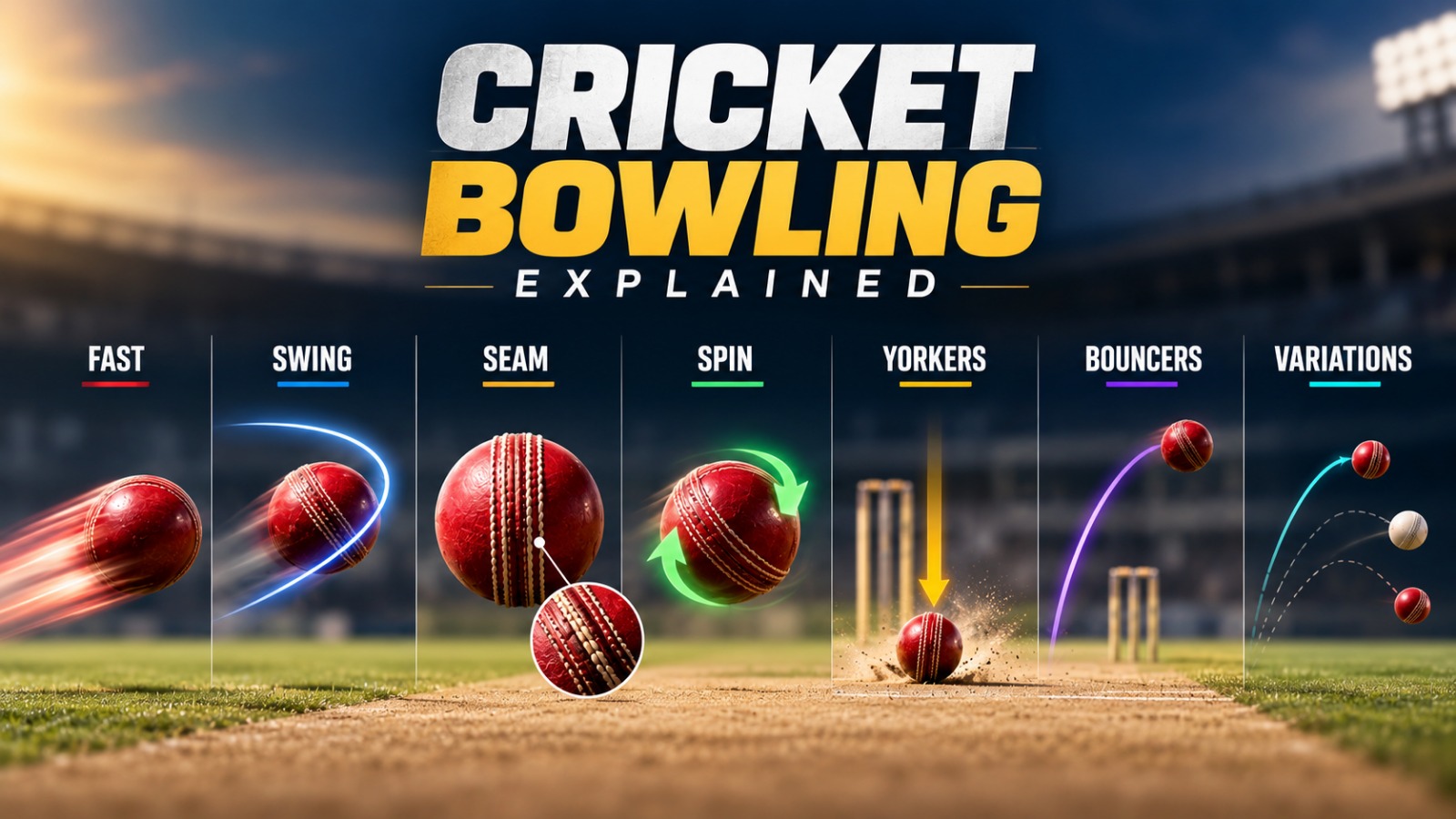
Cricket Bowling Explained: Fast, Swing, Seam, Spin, Yorkers, Bouncers and Variations
Bowling plays a crucial role in Cricket, where they dictate the terms of gentlemen’s game, where different variations, dictate the pace of the game vividly and efficiently.
Here in this article we will reveal Art of Cricket Bowling across- Fast, Swing, Seam, Spin, Yorkers, Bouncers and Variations To be shared in the below format:
Before we navigate the art, across bowling all I can add technology is played an important role, where bowling tendency have changed but the basic remains intact.
1. Pace Bowling : Fast, Swim and Swing:
The Pace Bowling art have changed over the years, where art of fast bowling is vividly discussed typically ranging from- 80 to Over 95 MPH where they challenge batter at their raw pace.
A- Fast Bowling:
The Core Goal around fast bowling revolve around intimidation, high velocity and breaking the batter rhythm.
Key Line and Lengths:
Here Bowler Target “corridor of Uncertainty” just outside off stump, where lengths across these areas will be delivered which include- Good Length( Where Ball will bounce around 4-8 meters from the batter near the Top of stumps.
Full length(where ball delivered will bounce around 2-4 meters out) where they target toes or knee- height)
Short Ball/Bouncer : (Where ball bounces well before the batter and rears up closer to chest or head)
Yorker: The delivery is pitched directly aiming at batter’s feet with 2 meter range where they target stumps base.
2. Swing Bowling:
Swing Bowling is another important factor in Bowling where lateral movement in the air, before balls reaches in batter’s radar, where one side is shiny and other being scuffed.
Swing also offers different variations which include-
Conventional Swing (This type of skill is applied by bowlers where traditionally they keep basics intact where one side is shinny and other being scuffed).
Outswinger (This type of skill is applied by Bowler usually against Right Handed Batter, where the bowler ensure that seam position should point towards slip cordon and eventually move away from batter.
Inswinger(The bowler holds seam position is angled towards fine leg, and the moment is ball is delivered with that angle it moves inwards towards batter.
Reverse Swing( It happens in the penultimate end of the match where it come into progression after 40-50 overs where ball on both sides are rough, where the ball delivered to swing towards the shiny side at high speeds.
3. Seam Bowling:
Seam bowling is certainly the art of delivering ball at exact surface where it offers that movement also to produce good results effectively seam position is important for any bowler and the moment they do it they would ought to clinch wickets or sure based on assistance they generate from surface.
Upright Seam (The bowler lands the delivery on the leather edge and the moment it gets delivered it is flicked sideway from surface)
Wobble/Cross Seam: (The Bowler rolls or cocks the seam position and the moment it is delivered all these balls land horizontally where they get unpredicted bounce and deviation.)
Cutters(Off- Cutters and Leg Cutters): (The Bowler rolls the fingers down the side of the ball during release in order to cut sharply off the pitch like mini-spin delivery.
4. Spin Bowling:
Spin Bowling is another important factor where the delivery usually speed around 45-55 mph, for heavy rotational revolutions.
The moment ball is delivered it grips the pitch surface, where the moment it lands it deviate sharply sideways or change bounce and angles.
Finger Spin : The skill who are part of this important methodology used in spin where bowler can deliver all sort of variations which include- Off- Break, Doosra, Arm Ball/Top Spinner (Where off- break is delivered through index and middle finger to impart clockwise spin for right hander, Doosra being Off- Spinner variation where once delivered spins out in opposite direction & Arm Ball being Undercut or Overspun straight delivery that didn’t turn instead regularly skidding below.
5. Wrist Spin Bowling:
Wrist Spin bowling is usually deployed by Leg Spinner where distinct variations are applied by them which include- Leg Break, Googly and Flipper.
Leg Break is bowled with twist in wrist position usually anticlock wise for right handed batter.
Googly is often touted as leg Spinner biggest mystery bowling, where the ball is released with disguised wrist action once it is pitched it normally tends away with batter.
Flipper is also known as Skiding variations, where ball is squeezed or back spun of hand once the ball is delivered is usually stays low off the pitch.
| Bowling Aspect | Description |
|---|---|
| Fast Bowling | Fast bowlers generally operate at speeds ranging from 80 mph to over 95 mph, challenging batters through raw pace, bounce and accuracy. |
| Core Objective | To intimidate batters, generate high velocity, disrupt their rhythm and create wicket-taking opportunities. |
| Good Length | The ball pitches approximately 4–8 metres from the batter, depending on the bowler’s pace and the conditions, creating uncertainty about whether to play forward or backward. |
| Full Length | The ball pitches approximately 2–4 metres from the batter, targeting the stumps, pads or bat through fuller deliveries. |
| Short Ball/Bouncer | The ball pitches well before reaching the batter and rises towards the chest, shoulders or head. |
| Yorker | The ball pitches close to the batter’s feet, generally around the base of the stumps, making it difficult to defend or score freely. |
| Corridor of Uncertainty | An area around and just outside off stump that forces batters to decide whether to play, leave or defend the delivery. |
| Swing Bowling | The ball moves laterally through the air before reaching the batter. The ball’s seam position, surface condition, release and atmospheric conditions can influence its movement. |
| Conventional Swing | The bowler maintains one shiny side and one rougher side of the ball, using seam position and wrist alignment to generate movement through the air. |
| Outswinger | A delivery that moves away from the batter in the air. Against a right-handed batter, it typically moves towards the slips, creating opportunities for catches and edges. |
| Inswinger | A delivery that moves into the batter in the air. Against a right-handed batter, it generally moves towards the pads or stumps. |
| Reverse Swing | A form of swing in which an older ball can move in a direction different from conventional swing. It is often associated with higher bowling speeds and an unevenly worn ball. |
| Seam Bowling | A technique in which bowlers use the ball’s seam and the pitch surface to generate sideways movement after pitching. |
| Upright Seam | The bowler releases the ball with the seam relatively upright, allowing it to grip the surface and potentially deviate sideways. |
| Wobble Seam | The bowler releases the ball with a less stable seam orientation, creating unpredictable movement and bounce after pitching. |
| Cross-Seam Bowling | The ball is released with the seam across the direction of travel, potentially producing variable bounce depending on the pitch conditions. |
| Off-Cutter | The bowler uses the fingers to impart movement that can make the ball deviate towards the off side for a right-handed batter, depending on the release and conditions. |
| Leg-Cutter | The bowler imparts a cutting action that can make the ball deviate towards the leg side for a right-handed batter. |
| Finger Spin | A spin-bowling technique in which the fingers impart rotation to the ball, allowing it to grip the pitch and change direction or bounce. |
| Typical Speed | Finger spinners often operate around 45–55 mph, although speeds vary considerably between bowlers and formats. |
| Off-Break | An off-spinner turns the ball from the off side towards the leg side for a right-handed batter. |
| Doosra | An off-spinner’s variation designed to turn in the opposite direction to the conventional off-break. |
| Arm Ball | A delivery that travels relatively straight or with limited turn compared with the bowler’s stock off-break. |
| Top-Spinner | A delivery imparted with topspin that tends to dip and bounce more sharply after pitching. |
Frequently Asked Questions(FAQ about Bowling and Variations):
Q-1: What are different Types of Bowling in International Cricket?
Answer: Different Types of Bowling used in International Cricket which include- Fast Bowling, Spin Bowling, Swing Bowling, Seam Bowling and Wrist bowling where bowler are applying the skills to the best of their ability.
Overall bowling skills is one of the best things and the one who is skilled knows the art of different bowling in International cricket is considered as exceptional.
Q-2: What are sub variations inside Bowling in International Cricket?
Answer: There are several sub variations inside all types of bowling which include- Bouncer, Yorker, Inswinger, Outswinger, Revese Swing, Good Length, Full Length, Wobble Spin, Leg Spin, Off Spin, Doosra, flipper and arm ball and the one who applies these deliveries are certainly one of the most skilled bowler.
Q-3: What skills a bowler needs if he wants to learn all variation and sub variation?
Answer: The Skills needs a bowler that they need to learn all variation and sub variation include- training at initial stage also need correct coaching guidance where they need to constantly practice on drift, angles and rotation on regular basis.
Q-4: Why the art of bowling needs more variations?
Answer: Considering how fast batting has changed, technological advancements and width of bat you certainly to add new variations as compare to the ones already up for display as that could certainly add more if they want to stay ahead of curve.
Overall, Bowling needs to change and adding more skills would help bowler stay ahead of curve against batter.
Q-5: Overall, how do you see evolution in Bowling?
Answer: The Evolution in Bowling have many aspect which is changing also in times to come it will change considering the dynamics a bowler has to prepared mentally and physically to stay afloat against any opponent. That constant wiggle and changing would take place, but the art of developing variations keep basics intact will always remain the same.
That would not change for sure.
My Perspective:
Cricket bowling variations play a crucial role in determining the outcome of a match, as bowlers constantly look for ways to outsmart batters through changes in speed, movement, bounce and trajectory.
Modern cricket has evolved significantly, and bowlers now use different techniques to create uncertainty and force batters into making mistakes.
Whether it is Test cricket, One Day Internationals or T20 cricket, variations have become an essential part of bowling strategies across formats.
Slower balls are widely used by fast bowlers to deceive batters who expect deliveries at higher speeds. By reducing their pace while maintaining a similar bowling action, bowlers can make batters play their shots too early.
This variation is particularly effective in limited-overs cricket, where batters frequently attempt aggressive strokes.
Bowlers may use different grips, including off-cutters and back-of-the-hand deliveries, to reduce speed and create additional movement.
A yorker is a delivery aimed at landing near the batter’s feet, close to the popping crease. It is difficult to score from because the batter has limited space to execute a shot.
Yorkers are especially useful during the final overs of T20 and ODI matches, when batters attempt to score quickly.
However, inaccurate yorkers can become full tosses or half-volleys, giving batters opportunities to score boundaries. Consistent practice and control are essential for executing this delivery successfully.
Bouncers are short-pitched deliveries that rise towards the batter’s upper body or head. Fast bowlers use them to challenge a batter’s reflexes, disturb their balance and restrict comfortable shot-making.
A well-directed bouncer can also create opportunities for catches in the deep or behind the wicket. However, bowlers must follow the applicable playing conditions and regulations regarding short-pitched deliveries.
Using bouncers strategically rather than repeatedly can make them more effective.
Swing bowling involves moving the cricket ball sideways through the air.
Conventional swing generally depends on the condition of the ball, its seam position, the bowler’s release and atmospheric conditions. Reverse swing can occur when an older ball moves through the air in the opposite direction to conventional swing under suitable conditions.
Swing bowlers aim to exploit uncertainty by making batters misjudge the ball’s line. Accurate seam presentation and control over wrist position are important elements of this skill.
Seam movement occurs when the ball deviates after pitching, influenced by the seam’s contact with the playing surface.
Bowlers can benefit from suitable pitch conditions to generate movement that challenges the batter’s technique.
Cutters are deliveries designed to move off the pitch through variations in finger pressure and release. Off-cutters generally move towards the leg side for a right-handed batter, while leg-cutters move towards the off side, subject to the bowler’s release and pitch conditions.
These deliveries can be effective on slower surfaces.
Spin bowlers use finger or wrist movements to impart rotation on the ball.
Off-spin, leg-spin, left-arm orthodox spin and left-arm wrist spin offer different directions of turn. Variations such as the googly, doosra, slider and arm ball can confuse batters who anticipate the usual direction of movement.
Successful spinners combine flight, pace, accuracy and deception instead of relying entirely on sharp turn. Reading a batter’s footwork and understanding the pitch help spinners select the right delivery.
The knuckle ball is a pace variation released with the fingers positioned differently from a conventional fast delivery.
It can reduce pace and produce an unexpected trajectory, making timing difficult for the batter. Some bowlers also use wide yorkers, cross-seam deliveries and changes in length to exploit weaknesses.
These variations become more effective when their release actions resemble the bowler’s regular delivery.
Ultimately, cricket bowling variations require discipline, tactical awareness and continuous improvement. Bowlers must understand match situations, batter preferences and pitch behaviour before choosing a particular delivery.
A variation becomes valuable when it complements the bowler’s natural strengths and is executed with precision.
Rather than using every available technique, successful bowlers develop a reliable set of deliveries and deploy them intelligently.
This combination of skill, patience and strategic thinking makes bowling an exciting and decisive aspect of cricket.
The Cricketing acumen and captain rotation could also build a repo where the bowler can exchange bowling ideas and execute skills to the best of their ability where they can dominate batters big time.