

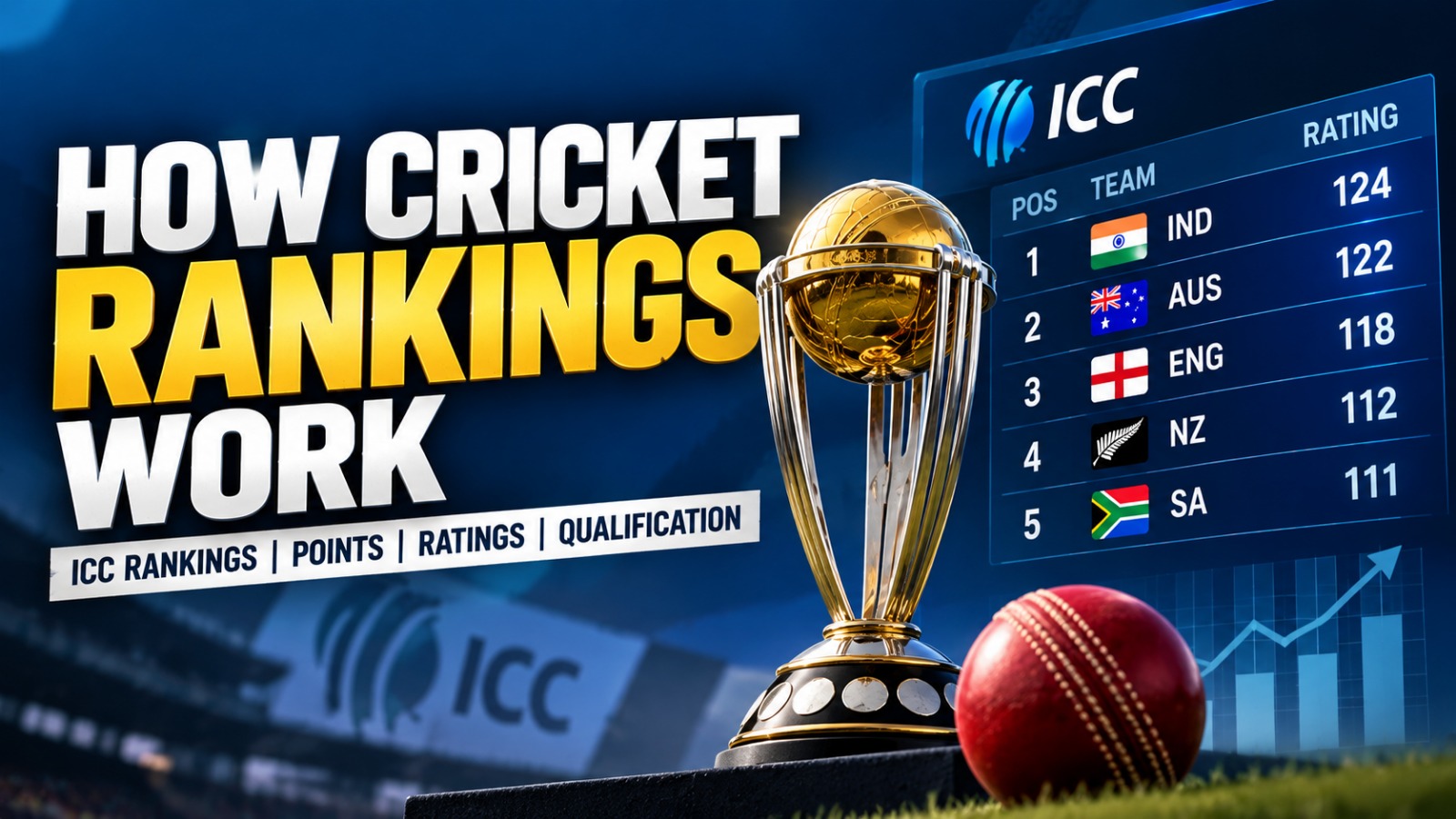
How Cricket Rankings Work: ICC Rankings, Points, Ratings and Qualification
Every Month we come across ICC(International Cricket Council Rankings) where we see position changing with time, very few understand the anomaly on how ICC Rankings is calculated.
Here in this article we will dig deep down to understand on how ICC Rankings are calculated step by step across several parameters which include- Rankings, Points, Ratings and Qualifications one by one in the below format:
1. ICC Team Rankings:
The International Cricket Council calculate Team Rankings- based on performances in three formats of the game – Test Cricket, ODI Cricket and T20I Cricket.
A- Rating Formula: A Team Rating is usually calculated based on Total Number of Points scored /total number of series and matches played which is pretty similar to batting and bowling average.
B- Point System: When you win a Match in Test Cricket you receive 1 points for draw you get- 0.5 Points and point fluctuate between extra or series win.
C- One More thing which you need to taken into consideration, Pre series rating difference also count between two teams who are up against each other.
2. Time Windows and Weighting:
When it comes to calculating Test match, ratings performance average around 36 to 48 hours stipulated time period, weighted around 100% and all the major updates regarding rankings is calculated on 1st May where older data drops off.
Whether its Test Cricket, ODI Cricket and T20I Cricket all winning, lose and draw will remains the same also the parameter to calculate the rankings remains same.
3. ICC Player Rankings:
Let us explain how ICC Player Rankings is calculated to be shared in the below format:
Every Individual Performance irrespective of formats would be judged based on the parameter around 0-1000 points using a sophisticated Point range.
Scale- 900+ Points- Supreme
750+ Points- Top 10 Hundred
500+ Points- Good Standard on International Cricket.
D- Key Points: When you are calculating any Player’s Individual rankings where points increase or decrease based on number of runs/wickets contained by players.
Also other reasons which include- wickets taken, quality of Opposition, pitch conditions and overall match results.
Let me explain simple formula based on how rankings are calculated – (Batting × Bowling) / 1000
Based on formula , any index above 300 would be world class.
4. Eligibility and Activity Window:
Any Player who are part of rankings must have active participation, between 12 to 15 months window roughly- 12 to 15 months which is Test Cricket and 9-12 months for T20I/ODI Cricket.
All those players who are retired are removed from the list.
When any player miss single match during this entire tenure- they will be awarded small penalty which certainly move around 1% in Test, 0.5% in T20 and ODI)
One more thing, Players ranking are updated on weekly basis, Tuesday for Women and Wednesday for Men you can cross check it on ICC official website.
5. Qualifications and Tournaments:
Qualification when it comes to major ICC Tournaments (Test/ODI and T20I) Ties directly into rankings and dedication qualification pathways.
E- Direct Qualification/Meeting Cut offs: All the teams are who are top ranked they often direct entry into World Cups or Super 8/Eight Group stage.
F- Regional and Local Qualifiers: All the teams who can’t qualify they have to undergoes local tournaments- where they compete against each other and based on rankings they make it to the top.
They are often termed as Mini Qualifier or Sub Qualifier also these teams come from Global Qualifier Tournaments where they qualify or fill remaining spot in ICC Tournaments.
G- Status Requirements:
When it comes to understanding the status requirement, it plays a vital role in deciding any team would fall into the category of test, odi as well Test rankings as the minimum requirement they they need to fulfil is none other than qualifying as ICC Official acquired status.
Overall rankings basic rules remains the same only core technicality will change.
| Section | Details |
|---|---|
| 1. ICC Team Rankings | The ICC calculates separate team rankings for Test, ODI and T20I cricket based on each team’s recent international performances. |
| Team Rating Formula | A team’s rating is calculated by dividing the total ranking points earned by the total number of matches or series played, then rounding the result to the nearest whole number. It works like a batting average: instead of runs divided by dismissals, it is ranking points divided by matches or series. |
| Point System | Teams earn points according to match and series results. A win earns more points than a draw, while a loss earns fewer points or no points. In Test cricket, a draw is also factored into the calculation. |
| Opposition Strength | The pre-series rating difference between the two teams matters. Beating a higher-rated team generally gives a bigger rating gain than beating a lower-rated team, while losing to a weaker team can cause a bigger rating drop. |
| Team Ranking Updates | Team rankings are updated after each Test series and after each ODI and T20I series. |
| 2. Time Windows and Weighting | Rankings are based on recent performances, with newer results carrying greater importance than older results. As time passes, older results gradually lose weight and eventually drop out of the calculation. |
| Annual Reset | Major annual ranking updates take place around 1 May, when older results are removed from the ranking window and the ratings are recalculated. |
| Format Consistency | The basic ranking principle remains the same across Test, ODI and T20I cricket. Wins, losses and draws are treated according to the format, but the core method of converting performances into ratings remains similar. |
| 3. ICC Player Rankings | ICC player rankings measure individual performances in batting, bowling and all-round categories using a points-based system on a scale of 0 to 1,000. |
| Rating Scale | A rating above 900 is considered exceptional or supreme. A rating around 750 or above generally indicates an elite, top-tier player. A rating above 500 reflects a good international standard. |
| Calculation Method | The ICC uses a sophisticated moving-average system. Every new performance is combined with the player’s previous rating. If a player performs better than their past standard, their rating rises; if they perform below it, their rating falls. |
| No Human Judgement | Player rankings are generated through pre-programmed algorithms based on match data. There is no human intervention or subjective opinion involved. |
| Batting Ranking Factors | Runs scored, quality of the opposition bowling attack, match situation, level of scoring in the match, whether the batter was dismissed, and the match result. |
| Bowling Ranking Factors | Wickets taken, runs conceded, quality of batters dismissed, pitch and match conditions, workload, and the match result. |
| All-Rounder Formula | All-rounder rating = (Batting rating × Bowling rating) ÷ 1,000. An all-rounder index above 300 is generally considered world-class. |
| 4. Eligibility and Activity Window | Players must remain active in international cricket to hold a meaningful ranking position. Retired players are removed from the active rankings. |
| Inactivity Penalty | If a player misses a match, they lose a small percentage of their rating points. In Test cricket, this is commonly around 1% per missed match, while a similar smaller penalty applies in ODI and T20I cricket. |
| Player Ranking Updates | Player rankings are updated weekly. Women’s ODI and T20I player rankings are updated every Tuesday, while men’s Test, ODI and T20I player rankings are updated every Wednesday. |
| Matches Included | Weekly updates include all matches completed up to the previous day. Matches played on the day of the update are not included until the following week. |
| 5. Qualifications and Tournaments | ICC rankings and results in designated qualification periods help determine direct entry, seeding, or progression pathways for major ICC tournaments. |
| Direct Qualification | Higher-ranked teams can receive direct entry into World Cups or advance directly to later stages such as Super 8 or group stages, depending on the tournament rules. |
| Regional and Local Qualifiers | Teams that do not qualify directly compete in regional or sub-regional qualifiers. These are often called mini qualifiers or sub qualifiers. |
| Global Qualifiers | Teams that progress from regional qualifiers compete in Global Qualifier tournaments for the remaining spots in major ICC events. |
| Status Requirements | To appear in a particular team-ranking table, a team must hold the relevant ICC official status, such as Test status, ODI status, or T20I status. |
| Overall Principle | The basic rules of ICC rankings remain the same across formats. Only the core technical details—such as match type, weighting, eligibility and qualification pathways—change from format to format. |
Frequently Asked Questions (FAQ) about ICC Rankings:
Q-1: Tell us a little Bit about Stipulated Time Period across all three formats of the Game?
Answer: When it comes to Stipulated Time Period in Terms of calculating rankings in all three formats of the game is defined by- 9 to 12 months period when it comes to ODI and T20I format and 12 to 15 months for Test Cricket also one most important point that needs to be taken into consideration all the players should remain active while playing cricket, that’s how they are considered for rankings only.
Q-2: Tell us Little bit about Formula for Calculating Individual Player Rankings in Cricket?
Answer: When it comes to Formula for Calculating Individual Player Rankings in Cricket is calculated based on the formula shared in the below format: (Batting rating × Bowling rating) ÷ 1,000
Where ratings preferred across three domain- 900+ For High Profile players
500-900- Average Player Rankings
300+ Mediocre rankings
In case players who are part of rankings when they miss any match, the deduction rate mathematically turns out to be 1% for Test match and 0.5% for T20I and ODI Cricket.
Q-3: Which Month is considered great for ICC annual rankings?
Answer: The rankings regarding players come once in a week, rankings in terms of team comes every month and the May is special month where ICC rankings are considered important for consideration.
In case May rankings are released all other rankings gets removed.
Q-4: Why ICC rankings direct qualification and regional qualifiers are important?
Answer: When it comes to ICC Rankings direct qualification all the top ranking teams automatically qualifies directly for World Cups whereas other teams who couldn’t make directly they need to play regional qualifier and winning those matches help them to reach at the Top
Q-5: Why ICC rankings also involve technicalities which no one talks about?
Answer: The International Cricket Council rankings are based on various technical principles which include- Criteria, Status, Weight, Stipulated Time Period and Specifications until and unless we don’t keep all factors into consideration we would not be able to paint down complete picture.
My Perspective:
The ICC uses a moving-average system to calculate player ratings. Every new performance is combined with the player’s previous rating If they perform below their usual level, their rating falls.
This means that a player cannot rely only on one great innings or one exceptional spell. Consistency over a period of time is essential to climb the rankings.
There is no human judgement involved in player rankings. The ratings are generated through pre-programmed algorithms based on match data.
This removes bias and ensures that every player is assessed through the same statistical framework.
Rankings also add context to performances. A century against a world-class bowling attack in tough conditions is valued more than a similar score against a weaker attack on an easy pitch.
The same logic applies to bowling. Dismissing established batters in a low-scoring match can be more valuable than taking wickets in a game where batting conditions are favourable.
However, rankings have limitations. They cannot fully measure leadership, temperament, pressure handling, fielding impact or a player’s influence in crucial moments.
A captain may not always top the batting or bowling charts, yet their tactical decisions can define a series. Therefore, rankings should be seen as one important indicator among several, not the only measure of greatness.
Rankings are another factor which is least talked about Topic on Mainstream TV where these things should be considered more often and naysayers should understand how rankings are calculated as people across players rankings as well as team rankings are categorically different.
One thing which we need to understand, that rankings are calculated based on how easy it is offered and explained to naysayers and the formula is extremely simple to decode where naysayers and experts both of them could use these formula and calculate those numbers and all these things will help them to understand one of the most technical aspect of game quite easily.
ICC Rankings across formats, Test, ODI and T20I are similar but the way these rankings are presented is quite different as compare to another where the magnitude matters as rankings in Test Cricket should be based on World Test Championship cycle, ODI cricket magnitude lies in World Cup and T20I cricket is based on World T20.
Overall, ICC Rankings weekly is quite less relevant instead Monthly as weekly magnitude could change quite rapidly also that doesn’t describe the correct picture on how good a player could be under short time period.
For them to do wonders, in rankings all those teams and players will be appreciated considering how good they could be across month as well as on yearly basis.