
How Football Refereeing Works: VAR, Cards, Offside, Penalties and Major Decisions
Football is a fast-moving game in which a single decision can change the result of a match. A goal may be disallowed because of offside, a player may receive a red card for a dangerous tackle, or a team may win a penalty after a foul inside the box. To make these decisions, referees follow the official Laws of the Game and work with other match officials and, in some competitions, video technology.
Football refereeing involves much more than blowing a whistle or showing cards. Referees must watch player movements, judge tackles, check handball offences, manage time and make decisions when several things happen at once. They also need to understand when play should continue and when a foul requires the game to stop.
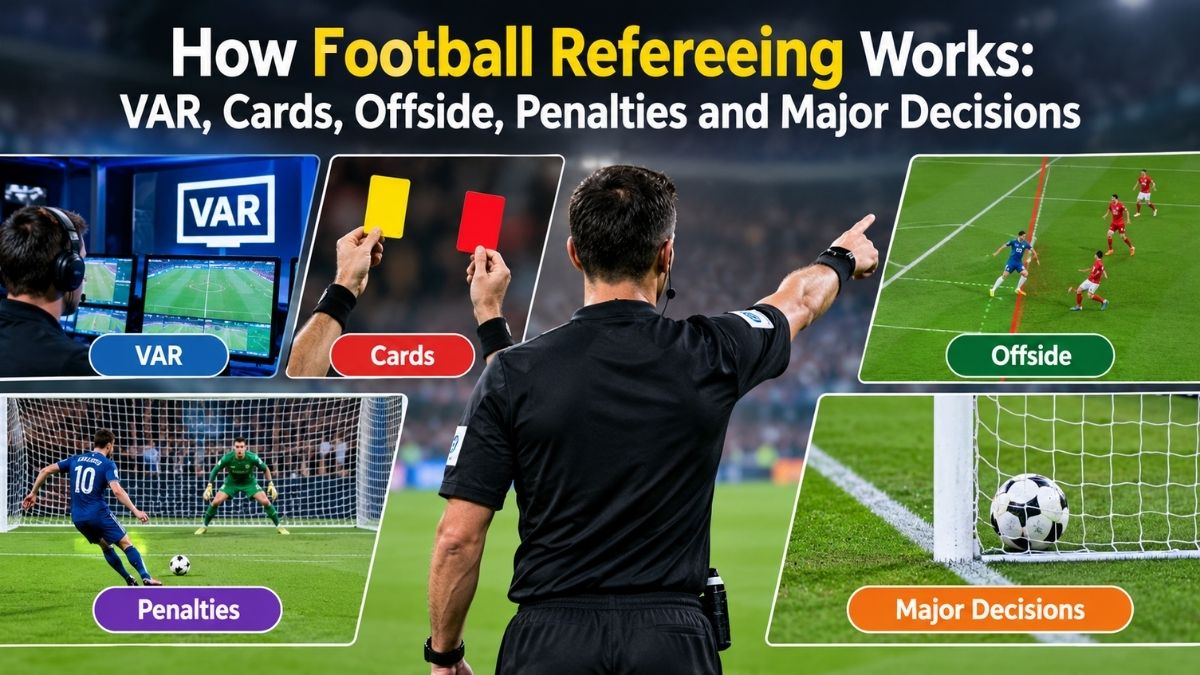
In modern football, the Video Assistant Referee (VAR) system helps officials review certain major incidents. However, VAR does not replace the referee on the pitch, and it cannot review every decision made during a match. From the meaning of the offside rule to the conditions for awarding a penalty, here is a complete guide to how football refereeing works.
What Does a Football Referee Do?
A football referee is responsible for controlling a match and making sure players follow the Laws of the Game. The referee has the authority to stop play, award free kicks and penalties, show yellow and red cards, allow goals and manage player behaviour. The referee also keeps track of time and decides when a match should start, stop or restart.
During a match, the referee moves around the pitch to get the best possible view of incidents. For example, when a defender tackles an attacker near the penalty area, the referee must judge whether the challenge was fair, whether the defender made illegal contact and whether the offence took place inside or outside the box. These details can decide whether the defending team receives a free kick or the attacking team wins a penalty.
The referee also works with assistant referees, the fourth official and, where available, video match officials. Each official has different duties, but they work together to make decisions according to the rules. Under Law 5 of the Laws of the Game, the referee remains responsible for the main decisions during the match, including the final decision after a VAR review.
How Do Assistant Referees and Other Match Officials Work?
Assistant referees usually stand along the two touchlines, with one assigned to each side of the pitch. They help the main referee by identifying offside positions, judging when the ball leaves the field and advising on certain fouls or incidents that may be difficult to see from the referee’s position. They also use their flags to communicate decisions and information to the referee.
The fourth official works near the technical areas, where coaches and substitutes sit during the match. Their duties may include helping manage substitutions, displaying the minimum additional time at the end of each half and monitoring the behaviour of team officials. If a player or coach behaves improperly in the technical area, the fourth official can inform the referee.
In matches using VAR, video officials watch replays from different camera angles and communicate with the referee when a review may be needed. Assistant referees, the fourth official and VAR officials support the main referee, but each must follow their assigned role. Their aim is to help the referee make decisions based on the available information and the Laws of the Game.
What Is VAR in Football?
VAR stands for Video Assistant Referee. It is a system that allows match officials to review certain important incidents using video replays. The system is used in competitions that have introduced and approved VAR, and its purpose is to help correct clear mistakes or deal with serious incidents that the on-field officials have missed.
VAR is mainly used for four key areas: goals and no-goal decisions, penalty and no-penalty decisions, direct red-card incidents, and mistaken identity when the wrong player receives a card. Under the 2026/27 VAR protocol, competitions can also allow reviews of clearly incorrect corner-kick decisions if the correction can be made immediately without delaying the restart. The current rules also allow reviews in cases involving a clearly incorrect second yellow card that results in a red card.
For example, suppose a striker scores a goal, but a defender claims that the striker handled the ball just before shooting. The VAR team checks the footage and informs the referee if the available evidence suggests that a review is needed. The referee may then review the incident directly on a pitchside monitor or make a decision using information provided by the VAR team.
How Does the VAR Review Process Work?
The VAR team checks relevant incidents and informs the referee if there may have been a clear and obvious error or a serious missed incident. The referee can decide to review the footage personally, or may use information supplied by the VAR team to make the final decision. The referee must first make a decision on the pitch rather than leaving the incident undecided simply because VAR is available.
A pitchside review is often used when the referee needs to judge an incident that involves personal assessment, such as the seriousness of a tackle or whether contact was enough to award a penalty. However, some decisions, including certain offside calls, can be handled using factual information provided by the VAR team. The referee remains responsible for the final decision.
VAR does not mean that every close call will be changed. The original decision is generally kept unless the review shows a clear and obvious error, or identifies a serious incident that was missed. This is why some decisions remain unchanged even after officials examine several replays.
What Decisions Can VAR Review?
Goal or no goal: VAR can check whether the whole ball crossed the goal line and whether an attacking offence occurred during the move leading to a goal. This can include offside, handball or a foul by the attacking team. If a goal was scored after a clear offence, the referee may disallow it.
Penalty or no penalty: VAR can check whether a foul occurred inside or outside the penalty area and whether a penalty was wrongly awarded or not awarded. It can also examine an incident when a referee may have missed a clear foul inside the box.
Direct red cards: VAR can review certain incidents involving serious foul play, violent conduct or a player denying an obvious goal-scoring opportunity. Under the current protocol, it can also assist with a clearly incorrect second yellow card that leads to a sending-off.
Mistaken identity: If the referee shows a card to the wrong player, VAR can help establish which player committed the offence. The current protocol also includes certain cases where the wrong team was penalised and a card was shown to the wrong player.
VAR cannot review every ordinary foul, throw-in, yellow card or free-kick decision. Its role is limited to the incidents allowed by the protocol and any additional options approved for that competition.
How Do Yellow Cards and Red Cards Work in Football?
Yellow and red cards are used by referees to deal with players who break the rules or behave improperly. A yellow card is a formal warning called a caution, while a red card means the player is sent off and cannot take any further part in the match. Referees consider the type of offence and the circumstances before deciding which disciplinary action is appropriate.
What Does a Yellow Card Mean?
A yellow card is shown for offences such as reckless challenges, unsporting behaviour, persistent rule-breaking, delaying a restart and showing dissent towards match officials. A referee may also caution a player for deliberately stopping a promising attack or committing certain handball offences. The exact punishment depends on the nature of the incident and the rules that apply.
For example, if a midfielder makes a careless tackle while trying to win the ball, the referee may award a free kick without showing a card. However, if the midfielder makes a reckless challenge that puts an opponent at risk, a yellow card is required. The difference lies in how the player made the challenge and the level of danger involved.
A player who receives two yellow cards during the same match is shown a red card and sent off. The team cannot replace the dismissed player with a substitute, so it must continue with fewer players. Competition rules may also impose suspensions after a player collects a set number of yellow cards across several matches.
What Does a Red Card Mean?
A red card is shown for serious offences, including serious foul play, violent conduct, spitting or biting another person, and certain cases of offensive or abusive behaviour. It can also be given when a player deliberately uses handball to stop a goal, or commits another offence that denies the opposition an obvious goal-scoring opportunity under the relevant rules. The referee must judge the incident according to the Laws of the Game.
For example, a defender who makes a dangerous tackle with excessive force may be sent off immediately. Similarly, a defender who deliberately handles the ball to prevent it from entering an open goal can receive a red card. These offences are more serious than a normal foul because they involve serious danger or unfairly prevent a clear scoring chance.
A red card affects more than the player who receives it. The team must continue with one fewer player, and the dismissed player must leave the field and its immediate surroundings as required by the rules. A suspension may follow, depending on the competition’s disciplinary regulations.
What Is the Offside Rule in Football?
The offside rule is one of the most discussed rules in football because it depends on the position of the attacking player at a specific moment. A player can be in an offside position without committing an offence. The referee or assistant referee penalises the player only when the player becomes involved in active play in one of the ways described by the law.
A player is generally in an offside position when part of their head, body or feet is in the opponent’s half and nearer to the opponent’s goal line than both the ball and the second-last opponent. The halfway line does not count as the opponent’s half, and the hands and arms are not considered when judging offside. A player who is level with the second-last opponent or the last two opponents is not in an offside position.
However, being in an offside position does not automatically mean that the referee should stop the game. The player must interfere with play, interfere with an opponent or gain an advantage from a rebound or deflection in the situations covered by the law. If none of these conditions applies, the referee can allow the attack to continue.
What Is the Difference Between Offside Position and Offside Offence?
Imagine that a midfielder passes the ball forward while a striker is standing behind the last line of defenders. If the striker is nearer to the goal line than the ball and the second-last opponent at the moment the ball is played, the striker may be in an offside position. If the striker then plays the pass or interferes with a defender, the referee may award an indirect free kick to the defending team.
Now imagine that the same striker is in an offside position but does not touch the ball and does not affect any opponent’s ability to play it. Another attacker, who is in an onside position, collects the pass instead. In this case, the referee can allow play to continue because simply standing in an offside position is not an offence.
The important moment is when a teammate plays or touches the ball, not when the receiving player finally controls it. The referee and assistant referee must judge the player’s position at that earlier moment, along with what the player does afterwards. This is also why a player can run back from an offside position and still be penalised if they become involved in play from that original position.
When Is a Player Not Offside?
There are three important situations in which a player cannot be penalised for receiving the ball directly from a set restart: a goal kick, a throw-in and a corner kick. For example, an attacker can stand behind the defenders and receive a direct throw-in without committing an offside offence. However, the offside rule can apply again if a teammate plays the ball afterwards.
A player may also be in an offside position without affecting play or interfering with an opponent. In that case, the assistant referee should not flag simply because the player is standing beyond the defenders. The referee must consider whether the player actually becomes involved in the move.
These details explain why offside decisions sometimes require a close look at the footage. Officials must identify the moment the ball was played and compare the positions of the relevant body parts of the attacker and the second-last opponent. VAR and semi-automated offside technology may support those checks in competitions where the technology is available.
How Are Penalties Awarded in Football?
A penalty kick is awarded when a player commits an offence punishable by a direct free kick inside their own penalty area, or when a qualifying offence takes place off the field as part of play. Common examples include tripping an opponent, holding a player or making an illegal tackle inside the box. However, not every collision or fall inside the penalty area is a foul.
The referee must judge whether an offence took place and whether the contact was careless, reckless or involved excessive force. If a defender legally wins the ball and does not commit an offence, the referee should allow play to continue. On the other hand, if a defender trips an attacker while attempting to stop a scoring opportunity inside the box, a penalty may be awarded.
The location of the offence is important. A direct-free-kick offence inside the defending team’s penalty area can lead to a penalty kick, while the same type of offence outside the area normally results in a direct free kick. VAR may help the referee confirm the location when the incident is close to the penalty-area line.
What Are the Rules for Taking a Penalty Kick?
The ball must be stationary, with part of it touching or overhanging the centre of the penalty mark. The player taking the kick must be identified, and the other players must remain outside the penalty area and penalty arc, behind the penalty mark and at least 9.15 metres from the mark until the ball is kicked. The defending goalkeeper must remain on the goal line between the posts, facing the kicker, until the ball is kicked.
At the moment the kick is taken, the goalkeeper must have at least part of one foot touching, in line with or behind the goal line. The ball must be kicked forward and is in play once it is kicked and clearly moves. The kicker cannot touch it a second time until another player has touched it.
If the goalkeeper breaks the rules and saves the penalty, the kick may need to be retaken, depending on the offence and whether it affected the result of the kick. Similarly, if an attacking player enters the area too early and then plays a rebound or interferes with the goalkeeper, the referee may disallow a goal and award an indirect free kick. The exact restart depends on the type of offence and its effect on play.
Can a Penalty Be Awarded After VAR Review?
Yes. VAR can help the referee check whether a penalty was wrongly awarded or whether a clear foul inside the penalty area was missed. It can also review whether the offence happened inside or outside the box, which can change the restart from a penalty to a free kick.
For example, an attacker may fall after contact with a defender near the penalty-area line. The referee might initially award a penalty, but the video review could show that the contact took place outside the area. If the referee changes the original decision, the team may receive a free kick instead of a penalty.
VAR can also help identify a penalty offence that was not seen during live play. However, it will not automatically award a penalty just because two players made contact. The referee must decide whether the incident meets the rules for a foul and whether the original decision needs to be changed.
How Do Referees Judge Fouls and Handball?
A foul occurs when a player breaks the rules through actions such as kicking, tripping, pushing, holding or making an illegal challenge against an opponent. The referee must look at the type of contact and how the player made the challenge. Not all physical contact is a foul, as players are allowed to compete fairly for the ball.
The laws describe some challenges as careless, reckless or involving excessive force. A careless challenge shows a lack of attention or precaution and normally results in a free kick without a card. A reckless challenge puts an opponent at risk and requires a yellow card, while a challenge using excessive force or endangering an opponent’s safety requires a red card.
Handball decisions follow specific rules and are not based only on whether the ball touches a player’s hand or arm. The referee must consider the position of the arm, the player’s movement and whether the player deliberately handles the ball, along with the other conditions set out in Law 12. The hands and arms are treated differently from other parts of the body when deciding offside, but handball offences are judged under the separate handball rules.
What Is the Advantage Rule in Football?
The advantage rule allows the referee to let play continue after an offence when stopping the game would benefit the team that committed the foul. For example, if a defender fouls a midfielder but the attacking team keeps the ball and has a clear chance to attack, the referee may allow the move to continue instead of immediately awarding a free kick. This gives the team that was fouled the opportunity to benefit from the situation.
The referee can signal advantage through a hand movement and may call out to indicate that play should continue. If the expected advantage does not develop within a short time, the referee can return to the original offence and award the appropriate free kick. The decision depends on whether the attacking team gains a real benefit from continuing the move.
Advantage does not mean that a player escapes disciplinary action. If the referee allows play to continue after an offence that deserved a yellow or red card, the card may still be shown at the next stoppage when required by the Laws of the Game. This is especially important when a dangerous challenge or a serious offence occurs during an attacking move.
How Do Referees Decide Whether a Goal Counts?
A goal is scored when the whole ball passes over the goal line between the goalposts and beneath the crossbar, provided the attacking team has not committed an offence. If part of the ball remains on or above the line, a goal has not yet been scored. The referee and assistant referee must judge whether the ball has fully crossed the line.
When goal-line technology is available, it can help officials determine whether the entire ball crossed the line. VAR can also review goal and no-goal decisions within its approved areas. However, ordinary camera footage and goal-line technology serve different roles, and their availability depends on the competition.
The referee must also consider what happened before the ball entered the goal. If the attacking team committed a foul or an offside offence during the move and that offence falls within the relevant rules, the goal may be disallowed. A ball crossing the goal line does not automatically make a goal valid if an offence has taken place.
How Is Added Time Decided?
Football matches are normally played in two halves of 45 minutes, with additional time allowed for time lost during each half. The referee keeps track of stoppages caused by substitutions, injuries, time-wasting, goal celebrations and other delays. At the end of each half, the referee indicates the minimum additional time to be played.
The fourth official usually displays the minimum additional time on the electronic board. However, the referee remains responsible for deciding how much time is played, and the match can continue beyond the displayed figure if more time is lost during added time. The referee then blows the final whistle when the required period has ended.
Added time is different from extra time. Added time compensates for delays within the regular halves, while extra time consists of additional periods played in certain competitions when a winner must be decided after a draw. Penalty shoot-outs may follow extra time if the competition rules require them.
Common Questions About Football Refereeing
Can a referee change a decision after consulting VAR?
Yes. If a VAR review shows a clear and obvious error or identifies a serious missed incident within the review rules, the referee can change the original decision. The final decision always belongs to the referee, whether it is made after a pitchside review or with information supplied by the VAR team.
Can VAR review every yellow card?
No. VAR is not designed to review every yellow-card decision. Under the 2026/27 protocol, it can assist with certain major incidents, including a clearly incorrect second yellow card that results in a red card, while ordinary yellow-card decisions generally remain outside the review process.
Is a player automatically offside if they stand behind the defenders?
No. A player must be in an offside position at the moment a teammate plays the ball and then become involved in active play in a way covered by the law. A player who does not interfere with play or an opponent should not be penalised simply for standing in an offside position.
Does every foul inside the penalty area result in a penalty?
No. The referee awards a penalty when a player commits an offence punishable by a direct free kick inside their own penalty area, subject to the laws. Legal contact, a fair challenge or an incident that does not amount to an offence does not automatically lead to a penalty.
What happens when a player receives two yellow cards?
When a player receives a second yellow card during a match, the referee shows a red card and sends the player off. The team must continue with one fewer player and cannot bring on a substitute to replace the dismissed player.
Who makes the final decision after a VAR review?
The referee on the pitch makes the final decision. VAR officials provide information and recommend a review where the rules allow, but they do not independently replace the referee’s decision. The referee either confirms the original call or changes it after considering the available evidence.
Related posts:
 Man City likely to observe evacuation of players post Champions League ban
 Frank Lampard nominated as Premier League manager of June month
 Japan recorded ball possession of 17% and still won against Spain by 2-1
 5 reasons why England can dream of World Cup glory despite facing France in the quarter-finals?