
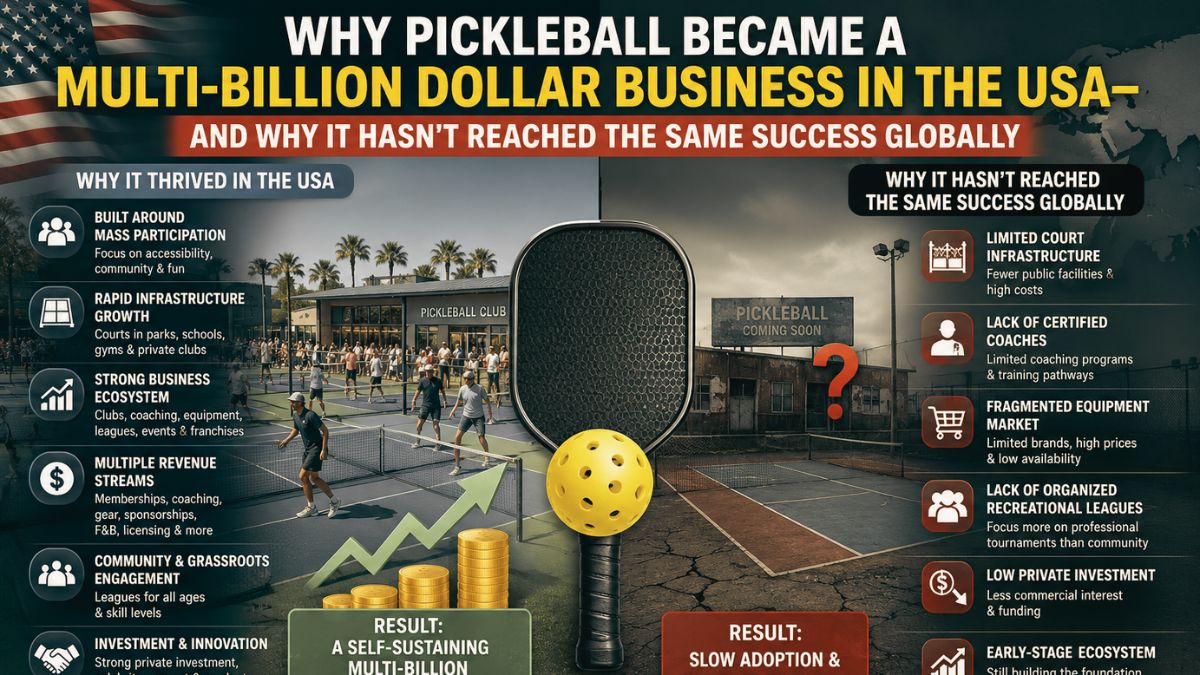
Why Pickleball Became a Multi-Billion Dollar Business in the USA—And Why It Hasn’t Reached the Same Success Globally
The Honest Reason Why Pickleball Became a Multi-Billion Dollar Business in the USA — But Is Still Struggling to Scale at the Same Level Globally :
- Pickleball Was Built as a Business Before It Became a Professional Sport:
Most sports grow from the top down.
Elite athletes come first.
Professional leagues follow.
Fans arrive.
Then businesses are built around the sport.
Pickleball flipped that model.
America focused on getting millions of everyday people playing first—not on producing world champions.
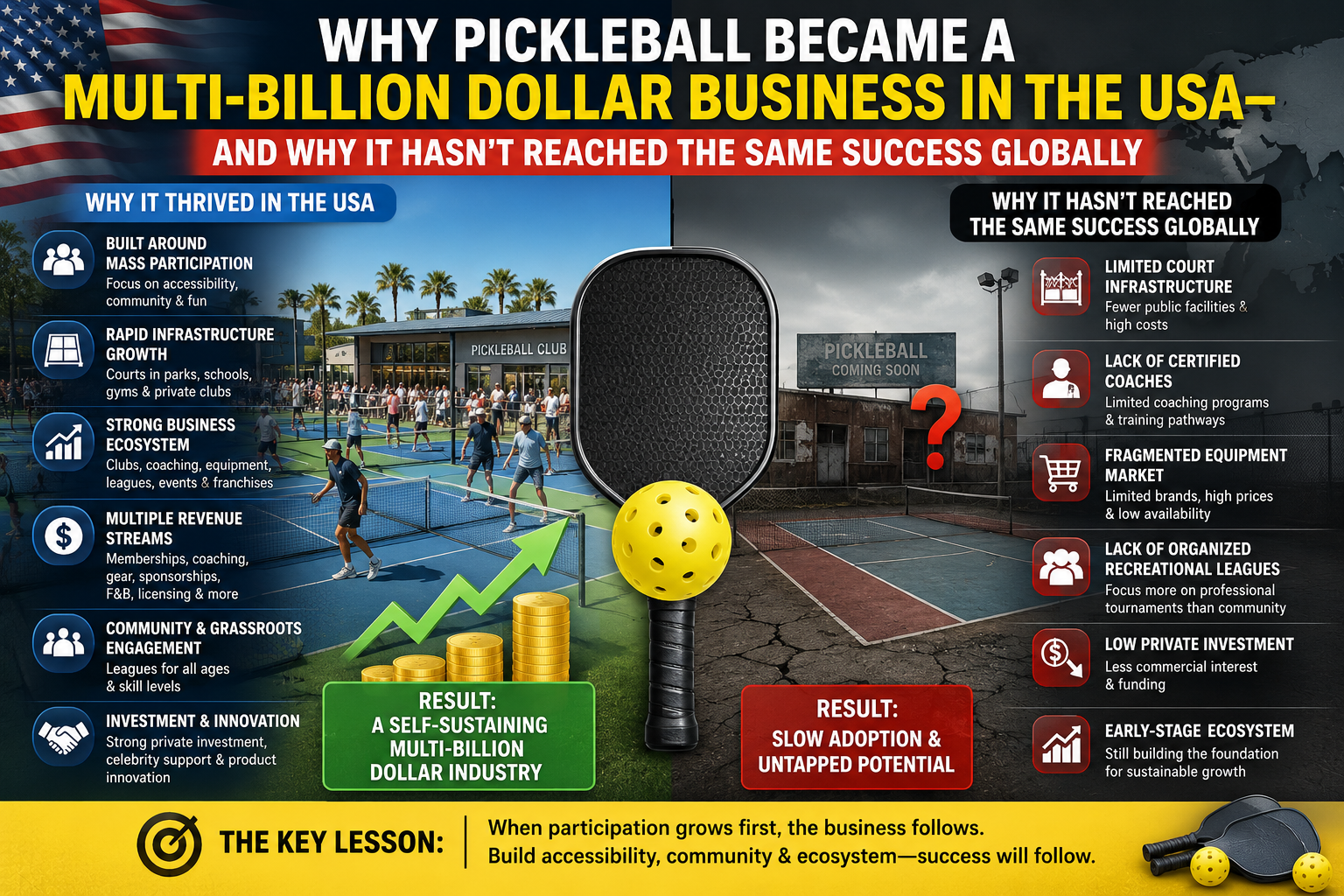
The growth engine looked like this:
More players
→ More courts
→ More memberships
→ More coaching
→ More equipment sales
→ More local tournaments
→ More sponsors
→ More investors
→ More media attention
Professional leagues came much later.
Participation created demand.
Demand created businesses.
Businesses built the entire ecosystem.
That is why Pickleball became an industry before it became a spectator sport.
2. Courts Became Revenue-Generating Assets, Not Just Playing Spaces:
Successful operators realized early that a court should never earn money from court bookings alone.
Modern Pickleball facilities generate revenue from multiple sources, including:
• Monthly memberships
• Annual subscriptions
• Corporate wellness packages
• Private coaching
• Group coaching programs
• Junior academies
• Senior citizen leagues
• Women’s leagues
• Birthday parties & social events
• Food & beverage outlets
• Pro shops & merchandise stores
• Tournament hosting
• League registrations
• Event rentals
• Sponsorship opportunities
Many premium clubs now operate more like fitness clubs than traditional sports centers.
The court is only one product.
The real business is the community built around it.
👍 Equipment Companies Created a Billion-Dollar Consumer Market
Most successful sports businesses don’t just sell entertainment.
They sell products repeatedly.
Pickleball brands didn’t wait for massive television audiences before investing.
Instead, they focused on serving players through:
• Premium paddles
• Entry-level starter kits
• High-performance balls
• Court shoes
• Apparel collections
• Bags and backpacks
• Smart accessories
• Paddle grips
• Protective gear
• Ball machines
• Training aids
• Performance analytics
Every new player becomes a long-term customer.
Unlike cricket, where a bat may last several years, Pickleball players often upgrade paddles to improve performance, experiment with new technologies, or simply enjoy the latest models.
That creates recurring consumer spending instead of one-time purchases.
Real Estate Became One of the Biggest Winners
One of Pickleball’s greatest strengths is its relatively low infrastructure cost.
Instead of spending millions building new stadiums, operators repurposed existing spaces such as:
• Empty warehouses
• Vacant retail spaces
• Old tennis courts
• Community centers
• School gyms
• Shopping malls
• Church halls
• Recreation centers
This significantly reduced capital expenditure.
It also allowed entrepreneurs to open clubs much faster than traditional sports facilities.
Lower investment.
Faster expansion.
Quicker profitability.
The Sport Is Easy to Learn but Difficult to Master
This may be Pickleball’s biggest competitive advantage.
Most beginners can enjoy a rally within their first hour.
That immediate sense of achievement keeps people coming back.
At the same time, improving strategy, reflexes, positioning, and shot selection provides enough challenge to keep experienced players engaged for years.
The result?
High retention.
People don’t just try Pickleball.
They continue playing it.
It Appeals to Almost Every Age Group
Few sports successfully bring together teenagers, working professionals, parents, and retirees on the same court.
Pickleball does exactly that.
Families play together.
Retirees stay active.
Young professionals use it as a networking activity.
Companies organize corporate leagues.
Schools introduce beginner programs.
That broad demographic reach dramatically increases the total addressable market.
Celebrities Turned Pickleball into a Lifestyle Brand
America benefited enormously from celebrity participation.
Actors.
Entrepreneurs.
Former Olympians.
NFL, NBA, MLB, and tennis stars.
Many invested in professional teams, appeared at tournaments, promoted the sport on social media, and played publicly.
The result?
Pickleball became fashionable—not just competitive.
When influential people embrace a sport, brands follow.
And when brands follow, media attention grows naturally.
Communities Were Built Before Fans
Unlike many sports that rely heavily on spectators, Pickleball built local communities first.
Weekly leagues.
Weekend tournaments.
Club socials.
Open-play nights.
Beginner clinics.
Mixed doubles events.
Corporate competitions.
These experiences encouraged friendships and repeat participation.
People didn’t just play Pickleball.
They became part of a community.
That community created long-term customer loyalty.
Broadcasting Was Never the Primary Revenue Source
This is one of the biggest misconceptions.
Unlike cricket, football, or the NBA, Pickleball’s business model does not depend primarily on billion-dollar broadcasting deals.
Its revenue is diversified across:
• Club memberships
• Court bookings
• Coaching programs
• Equipment sales
• Sponsorships
• Amateur tournaments
• League registrations
• Corporate events
• Food & beverage
• Merchandise
• Hospitality
• Digital content
• Licensing
• Franchising
• Sports tourism
Media rights add visibility.
But they are only one piece of a much larger business ecosystem.
That diversification makes the industry more resilient and less dependent on a single revenue stream.
So Why Hasn’t the Rest of the World Reached the Same Scale Yet?
Many countries are trying to copy the sport.
Very few are copying the business model.
In many markets:
• Court availability remains limited.
• Coaching ecosystems are still developing.
• Local leagues lack consistency.
• Equipment distribution is fragmented.
• Private investment is relatively small.
• Corporate participation is limited.
• Grassroots community building is still in its early stages.
Most importantly, many countries are focusing on creating professional competitions before creating millions of recreational players.
That reverses the formula that made Pickleball successful in the United States.
The biggest lesson isn’t about Pickleball.:
It’s about building any successful sports industry.
People often assume professional leagues create billion-dollar businesses.
In reality, participation creates economies.
When millions of people play a sport regularly, everything else follows:
Courts get built.
Coaches find careers.
Equipment companies grow.
Sponsors invest.
Investors enter the market.
Media takes notice.
Why Pickleball Became a Multi-Billion Dollar Business in the USA—But Is Still Struggling to Scale Globally
| Key Growth Driver | How It Fueled Pickleball’s Success in the USA |
|---|---|
| 1. Built as a Business Before a Professional Sport | Unlike traditional sports that begin with elite competition, Pickleball prioritized mass participation. More players led to more courts, memberships, coaching, equipment sales, tournaments, sponsors, investors, and eventually media attention. The business ecosystem was established before professional leagues gained prominence. |
| 2. Courts Became Revenue-Generating Assets | Indoor Pickleball clubs evolved into multi-revenue businesses through memberships, annual subscriptions, coaching programs, junior academies, senior leagues, women’s leagues, food & beverage, merchandise, tournaments, corporate events, sponsorships, and venue rentals. The court became just one component of a larger business model. |
| 3. Equipment Created a Billion-Dollar Consumer Market | Brands invested heavily in premium paddles, beginner kits, apparel, footwear, bags, smart accessories, grips, ball technology, training aids, and performance equipment. Because players frequently upgrade equipment, recurring consumer spending became a major revenue driver. |
| 4. Existing Real Estate Accelerated Expansion | Instead of building expensive stadiums, entrepreneurs converted warehouses, vacant retail spaces, shopping malls, old tennis courts, schools, community centers, and recreation facilities into Pickleball venues. This reduced capital investment and enabled rapid nationwide expansion. |
| 5. Easy to Learn, Difficult to Master | Beginners can enjoy the sport almost immediately, reducing barriers to entry. At the same time, advanced strategies, shot techniques, positioning, and competitive play provide long-term engagement, resulting in high player retention. |
| 6. Appeals to Every Generation | Pickleball attracts children, working professionals, families, and retirees alike. Schools, corporate wellness programs, community leagues, and senior recreation initiatives have expanded participation across nearly every demographic group. |
| 7. Celebrity & Investor Influence | High-profile actors, entrepreneurs, former Olympians, and stars from the NFL, NBA, MLB, and professional tennis invested in teams, promoted the sport publicly, and increased its cultural appeal. Celebrity involvement accelerated brand partnerships and media exposure. |
| 8. Community Was Built Before Spectatorship | Weekly leagues, beginner clinics, open-play sessions, corporate tournaments, mixed doubles events, and social gatherings created strong local communities. The emphasis on participation fostered loyalty and consistent engagement rather than relying solely on spectators. |
| 9. Diversified Revenue Beyond Broadcasting | Unlike many major sports, Pickleball is not primarily dependent on television rights. Revenue comes from memberships, court bookings, coaching, equipment sales, sponsorships, tournaments, hospitality, food & beverage, digital content, licensing, franchising, corporate events, and sports tourism. This diversified model improves financial resilience. |
| 10. Strong Grassroots Participation | Local parks, recreation departments, schools, private clubs, and residential communities made Pickleball widely accessible. Grassroots adoption created a continuous pipeline of new players, ensuring sustained long-term growth. |
| 11. Entrepreneur-Friendly Business Model | Compared to many sports, Pickleball requires relatively low investment to launch facilities. Lower setup costs, faster return on investment, and multiple revenue streams attracted entrepreneurs, franchise operators, and investors across the country. |
| 12. Corporate & Wellness Integration | Businesses increasingly adopted Pickleball as part of employee wellness initiatives, networking events, and team-building programs. This opened an additional commercial market beyond recreational players. |
| 13. Why Other Countries Are Growing More Slowly | While many nations have embraced Pickleball as a sport, relatively few have replicated the U.S. business ecosystem. Limited court availability, developing coaching infrastructure, fragmented equipment distribution, lower private investment, fewer organized leagues, and less corporate participation have slowed growth. Many markets focus on professional tournaments before building a broad recreational player base. |
| 14. The Biggest Business Lesson | Billion-dollar sports industries are not created by professional leagues alone. They are built by millions of everyday participants. As participation increases, demand naturally grows for facilities, coaching, equipment, sponsorships, investment, media coverage, and related businesses. Participation is the foundation of the entire sports economy. |
FAQ: Why Did Pickleball Become a Multi-Billion Dollar Business in the USA but Not Yet in Other Countries?
The success of Pickleball in the United States is not simply because Americans enjoy the sport more than people in other countries. Its growth is largely the result of a well-developed business ecosystem that was built around participation rather than professional competition. Instead of focusing first on television rights or elite athletes, the U.S. emphasized making the game accessible to everyone. Community parks, recreation centers, schools, gyms, and private clubs rapidly introduced Pickleball courts, making it easy for millions of people to play.
As participation increased, businesses recognized new opportunities. Entrepreneurs opened dedicated Pickleball clubs, equipment manufacturers launched innovative paddles and accessories, coaches developed training programs, and tournament organizers created leagues for every skill level. Investors and celebrities also helped increase the sport’s popularity, while real estate developers converted unused warehouses, tennis courts, and retail spaces into modern Pickleball facilities. These developments created multiple revenue streams through memberships, coaching, equipment sales, sponsorships, events, food and beverage services, licensing, and franchising. Unlike many traditional sports, the industry did not rely solely on broadcasting revenue.
In contrast, many countries are still in the early stages of developing this ecosystem. Limited court infrastructure, fewer certified coaches, lower private investment, fragmented equipment distribution, and a lack of organized recreational leagues have slowed adoption. In many markets, the focus remains on professional tournaments instead of building a large base of recreational players.
When participation grows first, it naturally creates demand for facilities, coaching, equipment, sponsorships, and media coverage. Countries that prioritize accessibility, community engagement, and business innovation alongside the sport itself are more likely to replicate the remarkable success that Pickleball has achieved in the United States.
| Aspect | United States (Why Pickleball Became a Multi-Billion Dollar Business) | Many Other Countries (Why Growth Is Slower) |
|---|---|---|
| Growth Strategy | Built around mass participation before professional competition. | Greater focus on professional tournaments than recreational participation. |
| Accessibility | Courts rapidly developed in community parks, schools, recreation centers, gyms, and private clubs. | Limited court infrastructure and fewer accessible public playing facilities. |
| Player Base | Millions of recreational players created a strong consumer market. | Smaller recreational player base limits commercial opportunities. |
| Business Ecosystem | Comprehensive ecosystem including clubs, coaching, equipment, leagues, events, and franchises. | Ecosystem is still developing with fewer commercial stakeholders. |
| Private Investment | Strong investment from entrepreneurs, venture capitalists, and celebrities. | Lower levels of private investment and commercial interest. |
| Infrastructure Development | Warehouses, tennis courts, and retail spaces converted into dedicated Pickleball venues. | Slower infrastructure expansion and fewer dedicated facilities. |
| Coaching & Training | Large network of certified coaches and structured training programs. | Limited number of certified coaches and coaching academies. |
| Equipment Industry | Strong demand fueled innovation in paddles, balls, apparel, and accessories. | Smaller equipment market with fragmented distribution channels. |
| Leagues & Events | Recreational leagues available for all ages and skill levels, encouraging continuous participation. | Fewer organized amateur and community leagues. |
| Revenue Model | Multiple revenue streams including memberships, coaching, equipment sales, sponsorships, tournaments, food & beverage, licensing, and franchising. | Revenue opportunities remain limited due to lower participation and infrastructure. |
| Media Dependency | Business growth driven by participation rather than relying solely on broadcasting rights. | Greater emphasis on media exposure without a sufficiently large playing community. |
| Community Engagement | Strong grassroots programs through schools, local clubs, and recreational organizations. | Grassroots initiatives are still emerging in many countries. |
| Market Maturity | Mature, self-sustaining sports business ecosystem. | Early-stage ecosystem still building foundational elements. |
| Key Growth Driver | Participation created demand for facilities, coaching, equipment, sponsorships, and media. | Need to first expand participation before commercial opportunities can scale. |
| Key Lesson | Build the player base first, and the business naturally follows. | Prioritize accessibility, grassroots participation, and ecosystem development before expecting large commercial returns. |
Related posts:
 MUM Vs HAR Dream11 Prediction, Live Score & U Mumba Vs Haryana Steelers Dream Team: PKL 2019
 WAT vs TOT Dream11 Prediction, Live Score & Watford vs Tottenham Hotspur Football Match Dream Team: English Premier League
 NZ-U19 vs JPN-U19 Dream11 Prediction, Live Score & New Zealand U19 vs Japan U19, Cricket Match Dream11 Team: ICC U19 World Cup
 MFE vs MTB Dream11 Prediction: Live Score, Today Match Prediction: Vanuatu Blast T10 League 2020 | Match: 04