

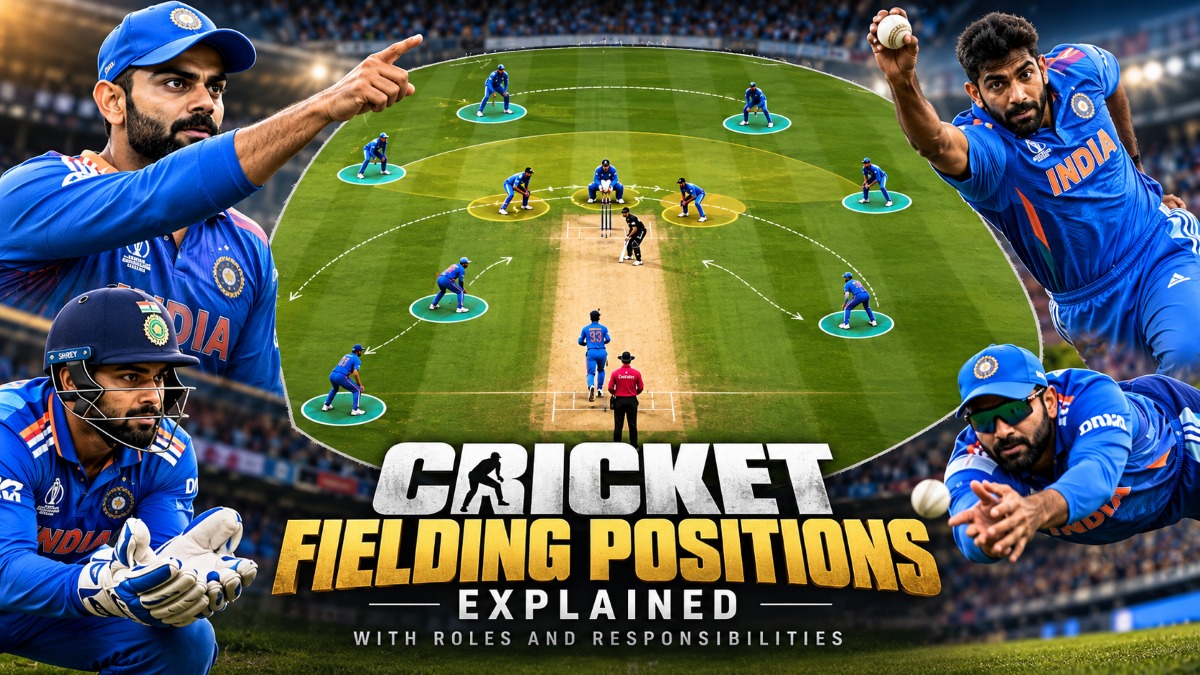
Cricket Fielding Positions Explained With Roles and Responsibilities
Let me tell you the simplest way how you can figure out if someone posses great knowledge about Cricket or not ?
In order to check that ask them about field positions and how it is different from other position? We will decode step by step on all different position to be shared in the below format:
In order to understand all three position and different minature step by step in the below format:
A- Close Catching Positions:
All these position are the ones where players standing close to bowlers where they an change the scenario of the game quite effectively and efficiently.
1. Wicketkeeper: Stands behind the stumps to catch deliveries, collect throws, prevent byes, and dismiss batters through stumpings and catches.
2. Slips (1–4): Positioned behind the wicketkeeper on the off-side to catch edges from attacking shots and defensive strokes.
3. Gully: Fields on the off-side, wider than the slips, to intercept sharp edges, cut shots, and unexpected deflections.
4. Short Leg / Forward Short Leg: Stands close to the batter on the leg-side to catch bat-pad deflections, especially against spin bowling.
5. Silly Point / Silly Mid-Off / Silly Mid-On: Field very close to the batter on the off-side or leg-side to catch soft edges, defensive shots, and mistimed strokes, particularly against spinners.
B- Inner Ring Position:
Here in this article we will reveal all possible field position which lies inside close circle in short 30 yard boundaries.
Let’s have a close look at those position to be shared in the below format:
• Point: Stands square to the batter on the off-side to stop square cuts and sharp drives; requires quick reflexes and strong arms.
• Cover / Extra Cover: Positioned on the off-side at a 45-degree angle to block cover drives and prevent quick singles.
• Mid-Off: Stands on the off-side in a straight line relative to the bowler to stop straight drives and anchor the bowling plan.
• Mid-On: The mirror image of mid-off on the leg-side; stops straight drives and backs up throws at the non-striker’s end.
• Square Leg: Stands square to the batter on the leg-side to field pull shots, hooks, and quick sweeps.
• Fine Leg (Infield): Positioned fine of square leg near the inner circle to stop gentle glances and deflections.
Also Mid Wicket: A Mid Wicket is another common fielding position in cricket, where player is standing on the leg side in terms of position it is located between square leg and mid on and the job of field is to stop ball in that area where fielder is standing often termed as position closer to batter for quick catches.
3. Outfield and Boundary( Beyond 30 yards):
– Third Man: Positioned near the off-side boundary behind the slip cordon to stop late cuts, thick edges, and deflections that pass the wicketkeeper or slip fielders.
– Fine Leg (Boundary): Stands deep behind square on the leg-side to stop glances, flicks, and top-edges from reaching the boundary. This position is particularly useful against short-pitched deliveries and balls redirected towards the fine-leg region.
– Deep Point / Sweeper Cover: Positioned near the off-side boundary to field powerful cuts, square drives, and cover shots. These fielders help prevent fours, restrict quick singles, and control scoring opportunities in limited-overs cricket.
– Deep Mid-Wicket: Fields near the leg-side boundary between deep square leg and long-on. This position is crucial for stopping powerful pull shots, slog-sweeps, flicks, and other aerial strokes, particularly during aggressive batting phases in limited-overs cricket.
-Long On/Long Off: These are deep boundary position in Cricket, where it is positioned straight down the ground which is usually placed on the Opposite side of pitch, to block lofted shots and short drives.
| Fielding Zone | Position Name | Side / Angle | Primary Role & Shot Interception |
| Close Catching | Wicketkeeper | Behind Stumps | Catches edge deflections, collects throws, prevents byes, and executes stumpings. |
| Close Catching | Slips (1–4) | Behind Keeper (Off-Side) | Intercepts outside edges off attacking or defensive strokes. |
| Close Catching | Gully | Wider than Slips (Off-Side) | Catches sharp edges, cut shots, and unexpected deflections. |
| Close Catching | Short Leg / Forward Short Leg | Close to Batter (Leg-Side) | Snag bat-pad deflections and pop-up catches, especially against spinners. |
| Close Catching | Silly Point / Mid-Off / Mid-On | Very Close to Batter | Fields soft edges, defensive prods, and mistimed defensive strokes. |
| Inner Ring (Infield) | Point | Square (Off-Side) | Stops square cuts and sharp drives; requires rapid reflexes and precision throwing. |
| Inner Ring (Infield) | Cover / Extra Cover | ~45° Angle (Off-Side) | Blocks cover drives, prevents quick singles, and attacks the ball. |
| Inner Ring (Infield) | Mid-Off | Straight (Off-Side) | Stops straight drives and reinforces the bowler’s strategic plan. |
| Inner Ring (Infield) | Mid-On | Straight (Leg-Side) | Mirror image of Mid-Off; cuts off straight drives and backs up non-striker throws. |
| Inner Ring (Infield) | Mid-Wicket | Between Square Leg & Mid-On | Stops shots flicked through mid-wicket and takes quick reflex catches close in. |
| Inner Ring (Infield) | Square Leg | Square (Leg-Side) | Fields pull shots, hooks, and sweep shots. |
| Inner Ring (Infield) | Fine Leg (Infield) | Behind Square (Leg-Side) | Cuts off delicate glances, deflections, and leg-side flicks inside the 30-yard circle. |
| Outfield & Boundary | Third Man | Deep Behind Slips (Off-Side) | Prevents boundaries from late cuts, thick edges, and deflections past the keeper. |
| Outfield & Boundary | Fine Leg (Boundary) | Deep Behind Square (Leg-Side) | Saves boundary runs from glances, flicks, and top-edges off short balls. |
| Outfield & Boundary | Deep Point / Sweeper Cover | Deep Boundary (Off-Side) | Patrols the deep off-side to contain powerful cuts, square drives, and aerial lofts. |
| Outfield & Boundary | Deep Mid-Wicket | Deep Leg-Side | Halts aggressive pull shots, slog-sweeps, and aerial hits during power-hitting phases. |
| Outfield & Boundary | Long-Off / Long-On | Straight Deep Boundaries | Guard the straight boundaries against lofted drives and clear-the-front-leg hits. |
All these field position is extremely important, where fielders can make difference and contribute towards towards the crunch phase of the game.
Field Position are vital for any captain who understand the dynamics of game, where they can manuver players all over the ground and create massive impact in the game.
If you are someone who understand field position really well, then you don’t need to worry about, you are already ahead of curve, where you can create massive impact in the gentlemen’s game.
Overall Fielding Positions,, makes it more evident, that speaks a volume about tactical side of game where they can maneuver their opponent really well.
Frequently Asked Questions (FAQ) about Cricket Field Positions :
Q-1. What are fielding positions in cricket?
Answer: Fielding positions in cricket refer to the designated areas where fielders stand to stop the ball, catch batters out, prevent boundaries, and restrict the opposition’s scoring opportunities. These positions are strategically selected by the captain and bowler according to the batter’s strengths, bowling style . Common positions include slip, point, cover, mid-off, mid-on, mid-wicket, fine leg, third man, and long-on.
Q-2. Why are fielding positions important in cricket?
Answer: Fielding positions are important because they directly influence how many runs a batting team can score and how frequently it loses wickets. A well-planned field can create catching opportunities, restrict boundaries, force batters into risky shots, and build pressure through dot balls. Captains use field placements to support their bowlers and exploit a batter’s weaknesses. In close matches, an intelligent fielding setup can change the outcome of the game.
Q-3. What are the three main categories of cricket fielding positions?
Answer: For a basic understanding, fielding positions can be grouped into three broad categories:
Close-catching positions: These include the wicketkeeper, slips, gully, short leg, and silly point. They are particularly useful for catching edges and bat-pad deflections.
Inner-ring positions: These include point, cover, mid-off, mid-on, square leg, and mid-wicket. Their primary responsibilities are to stop singles, intercept ground shots, and support attacking field placements.
Outfield and boundary positions: These include third man, deep point, sweeper cover, deep mid-wicket, fine leg, long-off, and long-on. They help prevent boundaries and field powerful shots hit into open spaces.
These are practical groupings rather than three official or exhaustive classifications of every fielding position.
Q-4. What is the difference between off-side and leg-side fielding positions?
Answer: The off-side and leg-side are determined by the batter’s stance and the direction the batter faces while preparing to receive the delivery. The off-side is generally the side in front of the batter, while the leg-side.
Positions such as point, cover, extra cover, and third man are on the off-side. Square leg, fine leg, mid-wicket, and mid-on are on the leg-side. Understanding this distinction helps players interpret field settings and understand a captain’s tactical decisions.
Q-5. What is the difference between point and cover in cricket?
Answer: Point and cover are both off-side fielding positions, but they occupy different angles. Point is positioned approximately square to the batter and is responsible for stopping square cuts, late cuts, and shots played behind or beside the batter.
Cover is positioned farther in front of point, between point and mid-off. The cover fielder primarily stops cover drives and shots played through the off-side. Extra cover is positioned between cover and mid-off. The exact placement depends on the captain’s plan and the batter’s scoring patterns.
Q-6. What is the difference between mid-off and mid-on?
Answer: Mid-off is positioned on the off-side, relatively straight in front of the batter, while mid-on occupies a similar position on the leg-side. Both positions help stop straight drives and control scoring opportunities along the ground.
Their responsibilities may change depending on the bowler’s line and length. A captain may position mid-off closer to the batter to prevent singles or move the fielder deeper to protect against lofted drives. Similar adjustments can be made at mid-on to control leg-side strokes and aerial shots.
Q-7. Why are slip fielders positioned behind the wicketkeeper?
Answer: Slip fielders stand behind and to the off-side of the wicketkeeper to catch edges produced when a batter makes contact with a delivery while attempting a defensive or attacking stroke. The ball may travel towards the slips after taking a thin edge from the bat.
The number of slips depends on factors such as the bowler’s pace, swing, line, length, pitch conditions, and match situation.
Q-8. What is the role of a wicketkeeper in cricket?
Answer: The wicketkeeper stands behind the stumps and is responsible for collecting deliveries that pass the batter, catching edges, preventing byes, and completing stumpings and run-outs. The wicketkeeper also plays an important tactical role by communicating with the bowler and captain about the batter’s movements and possible scoring options.
In addition to technical ability, a wicketkeeper needs concentration, quick reflexes, agility, and strong anticipation. Their position and distance from the stumps vary according to the bowler’s pace, the batter’s style, and the type of delivery.
Q-9. What is the difference between fine leg and third man?
Answer: Fine leg is positioned on the leg-side, behind square, to stop glances, flicks, and top edges that travel towards the fine-leg region. The fielder may be positioned inside the circle or near the boundary, depending on the situation.
Third man is positioned on the off-side, behind the wicketkeeper and slip cordon, to intercept late cuts, thick edges, and deflections that travel towards the third-man region. Both positions can be important boundary-saving areas, especially when batters frequently use the pace of the ball .
Q-10. What are long-on and long-off in cricket?
Answer: Long-on and long-off are deep fielding positions located relatively straight along the ground near the boundary. Long-on is on the leg-side, while long-off is on the off-side.
These positions are particularly important when batters attempt lofted drives, straight hits, and powerful aerial strokes. Boundary fielders need good catching ability, anticipation, throwing accuracy, and an understanding of where the ball is likely to land. Captains frequently use long-on and long-off during limited-overs cricket to control aggressive batting.
My Perspective:
Fielding Position are not the most talked about Topic, but the least covered topic on channels where no experts or players don’t discuss all these terminologies in detail.
Fielding as subject should be vividly talked about so that naysayers could understand it in detail.
Fielding across positions if placed properly can certainly dominate opponents in crunch phase where they can dictate terms and do wonders where they can earn vital points for his team.
Overall Fielding position can be imparted to next generation provided we make it more interesting for others to understand it.
Fielding positions in cricket play a crucial role in determining the outcome of a match. Every position has a specific purpose, depending on the bowler’s strategy, the batter’s strengths and weaknesses, and the match situation. Captains must understand these dynamics before placing their fielders strategically across the ground.
Positions such as slip, gully, point, cover, mid-off, mid-on, square leg, fine leg, third man, and deep midwicket serve different tactical purposes. . Each placement reflects the captain’s assessment of the batter, the pitch conditions, and the required scoring rate.
Fielding positions also change according to the format of cricket. Captains must constantly adapt their plans as the game progresses.
It also helps viewers appreciate the tactical battles unfolding beyond the contest between bat and ball.
Therefore, fielding positions deserve greater attention in cricket education and sports broadcasting. Explaining their purpose through examples, match situations, and expert analysis can make cricket more engaging for beginners and experienced fans alike.
Fielding is vital part of Cricket where most stats that expert usually talks about has everything to do with batting, bowling and all round domain a segment should be dedicated on regular basis on Fielding where experts can dissect the pro and cons of everyone sharply and effectively.
Related posts:
 Team Management Should give MS Dhoni License to Bat Freely: Harbhajan Singh
 Meet Atharva Desai- Young racing driver who is keenly looking to compete in Formula 3 and dream of becoming World Champion one day
 How to Grow Non Cricketing Sport in India? Let’s Explore in Detail
 Complete Guide to Sports in India: Professional Leagues, Federations, Academies and Pathways