
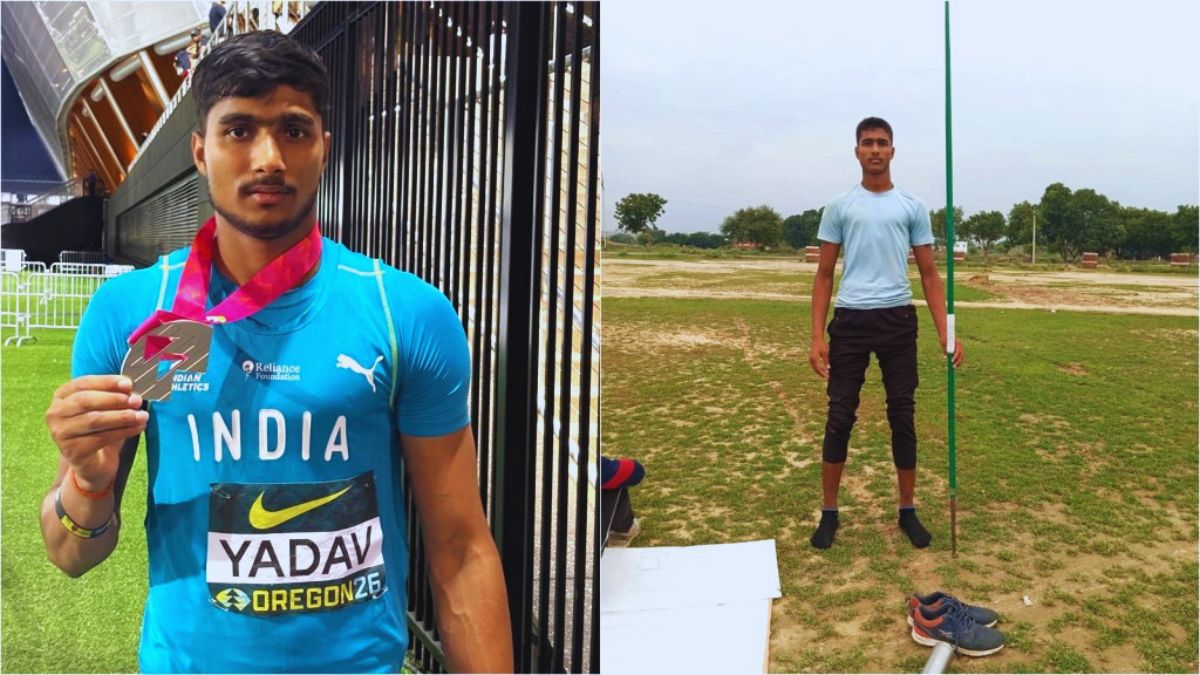
Ashish Yadav’s Incredible Javelin Journey From a Dry Pond to a World U-20 Silver
Ashish Yadav had no proper ground, no expensive training setup and, at one point, not even a proper javelin. Two years after starting the sport, the 19-year-old has won a silver medal for India at the 2026 World Athletics U-20 Championships. His journey from a small village in Mirzapur to the podium in Oregon is a story of hard work, family support and a dream inspired by Neeraj Chopra.
Two years ago, Ashish Yadav was training for javelin throw in a dry pond near his village in Mawaiya, Mirzapur. There was no proper athletics ground. There were no fancy training facilities. There was not even a regular javelin available to him.
Instead, Ashish used a wooden javelin and made the dry pond his training ground. The decision was not because he preferred the place. He simply did not have many other options.
The pond, around two kilometres from his home, would dry up and give him enough space to practise his throws. However, the place was far from safe. There were patches of quicksand, and according to Ashish, children had even lost their lives after getting stuck in the mud.
Yet, the young athlete kept going.
On Saturday, August 8, 2026, that journey reached a major moment when Ashish won the silver medal in the men’s javelin throw at the World Athletics U-20 Championships in Oregon, USA.
His best throw of 74.09 metres was enough to give India its first medal at the 2026 World U-20 Championships. More importantly, Ashish became only the second Indian to win a javelin medal at the World U-20 Championships, after Neeraj Chopra’s gold medal in 2016.
Ashish Yadav wins silver in World U-20 Championships
Ashish entered the javelin final in Oregon carrying the hopes of a country that has become closely linked with the event in recent years. However, his journey to the final had not been completely smooth.
He had suffered a knee injury and did not get enough time to train properly after returning from it. He admitted that he was only around 80 per cent fit when he competed in the World U-20 Championships.
Still, Ashish refused to use his fitness as an excuse. His best effort of 74.09 metres put him in second place.
South Africa’s Jan-Hendrik Heymans won the gold medal with a throw of 80.50 metres. Addison James of Dominica finished third with 73.89 metres, which was also a national record.
Ashish’s throw was not close to Neeraj Chopra’s famous 86.48-metre junior world record, set at the 2016 World U-20 Championships in Bydgoszcz, Poland. But Ashish was not looking to copy Chopra’s record. For him, the priority was to finish on the podium. And he did exactly that.
Ashish said that he still had a lot to do and did not want to be compared with Neeraj Chopra. At the same time, he admitted that Chopra had been one of the biggest reasons he chose javelin. The young thrower now has a World U-20 silver medal of his own.
A dream that started with Neeraj Chopra
Neeraj Chopra’s rise has had a huge influence on young athletes in India, and Ashish is one of them. Before Ashish started taking javelin seriously, he watched videos of Chopra again and again. His uncle, Dharamraj Singh, also remembers how interested Ashish was in watching the Olympic champion.
Dharamraj himself is a discus thrower and an Army man. He played an important role in helping Ashish start his sporting journey. Ashish also comes from a family with a connection to sport. His aunt, Punam Yadav, is a weightlifter who won a medal at the 2014 Commonwealth Games. Watching her compete gave Ashish another reason to think seriously about sport.
However, becoming an athlete was not always his main focus. Until the age of 17, Ashish spent a large part of his time helping his father with the family milk business.
From delivering milk to throwing the javelin
Ashish’s childhood was very different from that of athletes who grow up inside professional sports academies. From the age of 10, he would help his father with milk distribution. He would visit homes around the village and milk cows and buffaloes. His father would then sell the milk.
Sport was there in the family, but Ashish was not fully committed to it. His uncle Dharamraj eventually became frustrated with him because he was neither taking sport seriously nor doing well in his studies.
One day, Dharamraj gave him a strict warning. He told Ashish that if he wanted to get into javelin, he would have to work hard and stay committed. He also promised to arrange wooden javelins for him.
A wooden javelin cost around Rs 1,200, which was not a small amount for the family. Still, his uncle decided to support him. That support gave Ashish the chance to start training.
The problem, however, was finding a place to train. Mawaiya and the nearby villages did not have a proper athletics ground. So Ashish found his own solution. He went to the dry pond.
Training in a dangerous dry pond
The dry pond was around two kilometres away from Ashish’s home. When the water disappeared, it provided him with an open area where he could throw his wooden javelin.
For Ashish, it was one of the few places where he could train without worrying about hitting another person. But the pond had a serious danger. Some parts of the area had quicksand-like mud.
Ashish knew the risks, but he continued to train there. He recalled how his family had beaten him after finding out where he was practising. They were not angry because he was training. They were scared that something could happen to him.
According to Ashish, children had been pulled into the mud in the area, and some had died. Despite this, he kept returning to the pond. He said there was a Shivji temple near the pond and believed that he would be protected.
For Ashish, the thought was simple: there was no proper ground in his village, but he had to start somewhere. That sentence sums up the early part of his sporting journey. He did not wait for perfect conditions. He trained with whatever he had.
His uncle’s role in Ashish’s journey
Dharamraj Singh was not only the person who pushed Ashish towards sport but also one of the people who helped him financially. He bought wooden javelins for him and encouraged him to keep working.
Dharamraj also understood that javelin was not an easy sport. India had already developed a strong group of javelin throwers, and competition at the domestic level was becoming tougher. He told Ashish that he would have to work hard and not lose hope. The young athlete followed that advice. He also continued to watch videos of Neeraj Chopra.
Those videos gave him an idea of how professional javelin throwers trained and competed. But Ashish’s journey changed significantly when he got an opportunity to train at the Hisar Centre.
The turning point: Hisar Centre
Ashish’s big break came when he was selected to train at the Hisar Centre, which is run by the Sports Authority of India in collaboration with the Inspire Institute of Sport. It was a major change from training in a dry pond in Mirzapur. For the first time, Ashish had access to a proper training environment and a coach who could work closely with him.
Arvind Kumar, the coach at the Hisar Centre, saw something in the young thrower. Ashish did not top the selection trials with his throw. His best effort in the trial was around 64 metres.
However, the coaches noticed other qualities. His speed stood out. During the motor-ability tests, Ashish recorded a standing board jump of 3.10 metres. Coach Arvind Kumar explained that anything above three metres was considered very good. Most young athletes recorded jumps in the range of 2.70 metres to 2.80 metres.
Ashish also had a good vertical jump. His tall frame, speed and lean body gave the coach enough reasons to believe that he could develop into a good javelin thrower. That decision changed Ashish’s training and his life.
From 70 kg to 84 kg
When Ashish joined the Hisar Centre, he weighed only around 70 kilograms. At six feet and one inch, he was considered underweight for the kind of physical demands that come with javelin throw.
Coach Arvind Kumar helped him understand that throwing the javelin was not only about technique. Food, strength training, recovery and overall fitness were also important. Over time, Ashish’s weight increased to around 84 kilograms.
The physical change was also part of his development as an athlete. Ashish speaks very highly of his coach and considers him like a father. He said Kumar treated him like his own son. Financial support also came from both his uncle and his coach.
Whenever Ashish needed money for his sporting needs, they helped him. According to Ashish, neither his uncle nor his coach ever asked him to return the money. Their support allowed him to focus on training without worrying too much about the cost of equipment and other needs.
A fifth-place finish before the World U-20 silver
Ashish’s road to the World U-20 Championships was not perfect. Before travelling to Oregon, he competed at the Under-20 Asian Championships in Hong Kong in May. He finished fifth in that competition.
A fifth-place finish was not the result he wanted. However, instead of allowing that result to affect him for too long, Ashish continued working. Then came the World U-20 Championships.
He arrived in Oregon with an injury and limited preparation time. That made the challenge even harder. Still, he managed to produce a 74.09-metre throw and finish second. His silver medal turned his fifth-place finish in Hong Kong into a distant memory.
The importance of staying calm
Coach Arvind Kumar also played an important role before the final. Instead of giving Ashish a long list of instructions, he asked the youngster not to overthink. At 19, competing in a major international final can bring plenty of pressure.
But Ashish had already gone through a very different kind of challenge during his journey. He had trained in a dangerous pond. He had worked with his father in the milk business. He had started with wooden javelins. He had dealt with an injury. He had moved away from home to train at a professional centre. All of those experiences had prepared him for the moment in Oregon. The final result was a silver medal.
Ashish does not want to be compared with Neeraj Chopra
The connection between Ashish and Neeraj Chopra is natural. Both are Indian javelin throwers and have competed at the junior level. Both have inspired young athletes through their performances.
However, Ashish himself does not want comparisons. He knows that Chopra has already achieved Olympic gold, World Championship gold and several other major honours. Ashish’s journey has only reached its early stages.
He has won a World U-20 silver medal, but he understands that there is still a lot of work to do. He also knows exactly where he needs to improve.
Improving runway speed
Ashish believes he needs to improve his speed on the runway. In javelin, the throw is not only about how strongly an athlete can throw the spear. The run-up, speed, body position, timing and release all play important roles.
Ashish wants to make technical changes to his throwing style and become faster during his run-up. His coach has already identified his speed as one of his biggest strengths. That gives the young thrower a clear area to work on.
Ashish has also made it clear that he does not want to become comfortable after winning a medal. He knows how competitive Indian javelin has become. He also knows that one good performance is only one part of an athlete’s journey.
A silver medal born in a village pond
Ashish Yadav’s story is not simply about a 74.09-metre throw. It is about how a young boy from Mawaiya found a way to train despite having very little. He did not have a proper ground and did not have professional equipment. He started with a wooden javelin and a dry pond. His father was a milkman, and Ashish spent years helping with the family business. His uncle pushed him towards sport and helped him buy equipment.
His coach gave him an opportunity at the Hisar Centre and helped him understand how to train and eat like a professional athlete. Ashish then worked his way from local training to national competition and eventually to the World U-20 Championships.
At Hayward Field in Oregon, his throw travelled 74.09 metres. It was enough for a silver medal.
It also placed his name alongside Neeraj Chopra as only the second Indian javelin thrower to win a medal at the World U-20 Championships. For Ashish, the journey from that dangerous dry pond in Mirzapur to the international podium has been built one throw at a time.
And behind that medal are a father who supported his son, an uncle who pushed him towards sport, a coach who saw potential in him, and a young athlete who refused to let the lack of facilities decide how far he could go.
Related posts:
 From Jhansi to Budapest via Bangalore: Remarkable Journey of Shaili Singh to the Athletics World Championship Stage
 Muhammed Anas Yahiya Biography: Personal Life, Career, Playing Style, Age, Height, Girlfriend, Facts & Networth
 Neeraj Chopra to start 2024 season with Doha Diamond League
 World Para Championships: Deepthi Jeevanji broke the world record