
USA vs World Pickleball Comparison 2026: Players, Courts, Revenue & Growth Stats
USA vs Rest of the World: Honest Pickleball Ecosystem Comparison in 2026 (Stats & Numbers)
Pickleball’s global rise has been remarkable, but when comparing the United States with the rest of the world in 2026, the gap remains enormous. While countries across Asia, Europe, and the Middle East are experiencing rapid growth, the USA continues to dominate participation, infrastructure, professional leagues, sponsorship, and commercial investments.
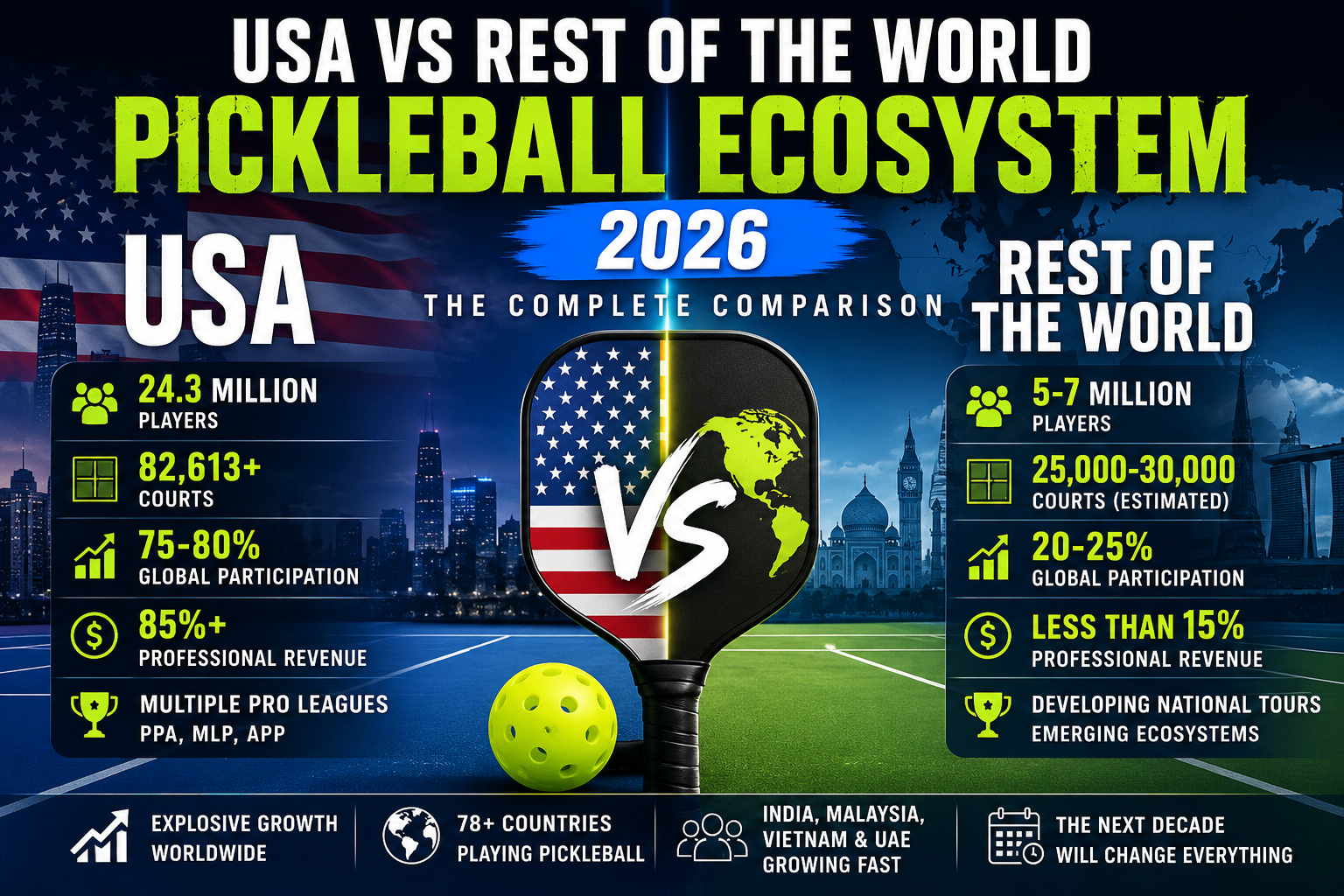
The most important number is participation. According to SFIA’s 2026 report, approximately 24.3 million Americans played pickleball during 2025, making it one of the most popular participation sports in the country. The sport added roughly 4.5 million new players in a single year.
- Infrastructure: USA Is Playing A Different Game
The United States has built an ecosystem that no other country currently matches.
USA Infrastructure
* 82,613+ courts nationwide
* 18,258 playing locations
* 14,155 new courts added in a year
* More than 2,500 dedicated facilities
* Hundreds of private clubs being developed annually
* Major cities now have dedicated pickleball complexes
Even though court growth has slowed from its explosive peak, the number of courts across major U.S. cities has increased nearly 900% since 2017.
2. Rest of World Infrastructure:
Outside the United States, growth is impressive but fragmented.
Countries showing strong momentum include:
* India
* Malaysia
* Vietnam
* Canada
* Australia
* United Kingdom
* Spain
* UAE
However, most nations are still converting badminton, tennis, or futsal courts rather than building large dedicated pickleball facilities.
3. Professional Ecosystem Comparison
USA
The United States owns virtually the entire professional pickleball economy.
Key assets include:
* Professional Pickleball Association (PPA)
* Major League Pickleball (MLP)
* APP Tour
* National television exposure
* Celebrity ownership models
* Franchise-based leagues
MLP ticket revenue reportedly grew 122% year-over-year while attendance increased 57%, highlighting commercial maturity.
4. Rest of World
Most countries are still developing:
* National tours
* Ranking systems
* Player development pathways
* Sponsorship structures
* Broadcast partnerships
International events exist, but few players outside North America can currently earn a full-time living
solely from pickleball.
Sponsorship & Investment
- USA:
The American ecosystem has attracted:
* Venture capital
* Celebrity investors
* Franchise operators
* Equipment manufacturers
* Real-estate developers
USA Pickleball approved 718 paddles and registered 193 new manufacturers in 2025 alone, showing the scale of commercial activity.
2. Rest of World:
Investment remains concentrated in:
* Court construction
* Local leagues
* Amateur tournaments
* Regional equipment brands
Most countries still lack sustainable sponsorship ecosystems.
Talent Development
USA Advantage
The USA currently possesses:
* Largest player pool (24.3 million)
* Most coaches
* Most tournaments
* Strongest junior pathway
* Most prize money
USA Pickleball sanctioned 144 tournaments in 2025 and expanded membership by more than 68% year-over-year.
Rest of World Challenge
The biggest challenge globally remains player density.
Many countries have talented athletes, but not enough competitive depth to consistently produce elite professional players.
Honest Reality Check For 2026
If the global pickleball ecosystem were measured like a business market, the United States would control roughly:
* 75-80% of global participation
* 85%+ of professional revenue
* 80%+ of sponsorship value
* Majority of global media attention
* Most of the world’s elite professional players
The rest of the world is growing faster percentage-wise, but from a much smaller base.
Final Perspective:
The United States remains the undisputed superpower of pickleball in 2026. With 24.3 million players, more than 82,000 courts, rapidly expanding professional leagues, and significant commercial investment, America is operating years ahead of every other market.
However, the real story is happening outside America. Countries like India, Malaysia, Vietnam, Australia, Canada, and the UAE are experiencing explosive adoption rates. The gap is still massive, but for the first time, the rest of the world is building ecosystems rather than simply importing the sport.
The honest conclusion: USA owns the present of pickleball, but the next decade will determine whether the rest of the world can challenge that dominance.
| Category | USA (2026) | Rest of the World (2026) |
|---|---|---|
| Estimated Players | 24.3 Million | 5-7 Million |
| Annual New Players Added | 4.5 Million | 1-2 Million |
| Share of Global Participation | 75-80% | 20-25% |
| Growth Since 2020 | +479% | +300%+ |
| Countries Playing Pickleball | Single Largest Market | 78+ Countries Combined |
| Market Maturity | Highly Developed | Emerging |
Infrastructure Comparison
| Infrastructure Metric | USA | Rest of World |
|---|---|---|
| Total Courts | 82,613+ | 25,000-30,000 (Estimated) |
| Playing Locations | 18,258+ | Fragmented |
| New Courts Added (2025) | 14,155+ | Limited Data |
| Dedicated Facilities | 2,500+ | Few |
| Private Clubs | Hundreds Added Annually | Growing Slowly |
| Dedicated Pickleball Complexes | Common | Rare |
| Court Growth Since 2017 | Nearly 900% | Rapid but Uneven |
Professional Ecosystem
| Metric | USA | Rest of World |
|---|---|---|
| Professional Tours | PPA, MLP, APP | Mostly National Tours |
| Franchise Leagues | Established | Very Limited |
| TV Coverage | National Networks | Mostly Digital |
| Professional Players | Thousands | Hundreds |
| Prize Money | Highest Globally | Limited |
| Full-Time Careers | Common | Rare |
| Commercial Value | Dominant | Emerging |
Sponsorship & Investment
| Category | USA | Rest of World |
|---|---|---|
| Venture Capital Funding | High | Low |
| Celebrity Investors | Extensive | Limited |
| Franchise Investment | Strong | Emerging |
| Equipment Brands | Hundreds | Growing |
| Real Estate Investment | Major Sector | Early Stage |
| Sponsorship Market Share | 80%+ | <20% |
Equipment Industry
| Metric | USA | Rest of World |
|---|---|---|
| Approved Paddles | 718 | N/A |
| New Manufacturers (2025) | 193 | Limited |
| Product Innovation | Highest | Developing |
| Global Market Influence | Dominant | Emerging |
Talent Development
| Category | USA | Rest of World |
|---|---|---|
| Player Pool | Largest Worldwide | Smaller |
| Coaching Network | Most Developed | Developing |
| Junior Programs | Extensive | Limited |
| Tournament Opportunities | Highest | Growing |
| Professional Pathway | Structured | Fragmented |
| Competitive Depth | Elite | Developing |
Fastest Growing Countries Outside USA
| Country | Growth Status |
|---|---|
| India | Explosive Growth |
| Malaysia | Infrastructure Boom |
| Vietnam | Rapid Expansion |
| Canada | Mature Recreational Market |
| Australia | Strong Tournament Growth |
| United Kingdom | Growing Club Culture |
| Spain | Increasing Participation |
| UAE | Heavy Investment |
Biggest Challenges Outside USA
| Challenge | Impact |
|---|---|
| Lack of Dedicated Courts | Slower Accessibility |
| Weak Sponsorship Ecosystem | Limited Funding |
| Limited Media Coverage | Low Visibility |
| Smaller Player Base | Reduced Competition |
| Fewer Professional Events | Limited Career Opportunities |
| Lack of Commercial Investment | Slower Ecosystem Development |
Honest Reality Check (2026)
| Global Metric | USA Share | Rest of World Share |
|---|---|---|
| Global Participation | 75-80% | 20-25% |
| Professional Revenue | 85%+ | <15% |
| Sponsorship Value | 80%+ | <20% |
| Media Attention | Majority | Minority |
| Elite Professional Players | Majority | Minority |
| Commercial Investment | Dominant | Emerging |
Final Verdict
| Question | Answer |
|---|---|
| Who Owns the Present of Pickleball? | USA |
| Who Has the Largest Player Base? | USA (24.3 Million) |
| Who Leads Infrastructure? | USA |
| Who Leads Professional Pickleball? | USA |
| Which Regions Are Growing Fastest? | India, Malaysia, Vietnam, UAE |
| Can Rest of World Catch USA? | Possible after 2030 |
| Overall Ecosystem Advantage | USA by a Significant Margin |
| Long-Term Opportunity | Rest of World |
Frequently Asked Question (FAQ)
| Question | Answer |
|---|---|
| Why is the United States so far ahead of the rest of the world in pickleball despite the sport becoming global? | The United States enjoys a massive first-mover advantage that no other country currently possesses. Pickleball was invented in America and has benefited from decades of grassroots development, community engagement, and infrastructure investment. By 2026, the country has more than 24.3 million players and over 82,000 courts, creating a self-sustaining ecosystem that continuously produces new players, coaches, tournaments, sponsors, and professional athletes. The USA is also home to the world’s leading professional organizations such as the PPA Tour, Major League Pickleball (MLP), and APP Tour, which provide structured competitive pathways and significant prize money. In contrast, most countries outside North America are still in the early stages of development and are focused primarily on increasing participation rather than building complete commercial ecosystems. Another major factor is investment. American pickleball has attracted venture capital firms, celebrity investors, equipment manufacturers, broadcasters, and real-estate developers who see long-term business potential in the sport. This level of financial backing has accelerated court construction, media exposure, and professional opportunities. Additionally, the United States has a much larger player density, meaning athletes can compete against stronger competition regularly, which improves talent development. Countries such as India, Malaysia, Vietnam, Australia, Canada, the United Kingdom, and the UAE are experiencing rapid growth and may become major pickleball hubs in the future, but they still face challenges related to infrastructure, sponsorship, media visibility, and professional pathways. While the rest of the world is growing at a faster percentage rate than the USA, the overall gap remains significant. As a result, the United States currently controls the majority of global participation, professional revenue, sponsorship value, and elite-level talent. The next decade will determine whether international markets can build sustainable ecosystems capable of challenging America’s dominance in the sport. |
Related posts:
 Pickleball Sports: Complete Price of Pickleball Equipments in India for the year 2025 in Detail
 Why Indian Mainstream Media is Ignoring Pickleball Coverage in 2026?
 10 Pickleball Documentaries & Shows Every Sports Professional Should Watch in 2026
 Sumadhura Centre Court Pickleball League: A New Chapter for Bengaluru’s Sporting Culture