
Is Pickleball a “Massy” or “Rich” Sport in India? A Parameter-by-Parameter Reality Check?
Is Pickleball a “Massy” or “Rich” Sport in India? A Parameter-by-Parameter Reality Check
As India’s sporting ecosystem evolves beyond traditional games like cricket, badminton, and football, several emerging sports are competing for space, attention, and participation. Among them, Pickleball has witnessed one of the fastest growth curves in the country. However, a recurring question continues to surface across conversations—Is Pickleball a sport only for the rich, or is it truly mass-oriented?
To answer this objectively, it is important to move beyond perception and examine the sport across practical, on-ground parameters. When analyzed through equipment cost, infrastructure investment, age accessibility, active participation, and geographical spread, the conclusion becomes quite clear.
1. Equipment Cost: Low Entry Barrier Drives Mass Adoption
One of the strongest indicators of whether a sport is “massy” or “elite” is its equipment affordability.
In India, an average Pickleball paddle and ball set costs approximately ₹2,000–₹3,000, making it significantly more affordable than most racket sports. By comparison, professional-grade badminton racquets or tennis racquets often start at much higher price points, with quality options easily exceeding ₹5,000–₹10,000.
This lower cost of entry plays a crucial role in democratizing the sport. When equipment is affordable, families, students, senior citizens, and first-time players are more willing to try the game without financial hesitation. The affordability factor ensures that Pickleball is not restricted to premium clubs or elite households but can organically grow within communities.
From a participation lens, this alone positions Pickleball closer to a mass sport rather than a luxury activity.
2. Infrastructure Investment: Rapid Court Growth Signals Popular Demand
Infrastructure is another decisive factor that reveals the true nature of a sport’s growth.
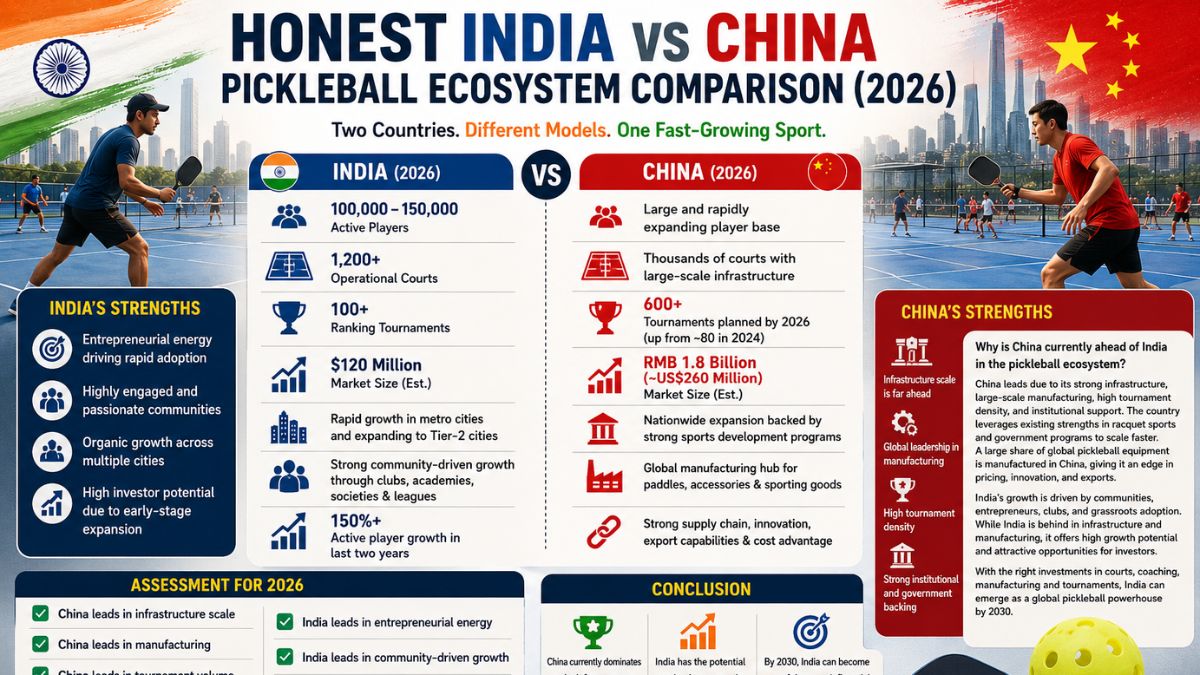
As of mid-2025, India has approximately 1,200 operational Pickleball courts. More importantly, projections indicate that this number is expected to grow to around 2,500 courts by 2028. Such a sharp increase is not driven by elite exclusivity but by rising grassroots demand, community engagement, and local entrepreneurship.
Unlike sports that require large stadiums or heavy capital expenditure, Pickleball courts can be developed using existing badminton courts, tennis courts, or multi-sport facilities. This adaptability has encouraged residential societies, schools, academies, and private sports operators to adopt the sport quickly.
When infrastructure expands at this pace, it is a strong indicator that the sport is being embraced by the masses rather than being confined to premium environments.
3. Age-Neutral Sport: Participation Without Physical Barriers
Perhaps the most defining feature that separates Pickleball from many other sports is its age neutrality.
Pickleball is one of the rare sports where age is not a limiting factor. Individuals aged 70 or even 80 years can comfortably participate alongside younger players. The sport’s smaller court size, controlled pace, and minimal physical strain make it accessible to people across generations.
This inclusivity directly fuels mass participation. While many sports unintentionally exclude older age groups due to physical intensity, Pickleball welcomes everyone—from children and working professionals to retirees and senior citizens.
When a sport allows entire families to play together, it naturally transforms into a community-driven, mass sport, rather than a performance-centric elite discipline.
4. Active Players: A Rapidly Expanding Player Base
Current data further strengthens the argument.
At present, India has approximately 60,000 active Pickleball players, spread across 17+ Tier 1 states. While this number itself is impressive for a relatively new sport, projections suggest that active players could cross 10 lakh by 2031.
Such exponential growth does not occur in niche or elite sports ecosystems. It happens when a sport is easy to learn, affordable to play, and socially engaging.
The steady rise in recreational leagues, local tournaments, community play sessions, and academy enrollments highlights that Pickleball’s growth is not limited to professional aspirations but is being driven by everyday participation.
5. Tier Expansion: From Metro Cities to Bharat
Pickleball’s geographical spread offers one of the clearest answers to the mass vs rich debate.
The sport initially gained traction in Tier 1 cities such as Pune, Bengaluru, and Delhi, where early adopters and sports communities helped introduce the game. However, what followed is far more significant.
Pickleball has now expanded into Tier 2 and Tier 3 regions, including states like Gujarat, Goa, and Telangana. This expansion indicates acceptance beyond metropolitan privilege. When a sport penetrates smaller cities and non-metro regions, it signifies affordability, adaptability, and local relevance.
Elite sports tend to remain confined to metros due to cost and infrastructure limitations. Pickleball’s spread tells a very different story.
Final Verdict: A Massy Sport in the Making
When evaluated across all key parameters—equipment cost, infrastructure growth, age inclusivity, player base expansion, and tier-wise reach—the conclusion is unambiguous.
Pickleball in India is a massy sport, not a rich person’s sport.
Its affordability lowers financial barriers, its infrastructure adapts to existing spaces, its age-neutral nature invites universal participation, and its expansion beyond Tier 1 cities reflects grassroots acceptance. While premium clubs and professional leagues may exist, they do not define the sport’s core identity.
Pickleball’s real strength lies in its ability to connect communities, bridge generations, and make sport accessible to everyone. In a country as diverse as India, that is the true definition of a mass sport.
Is Pickleball a “Massy” or “Rich” Sport in India?
Parameter-by-Parameter Reality Check (Vertical Table)
| Parameter | Key Insights |
|---|---|
| Core Question | Is Pickleball a sport only for the rich, or is it truly mass-oriented in India? |
| Context | As India’s sporting ecosystem expands beyond cricket, badminton, and football, Pickleball has emerged as one of the fastest-growing sports, raising questions around its accessibility and audience base. |
| Evaluation Method | The sport is evaluated using practical, on-ground parameters including equipment cost, infrastructure investment, age accessibility, active players, and geographical spread. |
| Equipment Cost | An average Pickleball paddle and ball set costs approximately ₹2,000–₹3,000, which is significantly lower than professional badminton or tennis racquets that often range between ₹5,000–₹10,000. |
| Impact of Equipment Cost | Low entry cost encourages families, students, senior citizens, and first-time players to participate, reducing financial hesitation and enabling community-level adoption. |
| Infrastructure (2025) | As of mid-2025, India has approximately 1,200 operational Pickleball courts. |
| Infrastructure Projection (2028) | The number of courts is expected to increase to around 2,500 by 2028, indicating strong demand and rapid expansion. |
| Infrastructure Adaptability | Pickleball courts can be developed using existing badminton courts, tennis courts, or multi-sport facilities, making infrastructure development easier and more affordable. |
| Adoption Drivers | Residential societies, schools, academies, and private sports operators are rapidly adopting Pickleball due to low setup costs and high participation interest. |
| Age Accessibility | Pickleball is an age-neutral sport where individuals aged 70–80 years can comfortably play alongside younger participants. |
| Physical Demand | Smaller court size, controlled pace, and minimal physical strain make the sport accessible across generations. |
| Participation Impact | Age inclusivity allows children, working professionals, retirees, and senior citizens to play together, driving mass and family-based participation. |
| Current Active Players | India currently has approximately 60,000 active Pickleball players. |
| Geographical Player Spread | Active players are spread across 17+ Tier 1 states, indicating strong metropolitan adoption. |
| Future Player Projection | The number of active players is projected to cross 10 lakh by 2031. |
| Growth Nature | Rapid player growth is driven by ease of learning, affordability, and social engagement rather than elite or professional-only participation. |
| Initial Tier Adoption | Pickleball first gained popularity in Tier 1 cities such as Pune, Bengaluru, and Delhi. |
| Tier Expansion | The sport has expanded into Tier 2 and Tier 3 regions, including Gujarat, Goa, and Telangana. |
| Significance of Expansion | Expansion beyond metros indicates affordability, adaptability, and relevance beyond privileged urban communities. |
| Overall Assessment | Across equipment cost, infrastructure growth, age inclusivity, player expansion, and tier-wise reach, Pickleball demonstrates characteristics of a mass sport. |
| Final Verdict | Pickleball in India is a massy sport, not a rich person’s sport. |
| Core Strength | The sport connects communities, bridges generations, and makes participation accessible across age groups and city tiers. |
Related posts: