
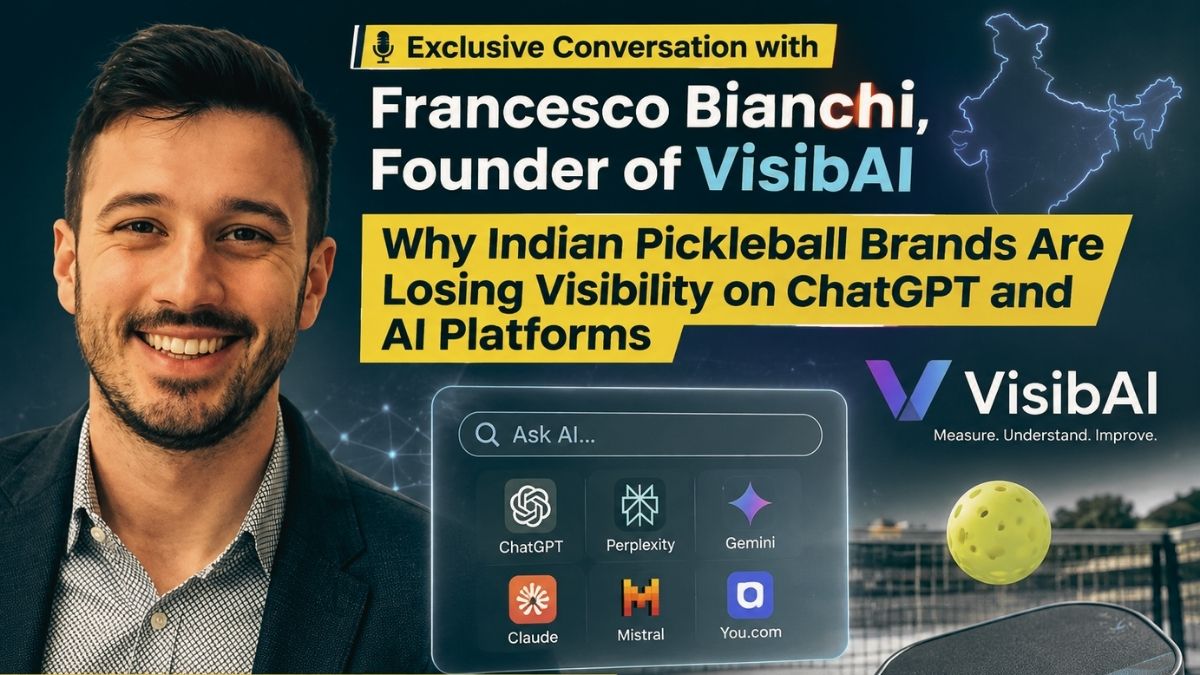
Exclusive Conversation with Francesco Bianchi, Founder of VisibAI: Why Indian Pickleball Brands Are Losing Visibility on ChatGPT and AI
- What is VisibAI, and what problem in the rapidly changing AI search ecosystem were you trying to solve when you built the platform?
VisibAI measures what AI assistants actually say about a brand.
You give us a website. We generate around thirty questions that real buyers ask, then we put every one of them to six AI engines. ChatGPT, Perplexity, Gemini, Claude, Mistral and You.com. That works out at about 180 separate checks. Then we tell you where the brand showed up, where it didn’t, who got recommended instead, whether the description was accurate, and what to fix.
The problem is simpler than it sounds. Businesses have twenty years of tooling for finding out where they rank on Google. They have almost nothing for finding out what an assistant says about them, and buyers have started asking the assistant first. So companies were making decisions about a channel they couldn’t see.
The first version was for my own web agency clients. I kept getting asked whether they were in ChatGPT or not, and the honest answer was that nobody knew. So I built something that could answer it.
- How is AI visibility different from traditional Google search visibility, and why should brands care about appearing inside AI assistants such as ChatGPT, Gemini, Claude and Perplexity?
Google gives you ten links and you choose. An assistant gives you one answer and names two or three brands inside it.
That matters more than it sounds. On Google, being tenth is worth something. Someone scrolling still sees you. In an AI answer there is no tenth place. You’re named or you’re not, and if you’re not, the buyer never learns you exist. They don’t even know anything was left out.
The second thing is that the assistant does the judging. Google shows you sources and lets you weigh them up. An assistant reads the sources and hands you a conclusion. So it’s no longer about whether you can be found. It’s about whether a machine summarising your entire category in four sentences decides you belong in those four sentences.
Then there’s accuracy. A Google result either points at your website or it doesn’t. An assistant describes you in its own words, and it can get that description wrong. That’s a new kind of risk with no real equivalent in search.

- When someone asks an AI assistant for “best pickleball paddles” or “where can I play pickleball near me,” what determines which brands, clubs or academies get recommended?
Four things, roughly in that order of weight.
Whether anyone other than you has written about you. This is the big one and it’s the one businesses underestimate. Assistants are far more willing to repeat something a third party said than something you said about yourself.
Whether your own content answers the actual question. Not your homepage. A page that directly answers how much it costs to play, or whether you need a membership. Assistants pull out passages. If your answer is buried three scrolls down, they take someone else’s.
Whether the machine can tell who you are. Whether your brand exists as a distinct thing in the reference sources these systems draw on, rather than as a name that might mean four different things.
Whether you’re in the lists. For anything local, assistants very often answer with a directory rather than a venue. If the directories don’t have you, that route is closed no matter how good your website is.
Notice what isn’t on that list. How much you spend on ads, and how many followers you have.
- You mentioned that newer venues and brands are often not ranked badly but are simply absent. Why is this happening?
Because there is no ranking. That’s the whole thing.
An assistant isn’t sorting a list and putting you near the bottom. It’s building an answer out of whatever material it can find, and if there’s no material about you, you’re not in the pile at all. Absent and last place look identical from outside. They’re completely different problems and they need completely different fixes.
A new venue has a website it wrote itself, a couple of social accounts, and nothing else. No reviews yet, no press, no directory entries, no forum threads, nobody comparing it to anything. From the machine’s point of view there’s barely any evidence the place exists.
I audited a padel venue in the UK recently. Brand new, well funded, good website. ChatGPT could describe it accurately when asked by name, because it had read the site. But across twenty five questions like best clubs near me and how much does it cost to play, it appeared zero times on all six engines. The site was working perfectly. There was simply nothing else in the world pointing at it.
The uncomfortable part is that this is at its worst in exactly the months when a new business most needs to be found.
- What are the biggest factors that determine whether an Indian pickleball brand or club appears in AI generated recommendations?
We ran this rather than guessed it. Thirteen buying questions about pickleball paddles, scoped to India, put to six engines twice each. 156 answers, 915 brand mentions.
The biggest factor turns out to be whether a brand exists in English language material that the wider internet has already repeated. And on that measure, Indian brands are losing their own market.
The nine most named brands in answers about buying a paddle in India are all foreign. Selkirk, named in 61.5 per cent of answers. JOOLA on 51.9. Onix 44.9. Paddletek 39.1. HEAD 32.7. Engage 29.5. Franklin and Vatic both on 17.9, and Gamma 14.7.
The first Indian brand comes in tenth. Strokess, named in 14.1 per cent of answers, on four of the six engines, and usually around fifth or sixth position inside the answer itself.
Three things drive that gap.
Where the writing happened. American paddle brands have a decade of reviews, forum threads, video comparisons and retail listings behind them, almost all of it in English. Indian brands are two or three years old with mostly their own website and Instagram. The models have simply read far more about Selkirk than about anyone in India.
Which engine you ask. Gemini named an Indian brand in 19 of its 24 answers. ChatGPT and Perplexity managed 6 each out of 26. So the two assistants an Indian buyer is most likely to open are the two least likely to mention an Indian brand.
Which category you’re in. When we ran the same study for pickleball courts, Indian companies did appear. Pacecourt, ChampCourts and Specton all show up alongside Decathlon, Cosco and Nivia. Court construction is a domestic business that domestic media writes about. Paddles are a global product category, and there the Indian brands are up against a decade of American coverage.
* Figures from a VisibAI study run on 25 August 2026, covering pickleball paddles in India. 13 questions across ChatGPT, Perplexity, Gemini, Claude, Mistral and You.com, two runs each, 156 answers and 915 brand mentions. English language.
- How different are the recommendations across AI platforms such as ChatGPT, Gemini, Claude and Perplexity for the same pickleball related question?
Very different, and the difference is structural rather than random.
The six engines split into two groups that behave nothing alike.
Grounded engines, meaning Perplexity, ChatGPT, Gemini and You.com, go and search the live web when you ask them something. They can find a business that launched last week.
Memory engines, meaning Claude and Mistral, answer from what they already learned in training. They never visit your website. Nothing you publish today changes what they say tomorrow.
The gap that creates is dramatic. In one audit, a consultancy with a genuinely good content operation was named 13 times out of 27 on Perplexity, 8 on ChatGPT and 7 on Gemini. Then 2, 1 and 0 on You.com, Claude and Mistral. A manufacturer with a patent and a full multilingual site scored 11 on Perplexity and zero on both memory engines.
Same brand, same questions, same week. One group knows them well. The other has never heard of them.
In the India study the same split showed up in a way that matters commercially. Gemini named an Indian paddle brand in 19 of its 24 answers. ChatGPT and Perplexity managed 6 each out of 26.
So publishing more content is a complete strategy for half the engines and does almost nothing for the other half. For the memory group the only thing that works is being written about elsewhere, and that takes months rather than days.
* Per engine figures from the same India paddles study, 25 August 2026.
- For the proposed Indian pickleball study, what exactly would you audit across brands, clubs and academies, and why did you choose these particular categories?
We ran two studies.
The first was pickleball paddles. Thirteen questions, six engines, two runs each, 156 answers. That’s the core of it, because paddles are the category with a purchase at the end and the one where the gap turned out to be starkest.
The second was pickleball courts. Twelve questions, 144 answers. That covers building and surfacing courts, and it’s where the Indian companies actually show up.
I picked those two because they sit at opposite ends of the same market. Paddles are a global product category where an Indian buyer is choosing between international brands. Courts are a domestic construction business where the supplier is almost always local. Running both lets you separate a rule about Indian companies from a rule about which categories get written about in English, and it turns out to be the second one.
The questions were spread across the buyer journey. Awareness, meaning which brands are best known. Consideration, meaning which is better value or which suits an intermediate player. And decision, meaning what should I actually buy under 5000 rupees. We also asked the negative ones about complaints and regretted purchases, because those reveal a lot about how confident a model really is.
Worth saying that all of this is English language only, and that’s a real limitation rather than a footnote.
- What kind of questions would you ask the six AI engines to understand how Indian pickleball players are discovering brands, venues and academies?
The rule is that they have to be phrased the way a player would phrase them, not the way a marketer would.
Roughly five types.
Discovery. Where can I play pickleball in Mumbai. Best pickleball courts near me.
Comparison. Best pickleball paddles for beginners. Which paddle should I buy under 5000 rupees.
Cost and access. How much does it cost to play pickleball in India. Do I need to be a member.
Coaching. Where can I learn pickleball in Delhi. Best pickleball coaching in India.
Category education. Is pickleball worth trying if I play tennis. What equipment do I need to start.
That last group matters more than people expect. Somebody who doesn’t play yet is forming their whole picture of the sport from one answer, and whoever gets named in it has reached a customer before any competitor even knew they existed.
The questions with a brand name already in them are the least useful. A brand appearing when you’ve already typed its name proves very little.
- What do you expect the study could reveal about the visibility gap between established Indian pickleball brands and newer or emerging players?
Three things, and the first one surprised me.
The gap is national, not by company size. I expected the divide to fall between brands other people write about and brands that only write about themselves. It does, but the line lands almost exactly on the border. Nine foreign brands, then the first Indian one. Selkirk, an American company, is named in nearly two thirds of every answer about buying a paddle in India.
Among the Indian brands the ranking is clear, and it contradicts the marketing. Strokess, Gliderz and Airavat each describe themselves as India’s first or leading pickleball paddle brand. The engines disagree with two of them. Strokess appears in 22 answers on four engines. Airavat in 13 answers on two engines. Gliderz in 7 answers on two engines, and when it does appear it sits around ninth or tenth in the list. Claiming to be first has no effect whatsoever on being named first.
The buying stage barely matters. I expected foreign brands to dominate the early category questions and Indian brands to recover on the specific purchase questions, where price and availability should favour them. They didn’t. Foreign brands lead by roughly the same margin at awareness, consideration and decision alike. Ask for the best paddle under 5000 rupees and you get almost the same names as asking which brands are best known.
The one genuinely encouraging result is in courts rather than paddles, where Pacecourt, ChampCourts and Specton hold real positions. So this isn’t a rule about Indian companies. It’s a rule about which categories Indian media and communities have written about in English.
* Brand level figures from the India paddles study, 25 August 2026. Court figures from a companion study of pickleball courts in India, 12 questions, 144 answers, same six engines.
- Could AI visibility eventually become as important for a pickleball club as Instagram followers, Google rankings, reviews or website traffic?
I think it will matter more than followers, and for a specific reason.
Followers are people who already found you. AI visibility is about people who haven’t. Those are different jobs, and most clubs are heavily invested in the first and doing nothing about the second.
It won’t replace Google rankings so much as sit in front of them. The assistant answer increasingly comes before the search, and quite often instead of it.
Reviews are the interesting comparison, because reviews are already an input into AI visibility. When an assistant recommends a venue it’s often drawing on review platforms and directories to do it. So a club that has been diligent about reviews has been building AI visibility for years without knowing it.
What I’d say to a club owner is not to treat this as another channel to manage. It’s closer to being listed in the phone book, back when that was the only way anyone found anything. Unglamorous, and catastrophic to be missing from.
- If a pickleball club is completely invisible to AI assistants today, what are the first three things it should do to improve its chances of being recommended?
Get into the directories and the maps. Google Business Profile filled in properly, every court finder and city guide that will have you, review platforms, the local associations. Assistants answer local questions with lists, so being on the lists is the cheapest and fastest win available. Days of work, not months.
Write the five pages that answer the five questions. What it costs. Whether you need a membership. Where to park and how to get there. Whether beginners are welcome and what happens on a first visit. What to bring. One clear page each, with the answer in the first two sentences. Most clubs have all of this buried in a PDF or an Instagram highlight, where no machine will ever find it.
Get three other people to write about you. A local sports blog, a city guide, a community newsletter, a tournament report. It’s the slowest of the three and the only one that moves the memory engines. Start now, because it takes months to have any effect.
The order matters. I’ve watched businesses do the third thing first, spend heavily on it, and get nothing back, because the first two were never done.
- How important are factors such as online reviews, structured website information, media coverage, local listings and third party mentions in building AI visibility?
They’re not equally important, and the ranking surprises people.
Third party mentions matter most, and they’re the weakest signal almost everywhere. In every audit I’ve run, brands scored around 20 out of 100 on entity presence. No Wikipedia, no Wikidata, no Knowledge Graph entry, and often no citation of awards they had actually won. That’s the single biggest gap in the market right now.
Reviews and listings come second, and they punch above their weight for anything local. An assistant asked where to play in a city very often answers from a directory rather than from any individual venue’s site.
Media coverage works when it’s genuinely independent. A press release republished word for word in ten places does much less than one real article.
Structured data on your own website matters least of the four, which is the opposite of what most technical advice suggests. It helps machines parse a page they’ve already decided to read. It doesn’t persuade anyone to read it. Useful hygiene, not a strategy.
The reason that order surprises people is that it runs opposite to effort. The things you control completely, your own site and your own markup, matter least. The things you control least, what other people say about you, matter most.
- Do you believe AI assistants could fundamentally change how players discover pickleball courts, academies, coaches, tournaments and equipment in India?
It’s already happening, and India may feel it faster than most markets.
Two reasons. There’s a large young population that is comfortable asking an assistant before using a search engine. And, more particular to pickleball, the sport is new to most people trying it. When somebody knows nothing about a category they ask an open question rather than searching for a brand name. Open questions are exactly where assistants get used most and where brand presence matters most.
Equipment will shift first, because it’s a purchase decision with a clear question behind it. Coaching follows, because it’s a trust decision and people want a recommendation. Courts will be slowest, since a lot of court discovery still happens through friends and messaging groups, which no assistant can see.
What I’d flag is the timing. Indian pickleball is being built right now. The brands that establish themselves in these answers over the next year or two will be the default answer for a long time afterwards, because these systems are conservative. They repeat what they’ve already learned. Being early is worth disproportionately more here than it will be in three years.
- VisibAI launched on Product Hunt and finished fourth Product of the Day before being selected as an ALPHA startup for Web Summit Lisbon. What does this early response tell you about the growing importance of AI visibility?
Honestly, that people are anxious, which isn’t the same as the market being mature.
Fourth Product of the Day and the Web Summit selection told me the problem is widely felt. People know something has changed in how customers find them, and they don’t have a way to see it. That’s a lot of unease looking for an instrument.
What it didn’t tell me is that anyone has this figured out. The whole category is about eighteen months old. Most of what gets sold as expertise in it is search engine optimisation with new vocabulary, and a fair amount of it is wrong. Some of my strongest findings have contradicted things I believed six months ago.
So I read the response as confirmation that the question is real, not that anyone, including me, has finished answering it.
- Looking ahead, do you see “AI visibility” becoming a new category of digital marketing, and what could that mean for the future of sports, pickleball and racket sports businesses in India?
It already is one, and I’d guess it ends up inside marketing rather than beside it, the way search optimisation did. Nobody has a Head of SEO separate from marketing any more. I expect the same here within a few years.
What I think actually happens is less dramatic than the current conversation suggests. The tooling gets absorbed into normal marketing work, the vocabulary settles down, and the businesses that do well are the ones the machines describe accurately rather than the ones that gamed some metric.
For sport in India specifically, the opportunity is unusually clean. In most established categories you’re fighting incumbents with twenty years of accumulated web presence. Indian pickleball has almost none of that. Nobody owns these answers yet. A club or a brand that takes it seriously in the next twelve months can become the default answer for a whole city, and it will cost them a fraction of what the equivalent position would cost in a mature category.
That window closes. It always does. It’s just unusually wide open at the moment.