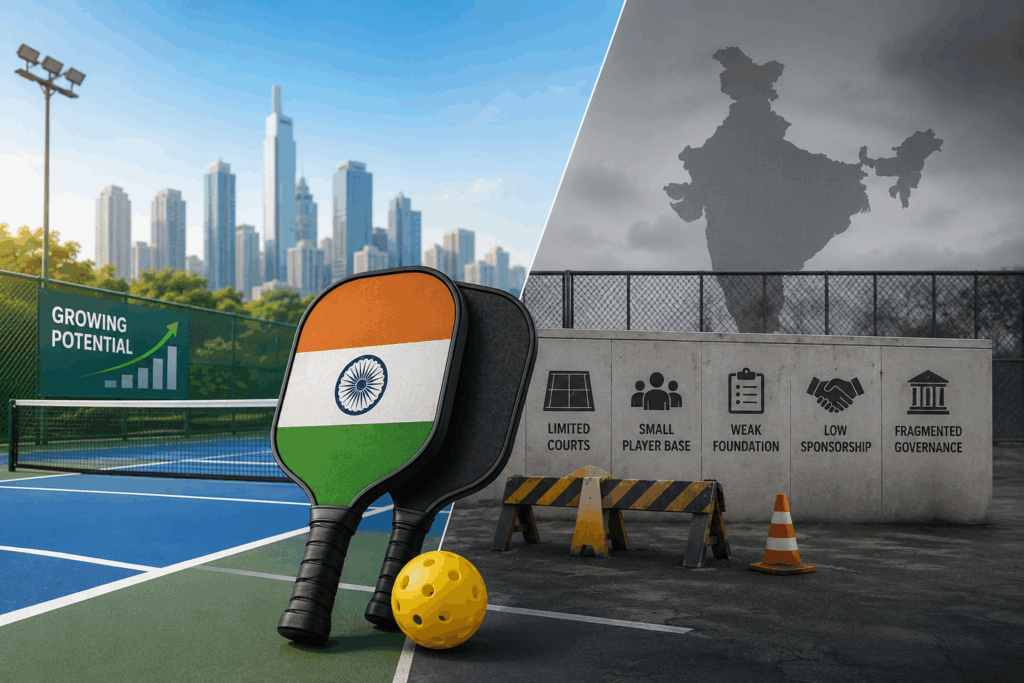
Reasons Why India is still Behind When it comes to Building Pickleball Ecosystem in 2026
From the United States to Europe and parts of Asia, the sport has rapidly transformed from a recreational activity into a serious competitive and commercial ecosystem. In India too, pickleball has started gaining visibility through celebrities, influencers, startups, and urban sports communities. New courts are opening, tournaments are increasing, and social media conversations around the sport are stronger than ever before.
However, despite all the excitement, India is still far behind when it comes to building a complete and sustainable pickleball ecosystem in 2026.
The biggest reason is simple — the growth of the sport is happening much faster than the development of the systems required to support it.
- Infrastructure Is Still Extremely Limited
One of the biggest challenges is infrastructure. India currently has an estimated 1,200 to 2,500 pickleball courts across the country.
While in United States of America they have already surpassed more than 85,000+ courts so far.
Most Indian courts are concentrated in metro cities such as Mumbai, Bengaluru, Delhi, Hyderabad, Pune, and Chennai. Smaller cities and rural regions still have very little access to the sport. In many places, players are forced to use converted badminton or tennis courts instead of dedicated pickleball facilities.
Without large-scale infrastructure expansion, it becomes difficult to create a strong participation base.
2. India’s Player Base Is Still Small
India’s pickleball community is growing rapidly, but the overall player base is still limited. Current estimates suggest India has around one lakh active pickleball players, while the United States has more than 2.4 crore players.
This difference matters because a larger player base creates stronger competition, better talent development, larger tournaments, and greater commercial opportunities. In India, pickleball is still seen as an urban lifestyle sport rather than a mainstream sporting movement.
The sport currently attracts mostly corporate professionals, fitness enthusiasts, and upper-middle-class communities. Reaching schools, colleges, smaller towns, and grassroots athletes remains a major challenge.
3. Grassroots Development Is Weak
Most schools and universities do not include pickleball in their sports curriculum. There are very few inter-school or inter-college tournaments. Unlike cricket, badminton, or even kabaddi, young athletes rarely get introduced to pickleball at an early age.
This creates a major development gap because long-term athlete growth depends heavily on junior participation. Countries with strong sports systems invest in youth pathways, coaching programs, rankings, and school competitions. India is still at a very early stage in this area.
4. Lack of Certified Coaches and Sports Science
Another major issue is the shortage of trained coaches. India currently has very few certified pickleball coaches compared to more established sports like badminton or tennis.
The ecosystem also lacks sports science support such as nutrition experts, physiotherapists, data analysts, mental conditioning specialists, and recovery systems specifically designed for pickleball athletes.
Without professional coaching pipelines, India may struggle to produce world-class players consistently.
5. Sponsorship and Media Rights Are Still Small
Commercial growth is another area where India is still behind. Globally, pickleball has become a billion-dollar industry attracting major investments, franchise leagues, and sponsorship deals. International celebrities and athletes have also invested heavily into professional pickleball leagues.
In India, however, sponsorship support is still relatively small and inconsistent. Most tournaments rely on local sponsors, community funding, or startup backing. Large sports broadcasters and mainstream advertisers are still cautiously observing the market.
The lack of strong television rights, streaming partnerships, and long-term brand investments slows down the ecosystem significantly.
6. Fragmented Governance Creates Confusion
One of the most discussed issues in Indian pickleball is governance. Multiple associations, competing bodies, and inconsistent tournament structures have created confusion among players, organizers, and investors.
A fragmented system affects rankings, player selection, sponsorship trust, and overall credibility. Investors and brands prefer stability before committing large amounts of money into any sport.
Without a unified vision and transparent governance model, long-term ecosystem building becomes difficult.
7. Celebrity Hype Alone Cannot Build a Sport
There is no doubt that celebrities and influencers have helped increase awareness around pickleball in India. Social media reels, exhibition matches, and celebrity participation have made the sport trendier among urban audiences.
But awareness alone is not enough to build a sustainable sports ecosystem.
Real ecosystem development requires:
structured academies
coaching systems
youth pathways
professional leagues
ranking structures
sponsorship stability
infrastructure growth
media coverage
athlete welfare programs
At the moment, India is still heavily dependent on hype rather than deep structural development.
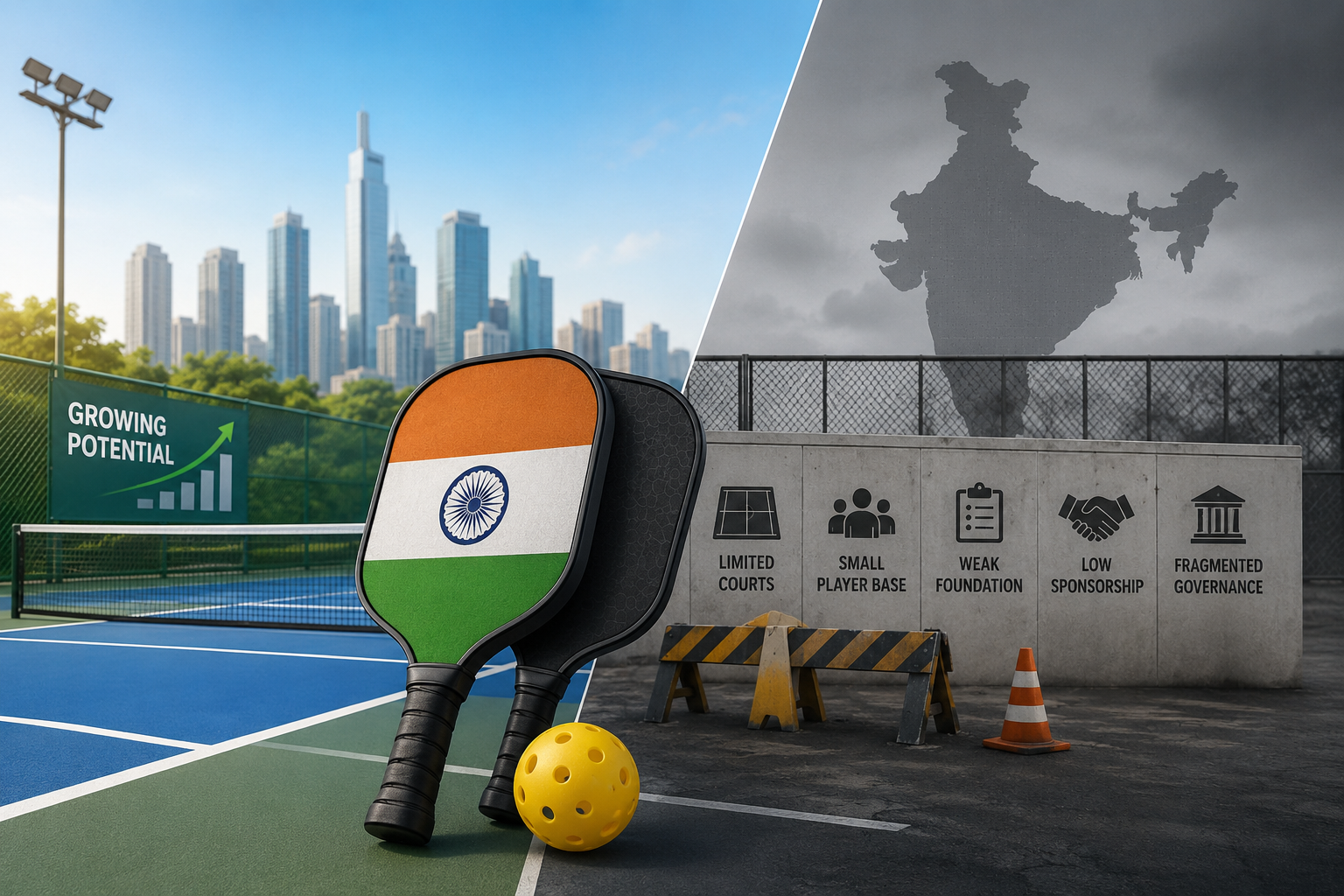
The Potential Is Still Massive
Despite all the challenges, India remains one of the fastest-growing pickleball markets globally. Industry estimates suggest annual growth rates of more than 150–200%, which shows enormous potential for the future.
India has a massive young population, growing fitness culture, increasing interest in alternative sports, and strong digital engagement. The sport is easy to learn, less physically demanding than some traditional racquet sports, and suitable for multiple age groups.
If India can improve infrastructure, governance, grassroots systems, and commercial planning over the next five years, pickleball could become one of the country’s biggest emerging sports industries.
The opportunity is huge.
The challenge now is execution.
| Category | India’s Current Situation (2026) | Global Benchmark / Challenge |
|---|---|---|
| Infrastructure | India has only around 1,200–2,500 pickleball courts mostly concentrated in metro cities like Delhi, Mumbai, Bengaluru, Hyderabad, Pune, and Chennai. | The United States has over 85,000+ courts, creating far wider accessibility and participation opportunities. |
| Player Base | India has an estimated 1 lakh active players. The sport is still limited largely to urban and upper-middle-class communities. | The United States has more than 2.4 crore players, creating stronger competition and a larger ecosystem. |
| Grassroots Development | Very few schools and colleges include pickleball in their sports programs. Limited junior tournaments and youth pathways exist. | Strong sporting nations invest heavily in school competitions, junior rankings, and structured athlete development systems. |
| Coaching Ecosystem | India has a shortage of certified pickleball coaches and limited professional training systems. | Mature ecosystems have large coaching networks, certification systems, and talent development pipelines. |
| Sports Science Support | Limited access to nutritionists, physiotherapists, mental conditioning experts, and performance analysts for pickleball athletes. | International athletes receive advanced sports science and recovery support for elite performance. |
| Commercial Growth | Sponsorships are still small and mostly dependent on startups, local sponsors, and community-backed events. | Globally, pickleball has evolved into a billion-dollar sports industry with franchise leagues and major investors. |
| Media Coverage | Limited television rights, streaming deals, and mainstream sports media attention. | International leagues receive strong broadcaster support and consistent digital streaming partnerships. |
| Governance Issues | Multiple associations and fragmented governing structures create confusion around rankings, tournaments, and player pathways. | Successful sports ecosystems operate under unified, transparent governance models that attract investors and sponsors. |
| Public Perception | Pickleball is often viewed as a lifestyle or recreational urban sport rather than a serious competitive sport. | In countries like the USA, the sport is now treated as both a recreational and professional sporting ecosystem. |
| Celebrity Influence | Growth is currently driven heavily by celebrities, influencers, and social media hype. | Sustainable ecosystems rely more on structured systems rather than temporary trends or hype cycles. |
| Tournament Structure | Tournament opportunities are growing but remain inconsistent across regions and categories. | Established ecosystems have structured national circuits, rankings, prize money systems, and professional tours. |
| Rural & Tier-2 Reach | Very limited penetration in Tier-2, Tier-3 cities, and rural India. | Leading countries have broad participation across regions, age groups, and communities. |
| Investment Stability | Investors are still cautious because the ecosystem lacks long-term structural clarity. | Mature sports markets attract stable private equity, franchise investments, and corporate partnerships. |
| Digital & Social Growth | Social media awareness and online engagement are growing rapidly in India. | While digital growth is positive, it still needs conversion into real participation and long-term infrastructure. |
| Future Potential | India is among the fastest-growing pickleball markets globally with 150–200% annual growth estimates. | The opportunity is massive if India improves governance, infrastructure, grassroots systems, and commercialization. |
Frequently Asked Question (FAQ)
Q1. Why is India still behind in building a complete pickleball ecosystem despite the sport growing rapidly in 2026?
India’s pickleball growth is currently being driven more by hype and urban popularity rather than deep structural development. While the sport has gained attention through celebrities, influencers, startups, and social media trends, the systems required to sustain long-term growth are still underdeveloped.
One of the biggest problems is limited infrastructure. India has only around 1,200–2,500 courts compared to over 85,000 courts in the United States. Most facilities are concentrated in metro cities, making accessibility difficult for players from smaller towns and rural regions.
Another major issue is weak grassroots development. Schools, colleges, and sports academies have not fully integrated pickleball into their programs, which limits junior participation and long-term athlete development. India also lacks certified coaches, structured ranking systems, sports science support, and stable governance models.
Commercially, the ecosystem is still evolving. Sponsorships, media rights, and broadcaster interest remain relatively small compared to global markets where pickleball has already become a billion-dollar industry.
Despite these challenges, India still has enormous potential because of its young population, rising fitness culture, and growing interest in alternative sports. If infrastructure, governance, grassroots programs, and investment strategies improve over the next few years, pickleball could become one of India’s biggest emerging sports industries.