
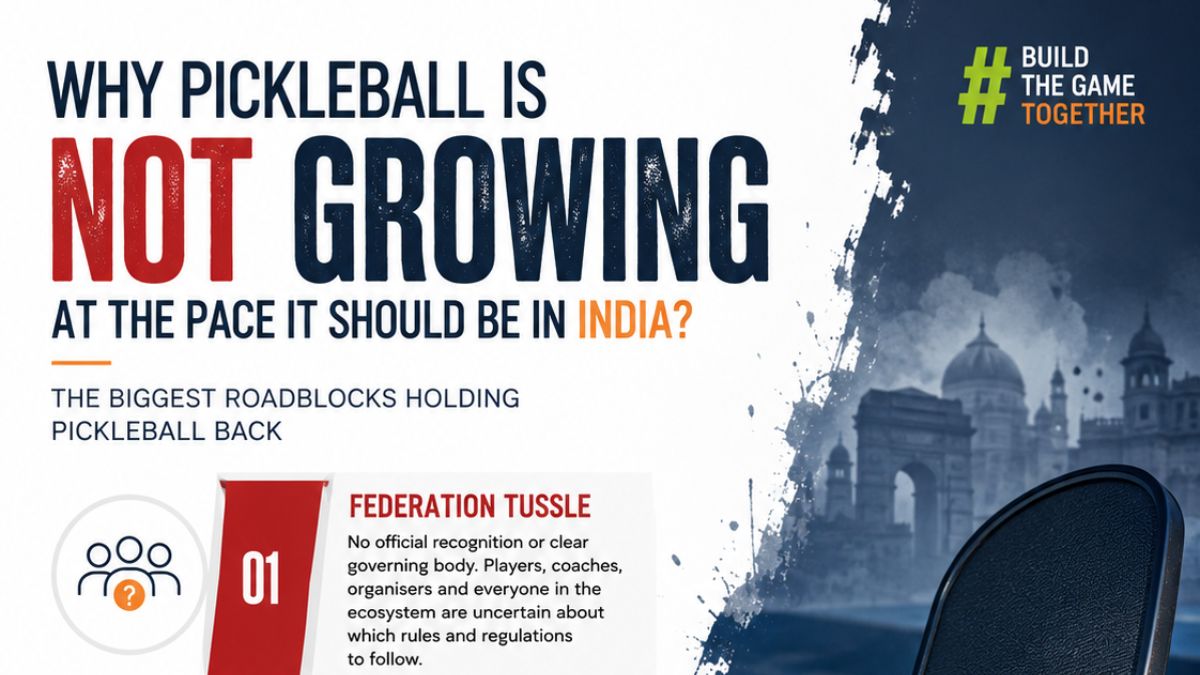
5 Major Reasons Why Pickleball Growth in India is Slowing Down in 2026
5 Biggest Reasons Which is Taking Indian Pickleball Backward in 2026 to be shared in the below format:
Here are the biggest reasons behind Pickleball’s slowdown in India 👇
1. Federation Tussle:
The biggest challenge right now is the lack of a clear governing structure.
Players, coaches, academies, and organisers still don’t know whose rules and system should actually be followed.
2. No Proper System in Place:
In 2026, there is still no defined pathway for a player to grow from grassroots to professional level.
No structured rankings, development pipeline, or long-term ecosystem.
3. Less Than 1% Media Coverage:
No sport can grow without visibility.
Pickleball barely gets coverage in mainstream or digital media, which means less awareness, fewer fans, and limited sponsor interest.
4. Middle-Tier Players Are Leaving:
Only a handful of top players are earning money.
Most mid-level athletes are self-funding their journey without enough sponsorships, prize money, or support systems — forcing many to quit the sport.
5. Overall Vision and Sustainability Missing:
When you look at Pickleball overall Vision is lacking and stakeholders should take responsiblity to make it one of the most popular entity when it comes to leagues no clear cut pathways have been laid out to carry forward it in better way.
Pickleball has massive potential in India.
But unless governance, media visibility, and player sustainability improve, growth will remain limited.
What do you think is the biggest challenge for Pickleball in India right now? Tell us in the comments we would love to read your comments
More Pointers in Detail:
1. Federation Tussle:
The biggest challenge right now is the lack of a clear governing structure.
Players, coaches, academies, and organisers still don’t know whose rules and system should actually be followed.
Different associations and governing bodies claiming authority over the sport have created confusion at every level. From tournaments to player registrations, rankings to certifications, there is no single unified system that everyone trusts and follows. This confusion directly impacts athletes because they are often unsure about which tournaments hold value for their future careers.
Sponsors and investors also hesitate to invest heavily in a sport where governance is still unclear. A stable federation structure is important for any sport to grow professionally. Without unity, the ecosystem becomes fragmented, and growth automatically slows down.
2. No Proper System in Place:
In 2026, there is still no defined pathway for a player to grow from grassroots to professional level.
No structured rankings, development pipeline, or long-term ecosystem exists for upcoming players who want to take Pickleball seriously as a career.
Unlike cricket, badminton, or even kabaddi, Pickleball still lacks district-level competitions, academy networks, junior development programs, and proper scouting systems. Most players enter the sport through private clubs or recreational setups rather than through an organised sporting structure.
There is also very little focus on coaching education and referee development. Without qualified coaches and standardised systems, the overall quality of the sport suffers. Young athletes need clarity about how they can progress from local tournaments to national and international stages, but currently that roadmap is still missing.
Until India builds a proper grassroots-to-pro pipeline, Pickleball will struggle to create long-term champions and sustainable growth.
3. Less Than 1% Media Coverage:
No sport can grow without visibility. Pickleball barely gets coverage in mainstream or digital media, which means less awareness, fewer fans, and limited sponsor interest.
Even though Pickleball is one of the fastest-growing sports globally, the Indian sports media ecosystem still gives very limited attention to it. Cricket dominates most sports conversations, while emerging sports continue fighting for space.
Most Pickleball tournaments in India receive little to no television coverage, and even digital storytelling around athletes is extremely limited. Fans cannot connect with players if they never hear their stories.
Media coverage plays a massive role in building sporting culture. When athletes become visible, brands follow, sponsorships increase, and youngsters become inspired to join the sport. Unfortunately, Pickleball in India still lacks consistent content creators, broadcasters, journalists, and influencers who can regularly push the sport into public conversations.
Without strong media backing, it becomes difficult to create fandom, attract investments, or generate long-term excitement around the sport.
4. Middle-Tier Players Are Leaving:
Only a handful of top players are earning money.
Most mid-level athletes are self-funding their journey without enough sponsorships, prize money, or support systems — forcing many to quit the sport.
This is one of the biggest silent problems within the Indian Pickleball ecosystem. While top players may receive some recognition, a majority of athletes struggle financially. They pay for travel, accommodation, equipment, coaching, and tournament expenses from their own pockets.
Over time, this becomes unsustainable. Many talented athletes eventually shift towards stable careers or other sports because they simply cannot afford to continue competing regularly.
A healthy sporting ecosystem always depends on a strong middle layer of players because they create depth, competition, and continuity. If only elite athletes survive while emerging players keep quitting, the sport cannot grow organically.
There is also limited corporate involvement at the domestic level. More leagues, sponsorship opportunities, scholarship programs, and athlete support systems are needed to retain talent within the sport.
5. Overall Vision and Sustainability Missing:
When you look at Pickleball overall, the long-term vision is still lacking and stakeholders should take responsibility to make it one of the most popular sporting properties in India.
No clear-cut pathways have been laid out to carry the sport forward in a structured and sustainable way.
Many tournaments are happening independently, but there is still no unified long-term mission focused on building the sport over the next 10–15 years. Questions around infrastructure, grassroots expansion, coaching systems, league sustainability, sponsorship growth, and international competitiveness still remain unanswered.
India has huge potential because Pickleball is easy to learn, affordable compared to several racquet sports, and suitable across different age groups. It can become a major recreational as well as competitive sport if the ecosystem works together with a shared vision.
Schools, colleges, private academies, brands, and media companies all need to collaborate to create a stronger foundation. Corporate leagues, university competitions, regional championships, and youth development programs can significantly improve participation levels.
Another important issue is infrastructure. Dedicated Pickleball courts are still limited in many cities, and most players rely on temporary converted courts. Without proper infrastructure expansion, participation growth will remain restricted.
At the same time, India needs more professional storytelling around the sport. Fans connect emotionally with athletes when they understand their journeys, struggles, and achievements. Building sports heroes is equally important for long-term popularity.
Pickleball has massive potential in India.
But unless governance, media visibility, infrastructure, and player sustainability improve, growth will remain limited.
What do you think is the biggest challenge for Pickleball in India right now?
| Topic | Detailed Explanation |
|---|---|
| 1. Federation Tussle | The biggest challenge right now is the lack of a clear governing structure. Players, coaches, academies, and organisers still don’t know whose rules and system should actually be followed. Different associations and governing bodies claiming authority over the sport have created confusion at every level. From tournaments to player registrations, rankings to certifications, there is no single unified system that everyone trusts and follows. This confusion directly impacts athletes because they are often unsure about which tournaments hold value for their future careers. Sponsors and investors also hesitate to invest heavily in a sport where governance is still unclear. A stable federation structure is important for any sport to grow professionally. Without unity, the ecosystem becomes fragmented, and growth automatically slows down. |
| 2. No Proper System in Place | In 2026, there is still no defined pathway for a player to grow from grassroots to professional level. No structured rankings, development pipeline, or long-term ecosystem exists for upcoming players who want to take Pickleball seriously as a career. Unlike cricket, badminton, or even kabaddi, Pickleball still lacks district-level competitions, academy networks, junior development programs, and proper scouting systems. Most players enter the sport through private clubs or recreational setups rather than through an organised sporting structure. There is also very little focus on coaching education and referee development. Without qualified coaches and standardised systems, the overall quality of the sport suffers. Young athletes need clarity about how they can progress from local tournaments to national and international stages, but currently that roadmap is still missing. Until India builds a proper grassroots-to-pro pipeline, Pickleball will struggle to create long-term champions and sustainable growth. |
| 3. Less Than 1% Media Coverage | No sport can grow without visibility. Pickleball barely gets coverage in mainstream or digital media, which means less awareness, fewer fans, and limited sponsor interest. Even though Pickleball is one of the fastest-growing sports globally, the Indian sports media ecosystem still gives very limited attention to it. Cricket dominates most sports conversations, while emerging sports continue fighting for space. Most Pickleball tournaments in India receive little to no television coverage, and even digital storytelling around athletes is extremely limited. Fans cannot connect with players if they never hear their stories. Media coverage plays a massive role in building sporting culture. When athletes become visible, brands follow, sponsorships increase, and youngsters become inspired to join the sport. Unfortunately, Pickleball in India still lacks consistent content creators, broadcasters, journalists, and influencers who can regularly push the sport into public conversations. Without strong media backing, it becomes difficult to create fando |
Related posts:
 Pickleball Markets: How Big is Pickleball Market in Delhi and Mumbai?
 Why Pickleball Emerges As 2nd Most Popular Sport in Indian After Cricket?
 Pickleball OTT and Television Broadcast Features in India: What the Next One Year Looks Like?
 3 Best Pickleball Paddles Under ₹2000 in India ? Let’s Explore in Detail