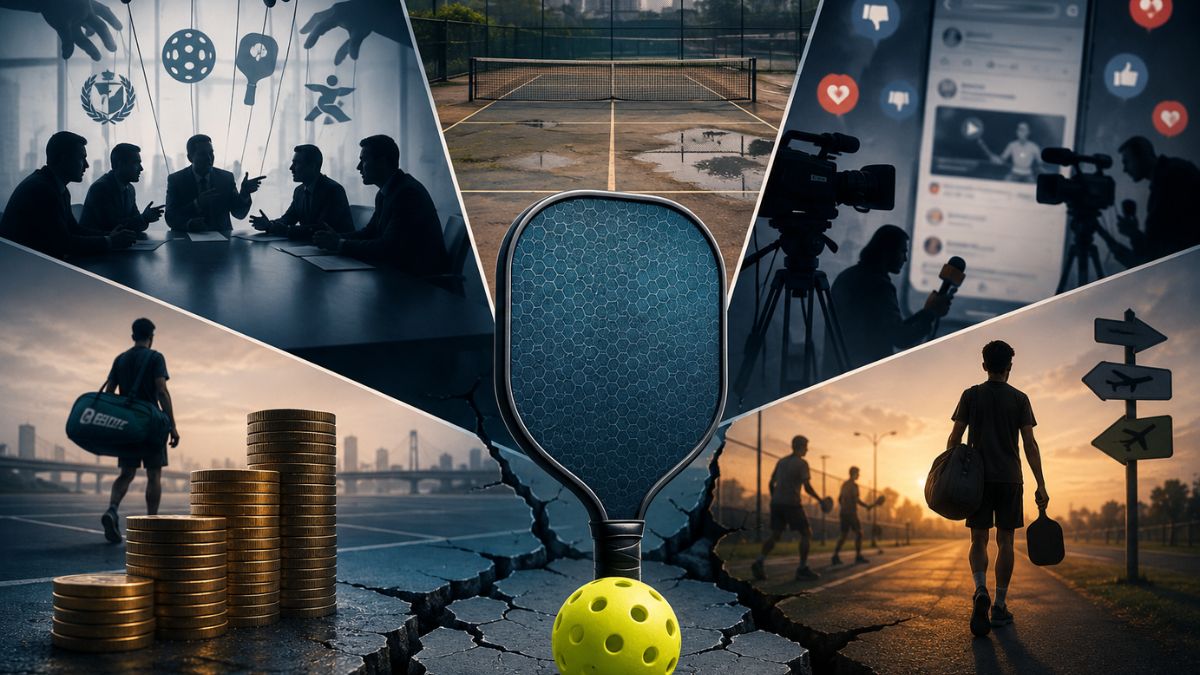
Pickleball in India have exponentially rose in last few years and credit should be given to all stakeholders who have worked behind the scenes to make this entity extremely popular.
However the game certainly picked up initially still struggling with challenges across many levels due to which it couldn’t become the sport which has to offer.
Here are the 5 biggest reasons why Pickleball is still struggling to grow properly in India in 2026 to be shared in the below format:
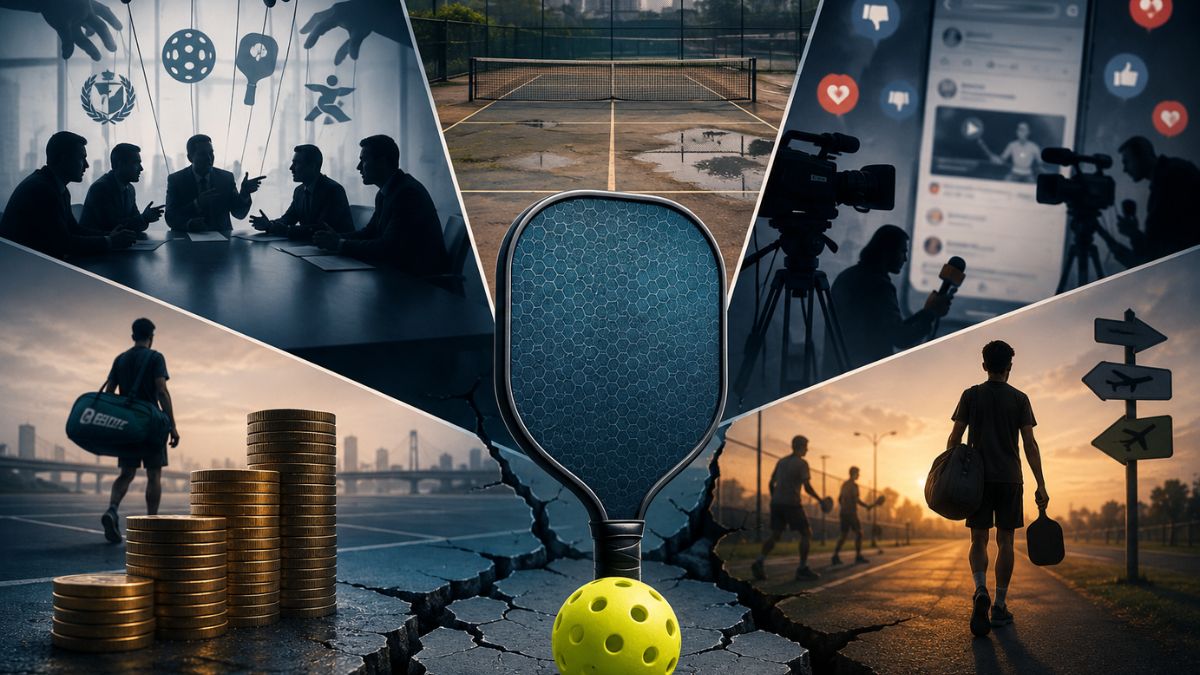
1. Federation Tussle & Lack of Unity:
One of the biggest problems hurting Indian Pickleball right now is the ongoing federation battle.
Different organizations are claiming authority over the sport, and because of this, players, coaches, tournament organizers, academies, and even sponsors remain confused about which structure to follow.
Instead of focusing on grassroots development, energy is getting wasted on internal politics, control battles, and recognition issues.
For any sport to grow professionally, there has to be one clear vision, proper governance, and long-term planning. Unfortunately, Pickleball in India is still struggling to achieve that stability in 2026.
2. No Structured Pathway for Players:
At the moment, there is still no proper roadmap for young athletes who want to build a career in Pickleball.
A player can start playing at a local court, but after that, the system becomes unclear.
There is no strong grassroots-to-professional pipeline, limited junior development programs, inconsistent rankings, and very few long-term athlete support systems.
In countries where sports grow rapidly, athletes know exactly how they can progress from beginner level to elite competition.
But in India, many talented Pickleball players are still dependent on self-learning, private funding, and random tournament participation without a clear future direction.
3. Less Than 1% Media Coverage:
No sport can become mainstream without media visibility.
Despite growing participation in metro cities, Pickleball still receives extremely limited coverage across television, newspapers, YouTube media pages, and sports broadcasters.
Most sports fans in India still don’t fully understand:
What Pickleball actually is
How it is played
Who the top Indian players are
Which tournaments are happening
Without regular storytelling, highlights, interviews, documentaries, and digital content, the sport struggles to create emotional connection with audiences.
And when visibility remains low, sponsorship opportunities also become limited.
4. Middle-Tier Players Are Leaving the Sport:
This is probably one of the most worrying signs for Indian Pickleball.
Only a small percentage of top-level players are able to earn through sponsorships, coaching, or tournament winnings.
But hundreds of mid-level players are spending money from their own pockets for travel, equipment, coaching, and tournament participation.
There is still very little financial security in the ecosystem.
5. Infrastructure Growth is Still Limited:
Even though Pickleball courts are increasing in metro cities, access is still very limited compared to India’s population size.
For the sport to truly grow, India needs:
More affordable courts
School and college participation
Government support
Grassroots tournaments
Certified coaching programs
At present, the sport is still heavily urban-focused, which limits large-scale participation across Tier-2 and Tier-3 cities.
Pickleball definitely has huge potential in India because the sport is easy to learn, social, engaging, and suitable for all age groups.
| Topic | Details |
|---|---|
| Federation Tussle & Lack of Unity | One of the biggest problems hurting Indian Pickleball is the ongoing federation battle. Different organizations are claiming authority over the sport, creating confusion among players, coaches, academies, organizers, and sponsors about which structure and rules should actually be followed. Instead of focusing on grassroots growth, energy is being wasted on politics, recognition issues, and control battles. The sport still lacks one clear vision, stable governance, and long-term planning. |
| No Structured Pathway for Players | There is still no proper roadmap for athletes who want to build a serious career in Pickleball. A player may begin at the local level, but the progression system after that remains unclear. India currently lacks a strong grassroots-to-professional pipeline, consistent rankings, junior development systems, and long-term athlete support. Many players are dependent on self-learning, private funding, and random tournaments without a clear future direction. |
| Less Than 1% Media Coverage | Pickleball continues to receive extremely limited media coverage across television, newspapers, YouTube pages, and mainstream sports broadcasters. Most Indian sports fans still do not fully understand what Pickleball is, how it is played, who the top players are, or which tournaments are taking place. Without proper storytelling, highlights, interviews, and digital content, the sport struggles to build fan engagement and emotional connection. Low visibility also affects sponsorship opportunities. |
| Middle-Tier Players Are Leaving the Sport | Only a small number of top-level players are currently earning through sponsorships, coaching, or tournament prize money. Meanwhile, many mid-level athletes are spending their own money on travel, coaching, equipment, and tournament participation. The ecosystem still lacks financial stability and support systems, forcing many talented players to quit the sport and focus on other career options. |
| Infrastructure Growth is Still Limited | Although Pickleball courts are increasing in metro cities, access remains very limited compared to India’s population size. Most quality facilities are concentrated in private clubs and urban centers. For the sport to grow properly, India needs more affordable courts, school and college participation, government support, grassroots tournaments, and certified coaching programs. Currently, the sport remains heavily urban-focused, limiting growth across Tier-2 and Tier-3 cities. |
Frequently Asked Questions (FAQs)
Q1. Why is Pickleball still struggling to grow properly in India despite being one of the fastest-growing sports globally?
Answer:
Pickleball is definitely growing in India, especially in metro cities where new courts, academies, and local tournaments are increasing every year. The sport is easy to learn, highly social, and suitable for all age groups, which makes it attractive for beginners and recreational players.
However, when it comes to building a proper professional ecosystem, several challenges are slowing down its overall growth in 2026.
The biggest issue remains the lack of a unified governing structure. Multiple organizations are trying to control the sport, creating confusion among players, coaches, academies, and tournament organizers. Without one clear system, long-term planning becomes extremely difficult.
Another major challenge is the absence of a proper grassroots-to-professional pathway. Young athletes still do not know how they can move from beginner level to national and international competition. Rankings, development programs, coaching systems, and athlete support structures are still evolving slowly.
Media visibility is also a big concern. Compared to cricket, badminton, or kabaddi, Pickleball receives very little coverage across television and mainstream sports media. Most Indians still do not fully understand the sport, which directly impacts sponsorships, investments, and fan engagement.
Infrastructure is improving, but access remains limited mainly to urban centers and premium clubs. For the sport to become truly mainstream, India needs more affordable courts, school participation, grassroots tournaments, and support from both government and private stakeholders.
Pickleball has massive potential in India, but unless governance, media visibility, infrastructure, and player sustainability improve together, the sport may continue to grow slower than expected.
Q2. What needs to happen for Pickleball to become a mainstream sport in India by 2030?
Answer:
For Pickleball to become a mainstream sport in India by 2030, the focus must shift from short-term hype to long-term ecosystem building.
The first and most important step is having one clear and stable governing body that can bring structure, transparency, and long-term planning into the sport. Stability at the top will help players, sponsors, academies, and investors feel more confident about the future.
The second step is grassroots expansion. Schools, colleges, residential communities, and local sports clubs must actively introduce Pickleball because participation is the foundation of every successful sport. India has a huge young population, and increasing access at grassroots level can completely change the sport’s future.
Media and content will also play a huge role. Sports today grow through storytelling, digital engagement, creators, influencers, and live broadcasts. Pickleball needs regular highlights, interviews, documentaries, athlete stories, and consistent social media presence to build fan interest.
At the same time, player sustainability must improve. More sponsorships, better prize money, professional leagues, and athlete support systems are necessary so players can continue playing competitively without financial pressure.
Infrastructure development is equally important. More affordable courts across Tier-2 and Tier-3 cities can help the sport move beyond metro audiences and create larger participation numbers.
If all these areas improve together — governance, media visibility, grassroots participation, infrastructure, and athlete support — Pickleball can genuinely become one of India’s biggest emerging sports by the end of this decade.
| Frequently Asked Question | Answer |
|---|---|
| Q1. Why is Pickleball still struggling to grow properly in India despite being one of the fastest-growing sports globally? | Pickleball is definitely growing in India, especially in metro cities where new courts, academies, and local tournaments are increasing every year. The sport is easy to learn, highly social, and suitable for all age groups, making it attractive for beginners and recreational players. However, when it comes to building a proper professional ecosystem, several challenges are slowing down its growth in 2026. The biggest issue remains the lack of a unified governing structure. Multiple organizations are trying to control the sport, creating confusion among players, coaches, academies, and tournament organizers. Another major challenge is the absence of a proper grassroots-to-professional pathway. Young athletes still do not know how they can move from beginner level to national and international competition. Media visibility is also a big concern because Pickleball receives very little coverage compared to cricket, badminton, or kabaddi. Infrastructure is improving, but access remains limited mainly to urban centers and premium clubs. For the sport to become mainstream, India needs more affordable courts, school participation, grassroots tournaments, and support from both government and private stakeholders. |
| Q2. What needs to happen for Pickleball to become a mainstream sport in India by 2030? | For Pickleball to become a mainstream sport in India by 2030, the focus must shift from short-term hype to long-term ecosystem building. The first and most important step is having one clear and stable governing body that can bring structure, transparency, and long-term planning into the sport. The second step is grassroots expansion. Schools, colleges, residential communities, and local sports clubs must actively introduce Pickleball because participation is the foundation of every successful sport. Media and content will also play a huge role. Pickleball needs regular highlights, interviews, documentaries, athlete stories, and consistent social media presence to build fan interest. At the same time, player sustainability must improve through better sponsorships, prize money, professional leagues, and athlete support systems. Infrastructure development is equally important because more affordable courts across Tier-2 and Tier-3 cities can help the sport move beyond metro audiences. If governance, media visibility, grassroots participation, infrastructure, and athlete support improve together, Pickleball can genuinely become one of India’s biggest emerging sports by the end of this decade. |