One Biggest Learning India Can Take From the USA for Pickleball Growth
👉 They made Pickleball a community-first sport before making it a professional sport.
Pickleball is currently one of the fastest-growing sports in the world, and the United States has shown exactly how a sport can transform from a recreational activity into a billion-dollar ecosystem. While India has started embracing Pickleball at a rapid pace, there is one major lesson the country can learn from the American model — focus on participation before professionalism.
1. In the US, parks, schools, housing societies, clubs, and senior communities all embraced Pickleball together.
One of the biggest reasons behind Pickleball’s explosive growth in the USA is accessibility. The sport was not limited to elite athletes or professional academies in its early stages. Instead, it became a sport for everyone.
Public parks converted tennis courts into Pickleball courts. Schools introduced the sport to children because it was easy to learn and affordable to play. Housing societies and gated communities began installing courts for recreational purposes. Senior communities adopted the sport because of its low-impact nature and social environment. Clubs and local community centers started organizing friendly tournaments and weekend activities.
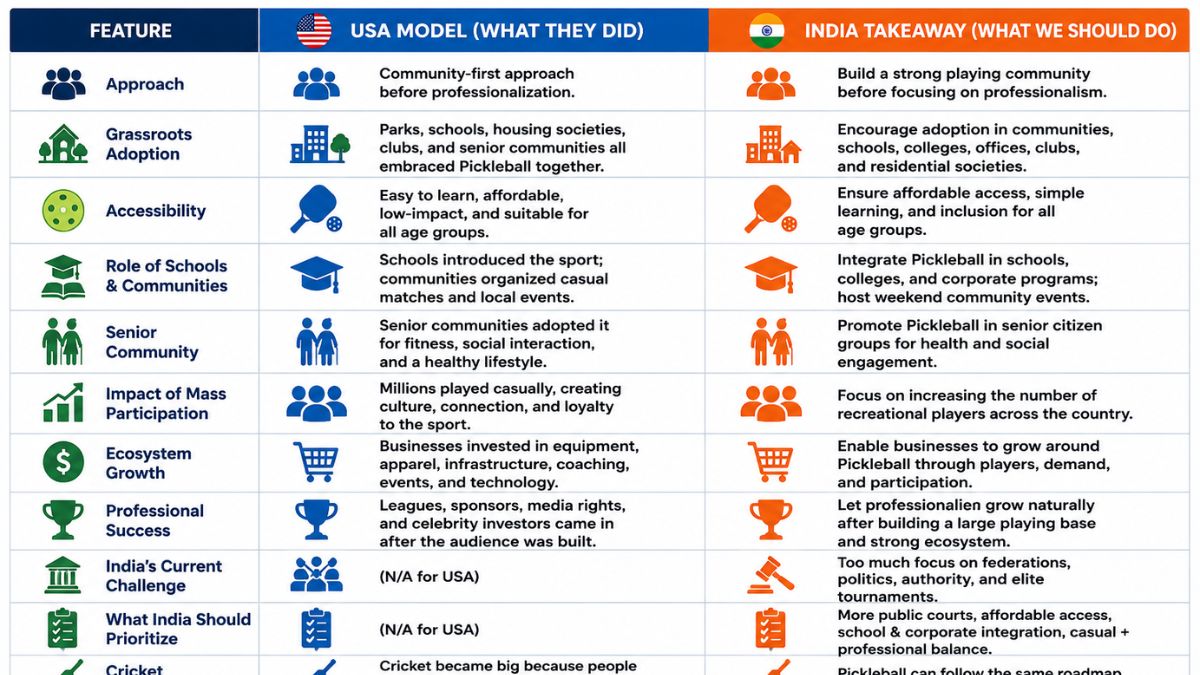
This grassroots acceptance created a strong emotional connection between the sport and the people. Pickleball in the US became more than just a game — it became a lifestyle and social activity.
2. That mass participation created culture, accessibility, and eventually a billion-dollar ecosystem.
The success of any sport depends on the size of its playing community. Before sponsorships, leagues, media rights, and professional tournaments arrive, a sport needs participants.
That is exactly what happened in the United States. Millions of people started playing Pickleball casually. As the number of players increased, businesses started investing in equipment, apparel, court infrastructure, coaching programs, events, and technology platforms around the sport.
Eventually, professional tournaments, celebrity investors, and global brands entered the ecosystem because the audience already existed.
The important takeaway here is simple:
Professional success followed grassroots participation — not the other way around.
3. India often focuses too early on federations, politics, and elite tournaments.
India has enormous potential to become a global Pickleball powerhouse. The country has a massive young population, growing interest in fitness culture, and a strong appetite for community-driven sports.
However, many emerging sports in India face a common problem:
Too much focus on governance battles, federation conflicts, and professional structures before building a strong playing base.
Instead of creating more accessible courts and encouraging recreational participation, conversations often revolve around tournaments, authority, and recognition.
But the real growth formula is simple:
✅ More public courts
✅ Affordable access
✅ Weekend community events
✅ School & corporate integration
✅ Casual + professional balance
India does not need thousands of elite athletes immediately.
It first needs millions of people picking up a paddle for fun.
Once participation increases, everything else — sponsorships, leagues, investments, media attention, and international success — will naturally follow.
4. Cricket became big because people played it everywhere first. Pickleball in India can follow the same roadmap.
The rise of cricket in India offers the perfect example.
Cricket did not become India’s biggest sport because of the IPL alone. It became dominant because generations of children played it in streets, schools, parks, terraces, and empty grounds long before professional leagues transformed it commercially.
The IPL succeeded because India already had a deep cricket-playing culture.
Pickleball has the opportunity to build something similar. The sport is easy to learn, highly social, affordable compared to many other sports, and suitable for all age groups. That makes it ideal for India’s urban communities, schools, fitness centers, and recreational clubs.
If more societies, schools, colleges, and local communities begin embracing Pickleball, the sport can grow exponentially over the next decade.
5. The country that wins the Pickleball race won’t just produce champions — it will produce players at scale.
The future of sports belongs to countries that can create participation ecosystems.
The nations leading in Pickleball tomorrow will not simply be the ones winning medals or hosting tournaments. They will be the countries where the sport becomes part of everyday culture.
India has the infrastructure potential, youth population, and digital reach to make Pickleball mainstream. But the priority should remain clear:
Build players first. Build communities first. Build accessibility first.
Champions will eventually emerge from that ecosystem naturally.
Pickleball’s future in India does not depend only on professional leagues.
It depends on whether ordinary people across cities, schools, offices, and neighborhoods start playing the sport consistently.
| Section | Key Insight | Explanation |
|---|---|---|
| Biggest Learning From USA | Community-first approach before professionalization | The USA focused on making Pickleball accessible to everyday people before building leagues, sponsorships, and professional structures. |
| USA’s Grassroots Model | Inclusive participation across communities | Parks, schools, housing societies, clubs, and senior communities all adopted Pickleball together, making it a mass-participation sport. |
| Accessibility Factor | Easy, affordable, and social sport | Public courts, low-cost equipment, and simple rules helped people of all age groups start playing quickly. |
| Role of Schools & Communities | Early adoption created strong culture | Schools introduced children to the game, while societies and local clubs organized casual matches and community events. |
| Senior Community Impact | Pickleball became a lifestyle activity | The low-impact nature of the sport made it highly popular among senior citizens, helping create long-term engagement. |
| Mass Participation Effect | Participation created ecosystem growth | Millions of recreational players eventually attracted businesses, sponsors, brands, coaches, and tournament organizers. |
| Business Growth in USA | Billion-dollar sports ecosystem | Increased player participation led to investments in equipment, apparel, infrastructure, events, and technology platforms. |
| Core Takeaway From USA | Grassroots first, professionalism later | Professional tournaments and celebrity investments succeeded because a large audience and playing culture already existed. |
| India’s Current Challenge | Early focus on governance and elite structures | Many discussions revolve around federations, authority, recognition, and professional tournaments instead of participation growth. |
| What India Should Prioritize | Build playing culture first | India should focus on increasing recreational participation before aggressively pushing elite competition structures. |
| Key Growth Areas for India | Accessibility-driven expansion | More public courts, affordable access, school integration, corporate participation, and weekend community events are essential. |
| Importance of Recreational Play | Casual participation builds sustainability | India does not need thousands of elite athletes immediately; it first needs millions of people playing casually. |
| Cricket Comparison | Cricket succeeded through widespread participation | Cricket became India’s biggest sport because it was played in streets, schools, parks, and neighborhoods long before IPL commercialization. |
| Pickleball’s Opportunity in India | Strong potential for mass adoption | The sport is easy to learn, social, affordable, and suitable for all age groups, making it ideal for urban India. |
| Long-Term Success Formula | Build players at scale | Countries leading Pickleball globally will be the ones creating large participation ecosystems rather than only producing champions. |
| India’s Advantage | Youth population + urban infrastructure | India has the demographics, digital reach, and growing fitness culture needed to make Pickleball mainstream. |
| Final Lesson | Communities create champions naturally | If India builds accessibility and participation first, sponsorships, leagues, media attention, and champions will eventually follow organically. |
Frequently Asked Question (FAQ)
Q. Why is the USA currently leading the global Pickleball revolution, and what can India learn from its growth model?
The United States is leading the Pickleball revolution because it focused on building a participation-driven ecosystem before turning the sport into a professional business. Instead of concentrating only on elite tournaments or governance structures, the USA made Pickleball accessible to ordinary people across parks, schools, local clubs, housing communities, and recreational centers. This helped millions of people experience the sport casually, creating a strong emotional and cultural connection with the game.
Once participation increased at the grassroots level, businesses naturally entered the ecosystem. Equipment brands, coaching academies, sports facilities, sponsors, media companies, and professional leagues all benefited from an already existing audience base. That is why Pickleball in the USA evolved into a billion-dollar sports industry within a short period.
India can learn an important lesson from this model. Rather than prioritizing federation battles or only elite competitions, the country should focus on increasing accessibility and community participation. More public courts, affordable infrastructure, school integration, corporate tournaments, and recreational events can help Pickleball become a mass-participation sport. If millions of Indians begin playing regularly, professional success, sponsorships, leagues, and international achievements will automatically follow over time.
| FAQ Topic | Detailed Answer |
|---|---|
| Question | Why is the USA currently leading the global Pickleball revolution, and what can India learn from its growth model? |
| USA’s Core Strategy | The United States focused on building a participation-driven ecosystem before turning Pickleball into a professional business. |
| Grassroots Development | Instead of concentrating only on elite tournaments or governance structures, the USA made Pickleball accessible across parks, schools, local clubs, housing communities, and recreational centers. |
| Public Participation Impact | Millions of people started playing Pickleball casually, which created a strong emotional, cultural, and social connection with the sport. |
| Accessibility Advantage | The sport became popular because it was affordable, easy to learn, and suitable for all age groups. |
| Business Ecosystem Growth | As participation increased, equipment brands, coaching academies, sports facilities, sponsors, and media companies naturally entered the ecosystem. |
| Professional Expansion | Professional leagues and tournaments succeeded because a large audience and playing culture already existed in the country. |
| Economic Outcome | Pickleball in the USA evolved into a billion-dollar sports industry within a short period due to massive grassroots participation. |
| India’s Key Learning | India should prioritize accessibility and community participation instead of focusing too early on federation battles or elite competitions. |
| Recommended Focus Areas for India | More public courts, affordable infrastructure, school integration, corporate tournaments, and recreational community events. |
| Long-Term Growth Formula | If millions of Indians begin playing Pickleball regularly, sponsorships, leagues, investments, and international success will naturally follow. |
| Final Takeaway | Community-first growth creates sustainable sports ecosystems, while professional success becomes a byproduct of mass participation. |