
How Much Do Pickleball Coaches Earn in India? 2026 Salary Breakdown & Reality Check
Pickleball is booming in India… but are coaches really making money?
The rise of pickleball across India has been nothing short of explosive. From premium clubs in metro cities to emerging setups in Tier-2 towns, the sport is clearly having its moment. Courts are filling up, brands are entering, and tournaments are increasing. But behind this visible growth lies a question that very few are honestly addressing — are pickleball coaches actually earning well in 2026?
Let’s decode the reality.
1. The Top Layer Looks Promising :
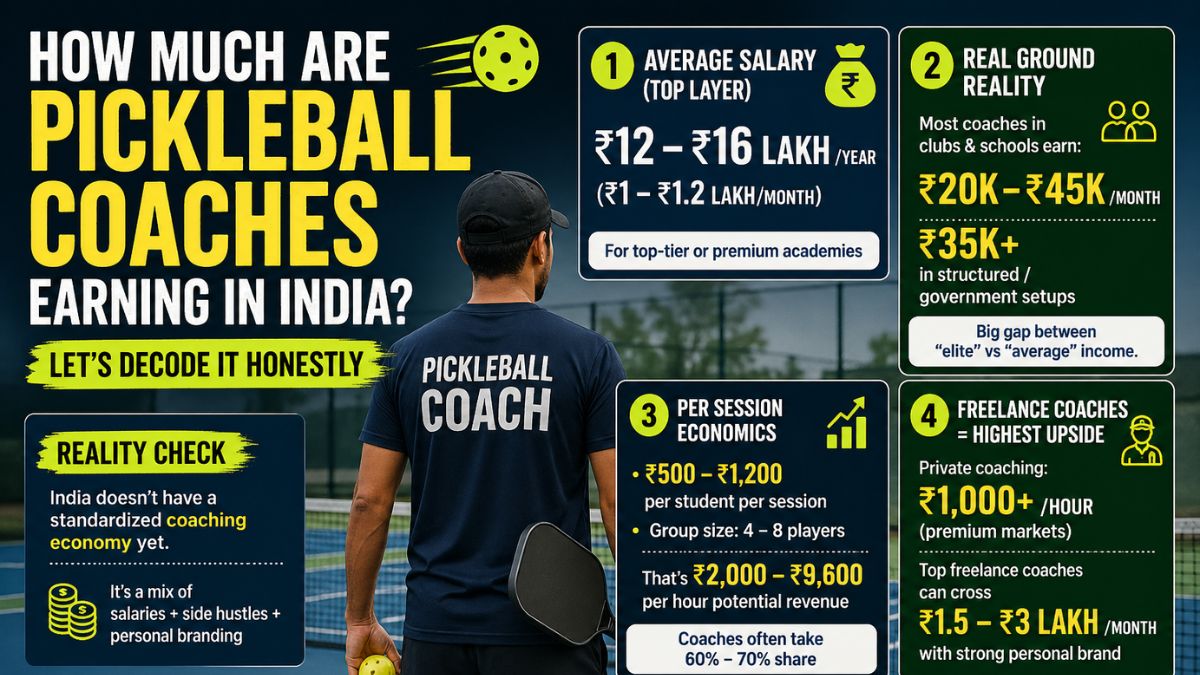
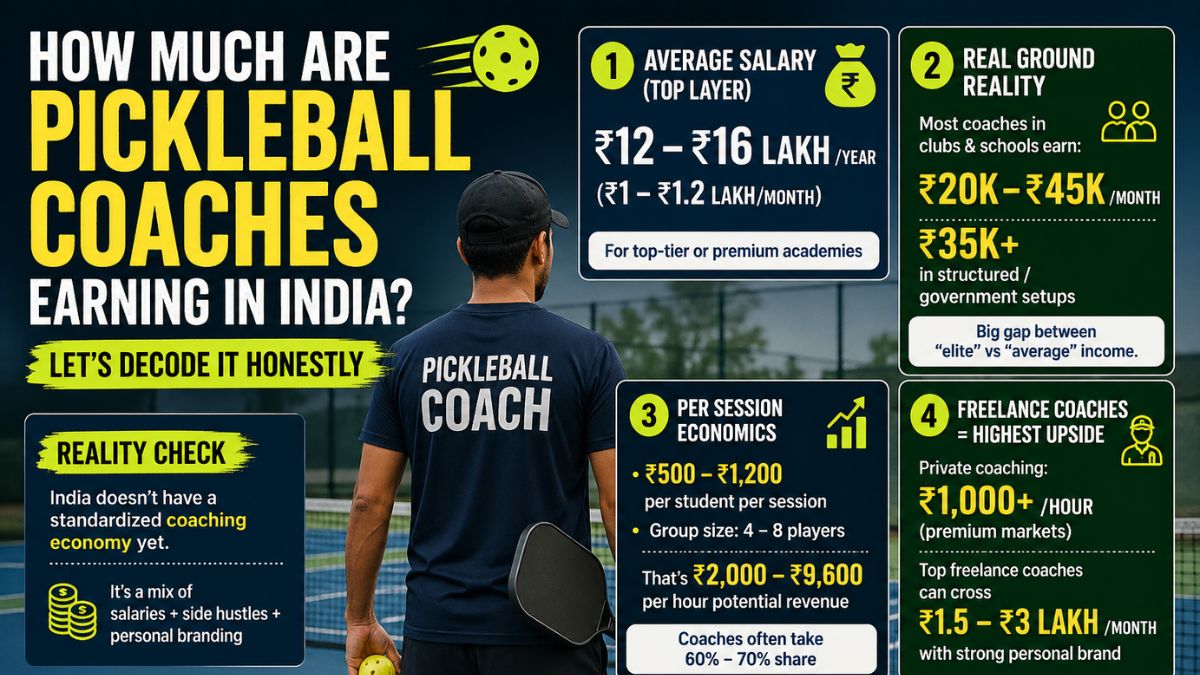
At the highest level, pickleball coaching in India can be quite lucrative. Full-time coaches working with premium academies, elite clubs, or high-end training setups are earning in the range of ₹12–16 lakh per year, which translates to approximately ₹1–1.2 lakh per month.
On paper, this looks like a strong income bracket, especially for a relatively new sport. These coaches often work in structured environments, have access to better facilities, and train players who can afford premium pricing.
However, this is just the top layer of the ecosystem — a small percentage of coaches who have either entered early, built credibility, or are associated with well-funded setups.
2. The Real Ground Reality :
For the majority of pickleball coaches in India, the situation is very different.
Most coaches working in local clubs, schools, or smaller facilities earn somewhere between ₹20,000 to ₹45,000 per month in fixed salary roles. In slightly more structured environments, such as government-supported programs or organized academies, earnings may go up to ₹35,000+ per month, but rarely beyond that without additional income streams.
This highlights a significant income gap between the elite and the average coach.
While the sport is growing, the financial stability for coaches is still inconsistent. Many are working long hours, handling multiple batches, and yet not seeing proportional financial rewards. This gap is one of the biggest structural challenges in the Indian pickleball ecosystem today.
3. Per Session Economics – Where the Real Money Is ??
Interestingly, the real earning potential in pickleball coaching does not come from fixed salaries — it comes from per-session coaching models.
Here’s how the math works:
Coaches typically charge ₹500 to ₹1,200 per student per session
Each group usually consists of 4 to 8 players
This means a single session can generate anywhere between ₹2,000 to ₹9,600 per hour.
However, coaches don’t keep all of this. Most facilities take a cut, and coaches usually earn around 60–70% of the total session revenue.
Even after the split, this model offers far more upside compared to fixed salaries — especially for coaches who can consistently fill batches and maintain retention.
This is why many smart coaches are moving towards hybrid models, combining fixed roles with session-based earnings.
4. Freelance Coaching = Highest Upside
The biggest earning potential in 2026 lies in freelance coaching and personal branding.
Independent coaches offering private sessions in premium markets charge ₹1,000 or more per hour, depending on their experience, reputation, and location.
Top freelance coaches — especially those who have built a strong personal brand through social media, content, or tournament visibility — are now earning between ₹1.5 lakh to ₹3 lakh per month.
This segment is still small but growing rapidly. It clearly shows that the future of pickleball coaching in India may not lie in traditional jobs, but in entrepreneurial coaching models.
Reality Check :
Despite all the growth, India still does not have a standardized coaching economy in pickleball.
There is no fixed pay structure, no universal certification-linked salary system, and no clear pathway for financial progression. As a result, most coaches are navigating a mix of:
Fixed salaries
Session-based income
Side hustles
Personal brand building
This lack of structure creates both uncertainty and opportunity at the same time.
The Real Opportunity :
The next wave of successful pickleball coaches in India will not just be trainers — they will be creators and builders.
They will:
Build personal brands on platforms like Instagram and YouTube
Launch their own academies or coaching programs
Create communities and engagement-driven ecosystems
In short, coaching alone may not be enough — ownership and visibility will define success.
Final Thought :
Pickleball in India is clearly on the rise, but the coaching ecosystem is still evolving.
The big question is:
Is pickleball coaching in India currently underrated… or is it financially unsustainable for the majority?
Your perspective matters.
Feel free to share your thoughts in the comments —
Let’s start an honest conversation around the future of coaching in Indian pickleball.
Indian Pickleball Coaches Earnings Breakdown (2026)
| Category | Earnings / Structure | Details | Reality Insight |
|---|---|---|---|
| Top Layer Coaches | ₹12–16 Lakh/year (₹1–1.2 Lakh/month) |
Full-time roles in premium academies & elite clubs | High income but limited to a small % of coaches |
| Majority Coaches (Ground Reality) | ₹20K – ₹45K/month ₹35K+ (structured setups) |
Club coaches, school setups, entry-level roles | Huge gap between elite vs average earnings |
| Per Session Model | ₹500 – ₹1,200 per student | Group size: 4–8 players | Core revenue model in the ecosystem |
| Hourly Revenue Potential | ₹2,000 – ₹9,600/hour | Based on group sessions | High earning potential if batches are full |
| Coach’s Share | 60% – 70% | Remaining goes to facility/academy | Real take-home depends on deal structure |
| Freelance Coaching | ₹1,000+/hour | Private coaching in premium markets | Highest flexibility & scalability |
| Top Freelancers Income | ₹1.5 – ₹3 Lakh/month | Strong personal brand & client base | Fastest-growing earning segment |
| Ecosystem Structure | No standardized system | Mix of salaries + sessions + side hustles | Still an unorganized market |
| Future Opportunity | Brand-led income | Personal brands, academies, communities | Coaches = Entrepreneurs |
Key Takeaway
| Insight |
|---|
| Pickleball coaching in India is not a fixed-income profession yet |
| Income depends heavily on location, network & personal branding |
| Freelancing + community building = highest upside |
1. Why is there such a big income gap among pickleball coaches in India?
The income gap mainly exists because the pickleball ecosystem in India is still in its early growth stage. There is no standardized salary structure or certification-based pay scale yet. Coaches working in premium academies or metro cities often earn more due to better-paying clients and higher participation levels. On the other hand, coaches in smaller clubs or Tier-2 cities depend heavily on fixed salaries, which are usually limited. Another key factor is personal branding—coaches who actively promote themselves on social media or build a strong network tend to attract higher-paying clients. In short, income is not just based on skill, but also on visibility, location, and opportunities.
2. Can pickleball coaching become a full-time sustainable career in India?
Yes, but with conditions. Pickleball coaching can become a sustainable full-time career if coaches diversify their income streams. Relying only on a fixed salary may not be enough in the current scenario. Successful coaches are combining group sessions, private coaching, and even online training to increase their earnings. Some are also building their own academies or partnering with sports facilities. The sport is growing rapidly, which means demand for coaches will increase in the coming years. However, those who adapt early by building a personal brand and strong client base will have a clear advantage over others.
3. What can coaches do to increase their income in pickleball?
To increase income, coaches need to think beyond traditional coaching roles. First, they should focus on building a personal brand through platforms like Instagram or YouTube to attract direct clients. Second, offering private coaching sessions can significantly boost earnings compared to group sessions alone. Third, creating structured training programs or beginner workshops can help in scaling income. Networking with clubs, schools, and corporate groups can also open new opportunities. Lastly, consistency in delivering quality training and maintaining player relationships plays a huge role in long-term financial growth.