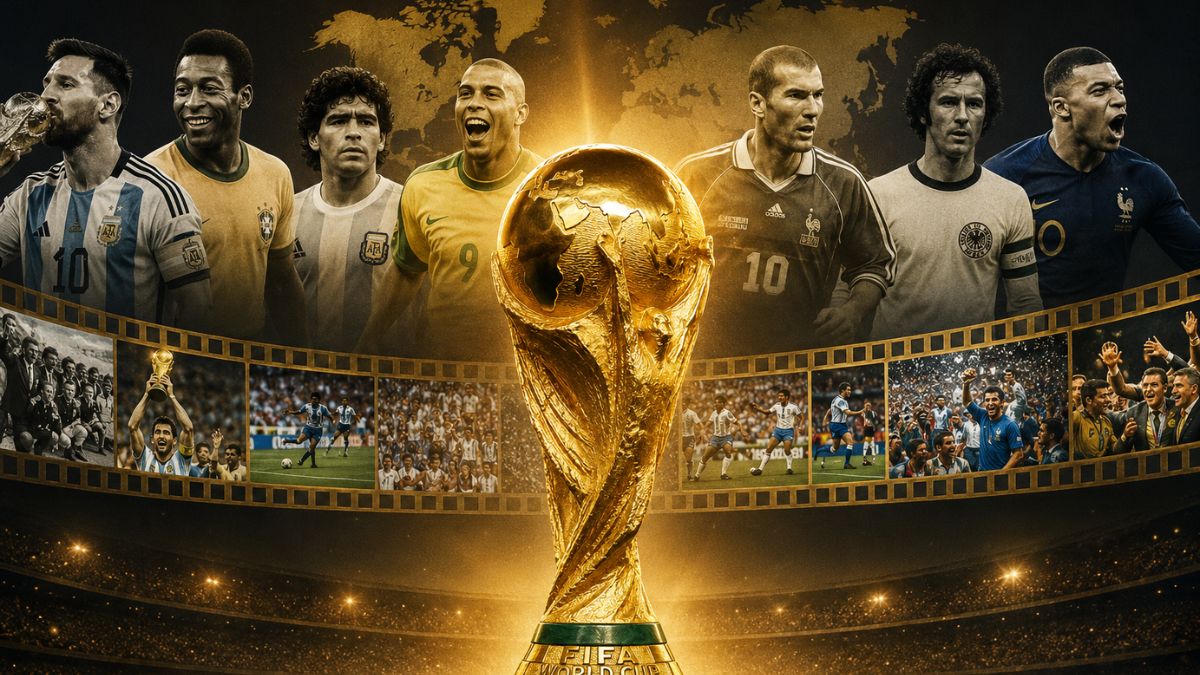
The FIFA World Cup is the most prestigious football tournament in the world and has shaped sporting history since its beginning in 1930. Played every four years, except during World War II in 1942 and 1946, the competition has produced unforgettable champions, legendary players, and historic moments that inspired billions of fans globally. From Uruguay’s triumph in the first edition to Argentina’s emotional victory in Qatar in 2022, the tournament has continued to grow into the biggest sporting spectacle on earth.
The inaugural FIFA World Cup started on July 13, 1930, in Uruguay. Only thirteen teams participated, and Uruguay defeated Argentina 4-2 in the final to become the first world champion. Italy then dominated the next decade, winning consecutive titles in 1934 and 1938 under coach Vittorio Pozzo. The competition was suspended during the Second World War before returning in 1950 in Brazil, where Uruguay stunned the hosts in the famous “Maracanazo” victory.
The 1954 tournament in Switzerland introduced West Germany as a football powerhouse after defeating Hungary in “The Miracle of Bern.” Brazil then entered a golden era by winning in 1958 and 1962, powered by the brilliance of Pelé, who became the youngest player to score in a World Cup final at just seventeen years old. England captured its only World Cup title in 1966 after defeating West Germany at Wembley Stadium in London.
Brazil lifted its third trophy in 1970 with one of the greatest teams ever assembled, including Pelé, Jairzinho, and Carlos Alberto. The victory allowed Brazil to permanently keep the Jules Rimet Trophy. West Germany won in 1974 with Franz Beckenbauer leading the side, while Argentina secured its first title in 1978 on home soil. Italy triumphed again in 1982, inspired by Paolo Rossi’s remarkable performances.
Argentina’s 1986 victory in Mexico remains iconic because of Diego Maradona, whose “Hand of God” goal and extraordinary solo strike against England became football folklore. West Germany reclaimed the trophy in 1990 before Brazil won its fourth title in the United States in 1994 through a penalty shootout against Italy. France celebrated its first triumph in 1998 on home soil as Zinedine Zidane starred in the final against Brazil.
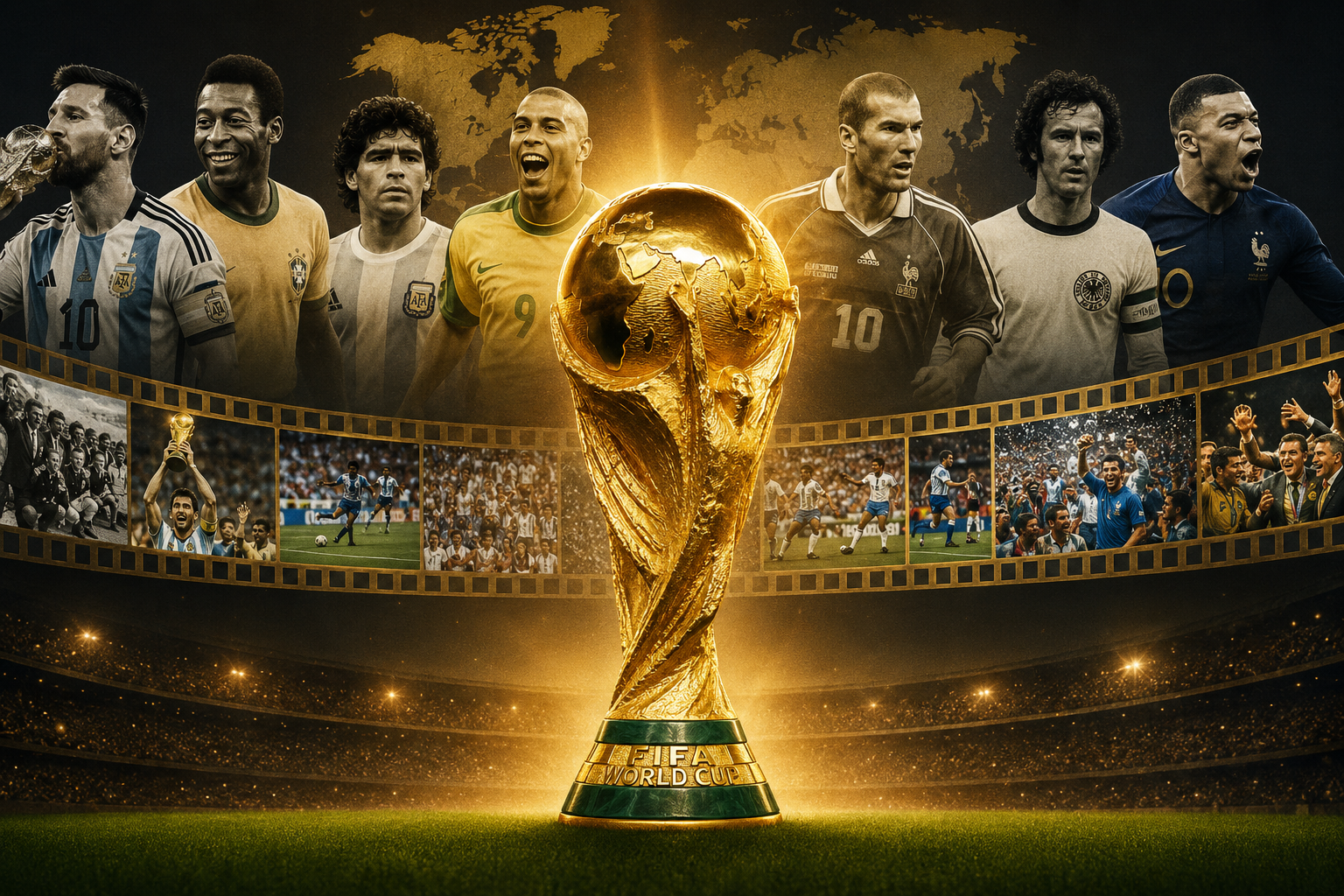
Brazil captured a record fifth title in 2002 in South Korea and Japan, the first World Cup hosted in Asia. Ronaldo finished as the top scorer and completed a remarkable comeback from injury. Italy secured its fourth crown in 2006 after defeating France in a dramatic final remembered for Zidane’s headbutt incident. Spain then won its maiden title in 2010, with Andrés Iniesta scoring the winning goal against the Netherlands in extra time.
Germany earned its fourth championship in 2014 after Mario Götze scored against Argentina in the final. The tournament also featured Germany’s unforgettable 7-1 semifinal victory over Brazil. France lifted its second title in 2018 behind Kylian Mbappé’s sensational rise, becoming only the second teenager after Pelé to score in a World Cup final. Argentina finally won its third World Cup in 2022 after defeating France in one of the greatest finals ever played, allowing Lionel Messi to complete football’s ultimate achievement.
Germany and Italy follow with four each, while Argentina now has three championships. Uruguay and France own two titles each, and England and Spain have won once. The World Cup has also created unforgettable individual milestones. Miroslav Klose holds the record for most goals with sixteen, while Lionel Messi holds the record for most appearances and match victories. Pelé remains the only player to win three World Cups, and Just Fontaine still owns the record for most goals in a single edition with thirteen in 1958.
The FIFA World Cup continues to unite nations, cultures, and generations through football. Every edition introduces new heroes, dramatic stories, and historic achievements that become part of global sporting memory. With the 2026 tournament set to expand to forty-eight teams across the United States, Canada, and Mexico, the competition is entering another exciting chapter while continuing to celebrate the rich legacy built by champions throughout history.
Beyond trophies and records, the World Cup has influenced culture, politics, and the global growth of football. The tournament introduced iconic moments such as Roger Milla’s celebrations for Cameroon in 1990, South Korea’s historic semifinal run in 2002, and Croatia reaching the final in 2018 despite being a small nation. African, Asian, and North American teams have steadily improved, proving the competition is no longer dominated only by Europe and South America.
Several individual awards have become major attractions during every edition. The Golden Ball recognizes the tournament’s best player, the Golden Boot honors the leading scorer, and the Golden Glove celebrates the top goalkeeper. Legends such as Maradona, Ronaldo, Messi, Zidane, Oliver Kahn, and Luka Modrić have all received major honors for extraordinary performances on football’s biggest stage. The tournament also created some of the sport’s most memorable rivalries, including Brazil versus Argentina, Germany versus Italy, and France versus England.
Modern technology has also transformed the World Cup experience. Video Assistant Referee technology was officially introduced in 2018, helping referees make accurate decisions during crucial moments. The World Cup remains football’s ultimate dream, inspiring young players everywhere to chase international sporting greatness
| Year | Host Country | Winner | Runner-Up | Start Date | Historic Highlights & Individual Milestones |
|---|---|---|---|---|---|
| 1930 | Uruguay | Uruguay | Argentina | 13 July 1930 | First-ever FIFA World Cup. Uruguay became inaugural champions after winning 4-2. |
| 1934 | Italy | Italy | Czechoslovakia | 27 May 1934 | Italy won its first title under coach Vittorio Pozzo. |
| 1938 | France | Italy | Hungary | 4 June 1938 | Italy became first nation to defend the World Cup successfully. |
| 1950 | Brazil | Uruguay | Brazil | 24 June 1950 | Famous “Maracanazo” as Uruguay shocked Brazil in Rio de Janeiro. |
| 1954 | Switzerland | West Germany | Hungary | 16 June 1954 | “Miracle of Bern” as West Germany defeated mighty Hungary. |
| 1958 | Sweden | Brazil | Sweden | 8 June 1958 | Pelé became youngest World Cup final scorer at 17 years old. |
| 1962 | Chile | Brazil | Czechoslovakia | 30 May 1962 | Brazil defended its title despite Pelé suffering injury. |
| 1966 | England | England | West Germany | 11 July 1966 | England won its first and only World Cup at Wembley Stadium. |
| 1970 | Mexico | Brazil | Italy | 31 May 1970 | Brazil won third title and permanently kept Jules Rimet Trophy. |
| 1974 | West Germany | West Germany | Netherlands | 13 June 1974 | Franz Beckenbauer captained Germany to glory. |
| 1978 | Argentina | Argentina | Netherlands | 1 June 1978 | Argentina lifted its maiden World Cup title at home. |
| 1982 | Spain | Italy | West Germany | 13 June 1982 | Paolo Rossi starred as Italy won its third championship. |
| 1986 | Mexico | Argentina | West Germany | 31 May 1986 | Diego Maradona produced “Hand of God” and Goal of the Century. |
| 1990 | Italy | West Germany | Argentina | 8 June 1990 | Germany claimed third title before reunification. |
| 1994 | United States | Brazil | Italy | 17 June 1994 | First final decided by penalty shootout; Brazil won fourth title. |
| 1998 | France | France | Brazil | 10 June 1998 | Zinedine Zidane inspired France to first-ever World Cup victory. |
| 2002 | South Korea & Japan | Brazil | Germany | 31 May 2002 | First World Cup in Asia; Ronaldo finished top scorer with 8 goals. |
| 2006 | Germany | Italy | France | 9 June 2006 | Italy won fourth title; final remembered for Zidane headbutt incident. |
| 2010 | South Africa | Spain | Netherlands | 11 June 2010 | Spain won maiden World Cup; Andrés Iniesta scored winning goal. |
| 2014 | Brazil | Germany | Argentina | 12 June 2014 | Germany defeated Brazil 7-1 in semifinal; Mario Götze scored in final. |
| 2018 | Russia | France | Croatia | 14 June 2018 | Kylian Mbappé became teenage World Cup final scorer after Pelé. |
| 2022 | Qatar | Argentina | France | 20 November 2022 | Lionel Messi completed career with iconic World Cup triumph. |
Overall FIFA World Cup Winners Record
| Country | Titles Won | Winning Years |
|---|---|---|
| Brazil | 5 | 1958, 1962, 1970, 1994, 2002 |
| Germany | 4 | 1954, 1974, 1990, 2014 |
| Italy | 4 | 1934, 1938, 1982, 2006 |
| Argentina | 3 | 1978, 1986, 2022 |
| Uruguay | 2 | 1930, 1950 |
| France | 2 | 1998, 2018 |
| England | 1 | 1966 |
| Spain | 1 | 2010 |
Major Individual FIFA World Cup Records
| Record | Player | Achievement |
|---|---|---|
| Most World Cup Titles | Pelé | 3 Titles |
| Most Goals in World Cup History | Miroslav Klose | 16 Goals |
| Most Goals in Single Edition | Just Fontaine | 13 Goals in 1958 |
| Most Appearances | Lionel Messi | 26 Matches |
| Youngest Final Goal Scorer | Pelé | 17 Years Old |
| First Teenager to Score in Final | Pelé | 1958 Final |
| Second Teenager to Score in Final | Kylian Mbappé | 2018 Final |
| Famous “Hand of God” Goal | Diego Maradona | 1986 Quarterfinal vs England |
Frequently Asked Question (FAQ)
Q1. Why is the FIFA World Cup considered the biggest sporting event in the world?
The FIFA World Cup is considered the biggest sporting event because it combines global competition, emotional national pride, legendary players, and massive worldwide viewership into one tournament. Since its first edition in 1930, the World Cup has grown from a small football competition into a global cultural celebration watched by billions across television, digital streaming, and social media platforms. Unlike club football, the tournament allows countries to compete for international glory, making every victory historic and emotionally significant for supporters. The World Cup has also introduced iconic moments such as Diego Maradona brilliance in 1986, Brazil’s dominance with Pelé, Germany’s consistency, and Lionel Messi magical triumph in 2022. The competition creates unforgettable stories including underdog performances dramatic penalty shootouts and last-minute goals that remain part of football history forever Every four years the tournament unites fans from different cultures languages and nations proving football’s unmatched global influence and making the FIFA World Cup the ultimate dream for every professional footballer worldwide. Its ability to inspire future generations, boost tourism, and create lifelong memories ensures its extraordinary popularity across every continent today.
| Frequently Asked Question | Answer |
|---|---|
| Why is the FIFA World Cup considered the biggest sporting event in the world? | The FIFA World Cup is considered the biggest sporting event because it combines global competition, emotional national pride, legendary players, and massive worldwide viewership into one tournament. Since its first edition in 1930, the World Cup has grown from a small football competition into a global cultural celebration watched by billions across television, digital streaming, and social media platforms. Unlike club football, the tournament allows countries to compete for international glory, making every victory historic and emotionally significant for supporters. The World Cup has also introduced iconic moments such as Diego Maradona brilliance in 1986, Brazil’s dominance with Pelé, Germany’s consistency, and Lionel Messi magical triumph in 2022. The competition creates unforgettable stories including underdog performances, dramatic penalty shootouts, and last-minute goals that remain part of football history forever. Every four years, the tournament unites fans from different cultures, languages, and nations, proving football’s unmatched global influence and making the FIFA World Cup the ultimate dream for every professional footballer worldwide. Its ability to inspire future generations, boost tourism, and create lifelong memories ensures its extraordinary popularity across every continent today. |