
DUPR Rating System: How to Calculate Pickleball Rating in India?
What is DUPR Rating in Pickleball? Explained in Simple Words
If you are entering competitive pickleball, one term you will hear very often is DUPR.
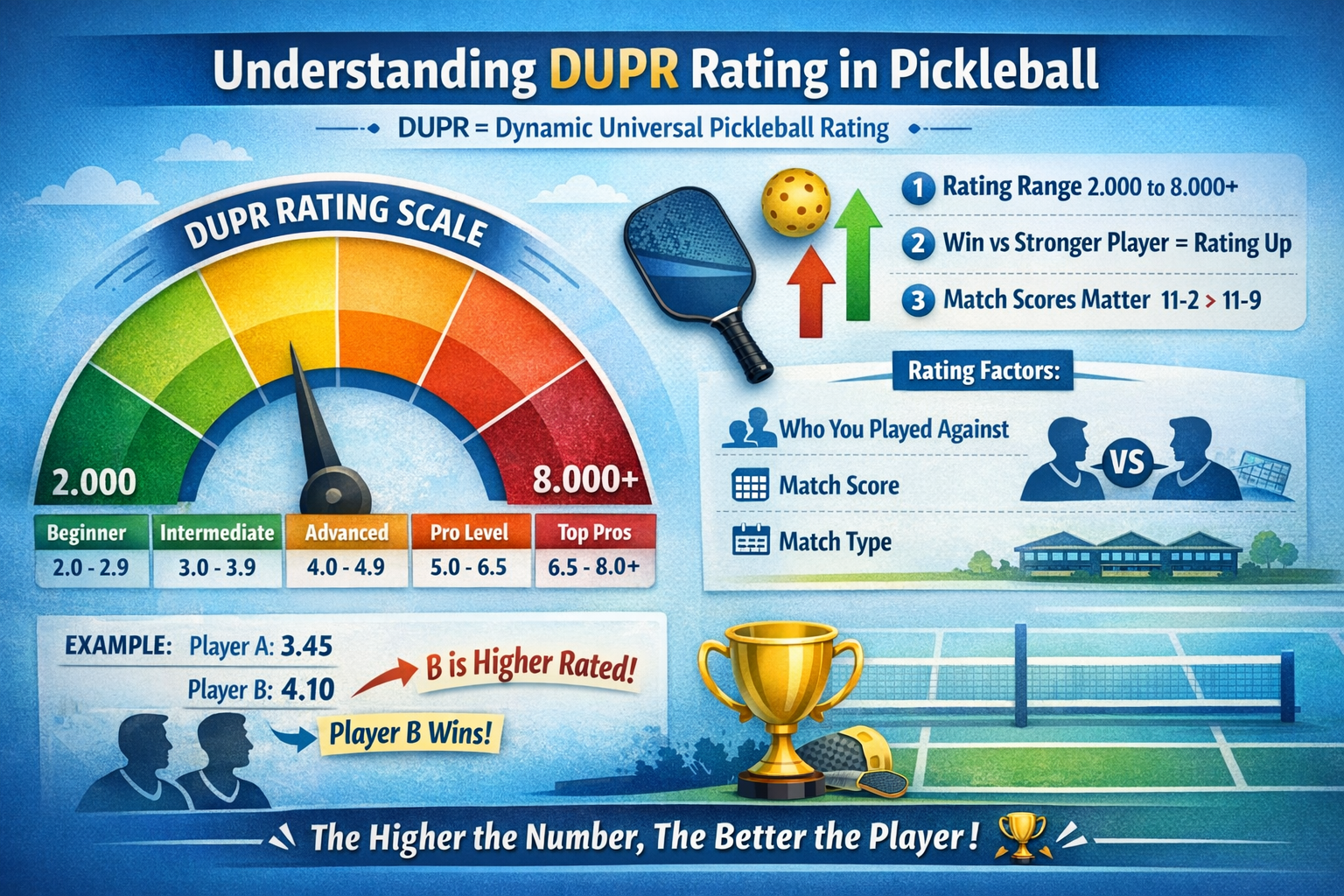
DUPR stands for Dynamic Universal Pickleball Rating, developed by Steve Kuhn in 2021. It is designed to create one global rating system that works for every player — whether you are a beginner, club player, or professional.
In simple words, DUPR is a number system that tells how good a pickleball player is.
A DUPR rating is a number that ranges from 2.000 to 8.000+.
Every time you play a recorded match, your rating can change.
DUPR Rating Levels (Skill-Wise Assessment)
Here’s how the numbers are generally divided:
Advanced Players: 4.000 – 4.999
Professional Level: 5.000 – 6.500+
Top World Pros: 6.500 – 8.000
Most average club players in India currently fall between 3.0 and 4.0.
So if someone says, “I am a 4.2 player,” it immediately tells you they are an advanced-level competitor.
Let’s say:
Player A = 3.45
Player B = 4.10
Player B is stronger because 4.10 is higher than 3.45.
That’s how simple the comparison is.
The Biggest Question: How Does DUPR Rating Increase or Decrease?
Your rating changes after every recorded match. But it does not change randomly. It depends on three main factors:
**Who You Played Against
This is the most important factor.
If you beat a higher-rated player, your rating increases more.
If you lose to a lower-rated player, your rating drops more.
For example, beating someone rated 4.5 when you are 3.8 gives you a strong boost. But losing to a 3.2 player when you are 4.0 can hurt your rating significantly.
** Match Score (Winning Margin)
Margin matters.
Winning 11–2 gives you more rating gain than winning 11–9.
Why? Because a big margin shows dominance. A close match shows the skill levels were similar.
Similarly, if you lose badly (like 11–2), your rating may drop more than if you lose 11–9 in a tight contest.
** Match Type
Not all matches carry the same weight.
Tournament matches = Stronger impact
League matches = Moderate impact
Recreational matches = Lower impact
Tournament games are considered more competitive and verified. That’s why they influence ratings more strongly.
Let’s Understand with a Practical Example
Imagine:
You = 3.50
Opponent = 3.90
If you win 11–6:
Your rating may go from 3.50 → 3.62
Opponent may drop from 3.90 → 3.82
You gained more because you defeated someone rated higher than you.
Now imagine you lose 11–9:
Your rating may drop slightly from 3.50 → 3.47
Because the match was close, the rating does not drop heavily.
This makes the system fair. It rewards performance but does not punish players too harshly for competitive losses.
Where is DUPR Used?
DUPR is widely used in:
Tournaments
Competitive leagues
Official events
Club competitions
Skill-based matchmaking
It helps players find opponents of the same level, which makes matches more competitive and enjoyable.
Many global pickleball events now use DUPR as an official rating standard.
Simple Formula to Understand DUPR Better
You gain more points when:
You beat stronger players
You win by a big margin
You play more verified matches
You lose more points when:
You lose to lower-rated players
You lose by a big margin
So performance + opponent strength + margin = rating movement.
Why DUPR is Important
Before DUPR, players often self-rated themselves. That created confusion. One club’s “4.0” player might be another club’s “3.5” player.
DUPR solves this problem by creating one universal number for everyone.
This helps:
Tournament organizers create fair brackets
Players avoid mismatched games
Leagues maintain competitive balance
Coaches track improvement over time
It also motivates players. When your rating increases from 3.2 to 3.6, you can clearly see your progress.
Final Perspective
Think of DUPR like a credit score for pickleball.
More wins against strong players = Rating goes up.
More losses against weaker players = Rating goes down.
The scale runs from 2.000 to 8.000+.
It is dynamic, data-driven, and performance-based.
If you are serious about improving in pickleball, understanding your DUPR rating is essential. It tells you where you stand, what level you belong to, and how far you need to go.
In simple words:
Play better. Beat stronger opponents.
Q-1: What is DUPR Rating in Pickleball?
It was developed by Steve Kuhn in 2021 to create one global rating system for all pickleball players. Whether you are a beginner, club player, or professional, DUPR gives you a single number that reflects your skill level.
In simple terms, DUPR is a number that tells how strong a player is. The rating ranges from 2.000 to 8.000+. Every time you play a recorded match, your rating can change based on your performance.
For example, if Player A has a rating of 3.45 and Player B has 4.10, Player B is considered stronger. Most average club players in India fall between 3.0 and 4.0. So if someone says they are a 4.2 player, it means they compete at an advanced level.
Q-2 How Does DUPR Rating Increase or Decrease?
Your DUPR rating changes after every recorded match, but it does not change randomly.
First, who you played against. If you defeat a higher-rated opponent, your rating increases more. If you lose to someone rated lower than you, your rating may drop more.
Second, the match score matters. Winning 11–2 gives a bigger boost than winning 11–9 because the margin shows dominance. Close matches usually result in smaller changes.
Third, match type also affects the rating. Tournament matches have stronger impact, league matches have moderate influence, and recreational games have lower impact.
Q-3: Why is DUPR Important in Pickleball?
Before DUPR, many players rated themselves, which created confusion. One club’s 4.0 player could be another club’s 3.5. DUPR solves this by giving everyone one universal number.
It is widely used in tournaments, leagues, official events, and skill-based matchmaking. It helps organizers create fair brackets and ensures players compete against similar skill levels.
Think of DUPR like a credit score for pickleball. Lose to weaker players and it goes down. It is dynamic, performance-based, and helps track real improvement over time.
Related posts:
 Pickleball Sports: Let’s Understand the market of this Popular Sport in Detail with numbers
 Top 5 Indian Celebrities to Acquire Teams in Pickleball League so far in Detail
 Is Pickleball a “Massy” or “Rich” Sport in India? A Parameter-by-Parameter Reality Check?
 Is Indian Sports Media Really Covering Pickleball or Not? With Facts