

Why India Must Invest in Players and Coaches to Build a Sustainable Pickleball Ecosystem?
2 Biggest Things Indian Pickleball Stakeholders Need to Fix If the Sport Wants to Flourish 🇮🇳
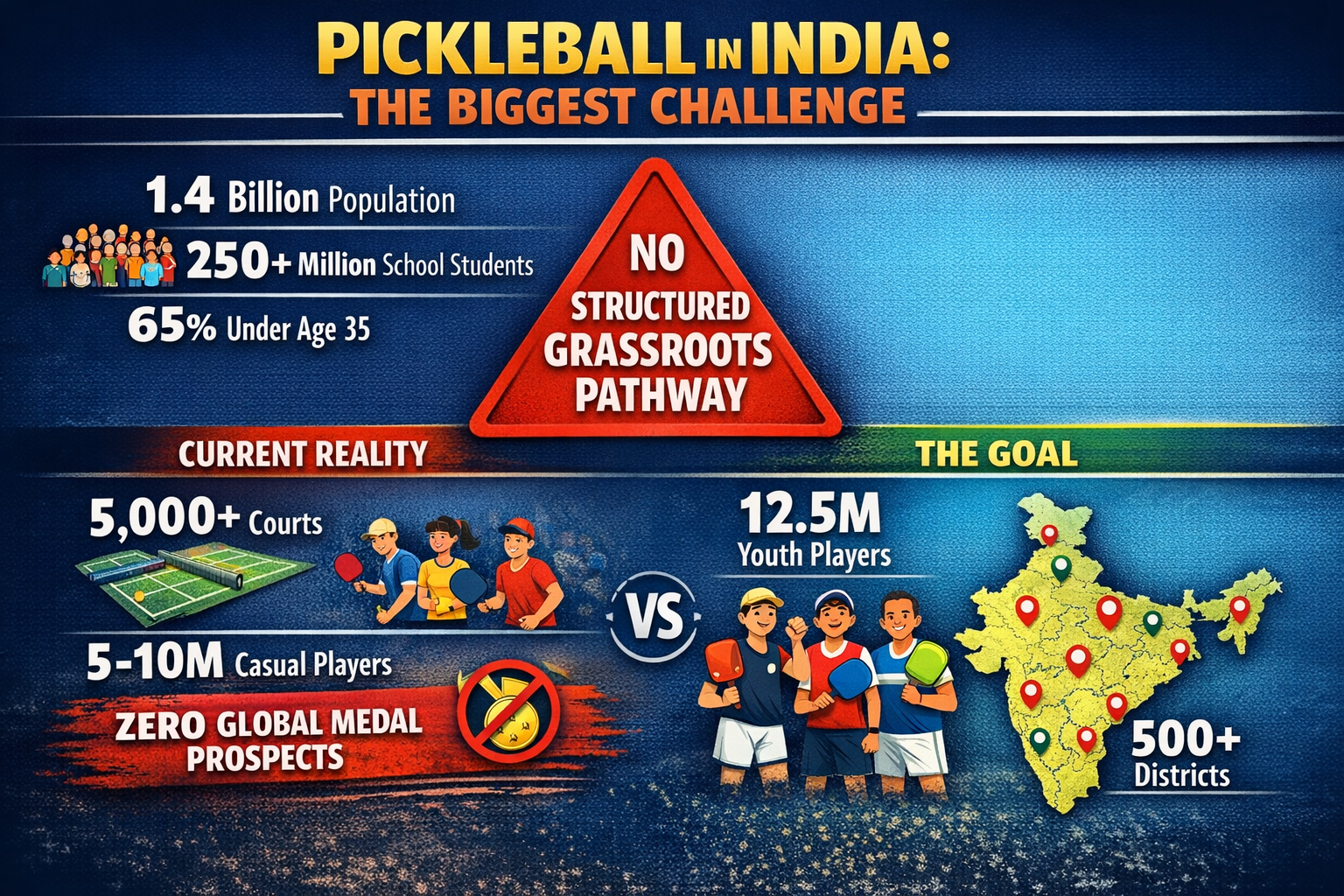
India stands at a powerful sporting inflection point. With a population of over 1.4 billion people, more than 250 million school-going students, and nearly 65% of citizens under the age of 35, the country has the demographic strength to build the world’s largest pickleball participation base. Urban recreational culture is expanding rapidly. Gated communities are adding courts.Weekend tournaments are increasing.
But participation growth alone does not create a sporting powerhouse.
If Indian pickleball truly wants to scale across 100+ cities and evolve from a recreational trend into a structured national ecosystem, two pillars demand urgent structural focus:
1️⃣ Empowering Players
2️⃣ Empowering Coaches
Without these two, scale will remain surface-level.
1️⃣ Empowering Players: Players Are the Product
Every successful sports ecosystem in India has revolved around one core principle — the athlete is the centerpiece of value creation.
Under the Board of Control for Cricket in India, cricketers became financially secure professionals through central contracts, domestic structures, match fees, and commercial visibility. Stability created aspiration. Aspiration created depth.
Similarly, the Pro Kabaddi League turned kabaddi players into prime-time stars. Within a few seasons, athletes from small towns became nationally recognized names. Television exposure, sponsorship, and grassroots participation surged together.
Heroes create aspiration.
Aspiration fuels grassroots participation.
Participation drives commercial expansion.
Now compare this model with Indian pickleball.
The sport is participation-driven but not yet career-driven. It currently lacks:
• A unified national ranking pyramid
• Stable annual earning pathways
• Insurance and athlete welfare systems
In most emerging Indian sports, middle-tier athletes sustain themselves for two to three years through personal funding, limited sponsorships, or family support. However, if structured financial systems do not exist beyond that period, attrition becomes inevitable.
If a young pickleball player cannot see a sustainable five-to-seven-year professional pathway, migration toward cricket, badminton, or traditional employment becomes rational.
Assume 1,000 competitive pickleball players emerge nationally each year. If even 40% exit within three years due to financial instability, the talent pipeline weakens dramatically. Over five years, that cumulative attrition prevents the formation of elite depth.
Participation without retention does not build champions.
To stabilize the player ecosystem, stakeholders must focus on structural mechanisms:
• Sustainable and predictable tournament prize pools
• A centralized and transparent national ranking circuit
• Sponsorship matchmaking systems linking brands to athletes
• Travel grants and medical insurance coverage
• Multi-year performance-based contracts for elite players
When athletes see pickleball as a viable profession instead of a temporary passion, discipline increases. Training intensity improves. Long-term commitment strengthens.
And when commitment strengthens, heroes emerge.
No heroes means no aspiration.
No aspiration means no long-term grassroots demand.
If players are not empowered, the ecosystem remains recreational.
2️⃣ Empowering Coaches:
While players are the product, coaches are the force multipliers.
Courts do not build champions. Coaching systems do.
One certified coach can train between 150 and 300 players annually. If India develops 500 certified coaches, that directly impacts up to 75,000 players every year. Expand that to 1,000 certified coaches, and the grassroots influence exceeds 150,000 athletes annually.
This is how pyramids are built — through multiplication, not mere participation.
However, Indian pickleball currently lacks foundational coaching structure:
• Tiered certification systems (Level 1, Level 2, Level 3)
• School-level integration modules
• Defined career growth pathways for coaches
• A centralized licensing and ranking database
Without structured certification, coaching quality varies widely. Inconsistent coaching produces inconsistent skill development. Inconsistent skill development weakens competitive standards.
Look at the United States model, where pickleball’s rapid rise was supported by formal certification pathways and academy systems. Coaches were trained, licensed, evaluated, and upgraded. That consistency allowed grassroots expansion to maintain technical quality.
It was engineered through coaching infrastructure.
If each certified coach develops even five high-potential competitive players annually, 500 coaches generate 2,500 strong athletes every year. Over five years, that becomes a significant national talent pool.
Without trained coaches, courts risk becoming social hubs instead of competitive nurseries.
Infrastructure alone does not create excellence. Systems do.
To scale pickleball across 100+ Indian cities, stakeholders must implement:
• Nationally recognized tiered certification pathways
• Mandatory curriculum standardization
• Integration into school physical education frameworks
• Partnerships with private academies and sports institutions
• Incentives that allow full-time pickleball coaching careers
• A transparent database for coach licensing and rankings
When coaching becomes a stable profession rather than a side income, long-term grassroots development becomes possible.
And when grassroots development strengthens, elite performance becomes inevitable.
The Structural Crossroads
Indian pickleball is currently in its early-growth recreational phase. The next five years will determine whether it evolves into a structured national sport or plateaus as an urban fitness trend.
Horizontal growth — adding courts and participants — creates visibility.
Vertical depth — empowering players and building coaching systems — creates sustainability.
Without vertical depth, horizontal growth eventually stalls.
With both pillars aligned, compounding begins.
Final Thought
If Indian pickleball stakeholders truly want long-term scale instead of short-term buzz, they must protect and empower two critical entities:
Here is your content converted into a clear, structured tabular format, using only the information you provided:
🇮🇳 2 Biggest Things Indian Pickleball Stakeholders Need to Fix
| Pillar | Why It Matters | Current Gaps | Required Structural Fixes | Impact If Implemented | Risk If Ignored |
|---|---|---|---|---|---|
| 1️⃣ Empowering Players | Players are the centerpiece of value creation in any sports ecosystem.
Example models: Heroes create aspiration → Aspiration fuels participation → Participation drives commercial expansion. |
• No unified national ranking pyramid • No stable annual earning pathways • No insurance or athlete welfare systems • Limited sponsorship access • High attrition (up to 40% within 3 years due to financial instability) |
• Sustainable & predictable tournament prize pools • Centralized & transparent national ranking circuit • Sponsorship matchmaking systems • Travel grants & medical insurance coverage • Multi-year performance-based elite contracts |
• Stronger athlete retention • Long-term professional commitment • Improved training intensity • Emergence of national heroes • Career-driven ecosystem instead of recreational trend |
• Talent pipeline weakens • Migration to cricket, badminton, or traditional jobs • No elite depth • No long-term grassroots demand |
| 2️⃣ Empowering Coaches | Coaches are force multipliers.
1 certified coach can train 150–300 players annually. Pyramids are built through multiplication, not participation. |
• No tiered certification (Level 1, 2, 3) • No school-level integration modules • No defined coaching career pathway • No centralized licensing & ranking database • Inconsistent coaching quality |
• Nationally recognized tiered certification pathways • Mandatory curriculum standardization • Integration into school PE frameworks • Partnerships with private academies • Incentives for full-time coaching careers • Transparent coach licensing database |
• Consistent technical standards • Strong grassroots development • 500 coaches × 5 high-potential players/year = 2,500 competitive athletes annually • Long-term national talent pool • Sustainable vertical depth |
• Courts become social hubs, not competitive nurseries • Weak competitive standards • Horizontal growth without sustainability • Sport plateaus as urban fitness trend |
Structural Crossroads Summary
| Growth Type | Creates | Limitation Without Structure |
|---|---|---|
| Horizontal Growth (More courts, more participants) | Visibility | Eventually stalls without depth |
| Vertical Depth (Empowered players + Structured coaching) | Sustainability & Elite Performance | Enables compounding national growth |
Related posts:
 Pickleball Sports: Complete Price of Pickleball Equipments in India for the year 2025 in Detail
 Pickleball Facts: Let’s have a Look at Current History of Pickleball
 Pickleball: Why this Popular Sport would Beat Kabaddi by 2031? With Facts
 Is Indian Sports Media Really Covering Pickleball or Not? With Facts