
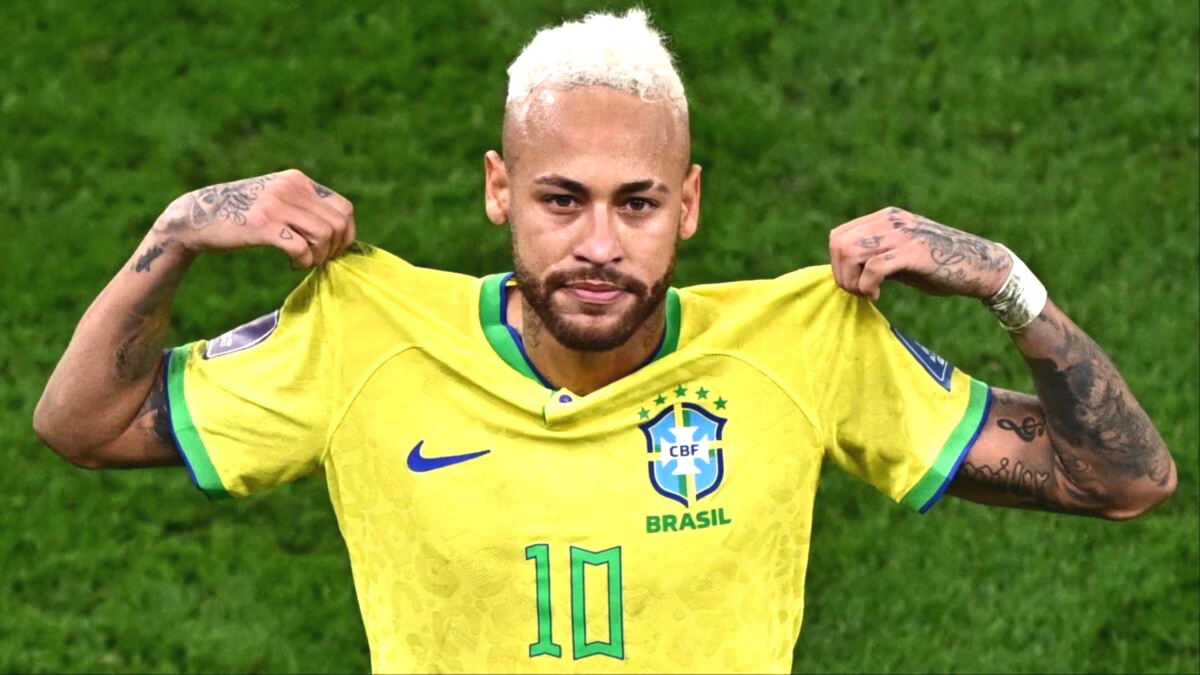
Neymar at the FIFA World Cup 2026: Brazil’s Last Bet on Its Biggest Star
There is a weight that comes with wearing the Brazilian football jersey. It is not just about playing well. It is about carrying the hopes of an entire nation that has tasted World Cup glory five times and has been waiting for a sixth since 2002. For the last 15 years, that weight has rested on one man’s shoulders more than anyone else, Neymar.
Now 34 years old, Neymar is heading into what is almost certainly his final World Cup. His body has been through injuries, surgeries, and long spells on the sidelines. His club football has been patchy at best. And yet, here he is, on the squad list, in the conversation, and still somehow in the middle of it all.
So what exactly does Neymar bring to this Brazil team in 2026? And can a team built around collective effort finally deliver the World Cup that Neymar alone could not?
The Burden of Being Brazil’s Star
To understand Neymar’s journey, you first need to understand what it means to be a talented Brazilian footballer.
After Pelé led Brazil to three World Cup victories between 1958 and 1970, a very clear standard was set. Every great Brazilian player who came after him was judged by one question, can you win the World Cup?
Romário answered it in 1994. Ronaldo answered it in 2002. But Ronaldinho in 2006 and Kaká in both 2006 and 2010 could not. When they came up short, Neymar became the next in line.
He first caught attention as a 17-year-old at Santos, playing with a style and confidence that was unusual for someone so young. He quickly became Brazil’s next big hope, their “King in Waiting.” He moved to Barcelona, won trophies, and then made the record-breaking €222 million move to Paris Saint-Germain in 2017, the most expensive transfer in football history at the time.
But despite all of this, the World Cup continued to escape him.
Three World Cups, Three Heartbreaks
Neymar has now appeared at three World Cups, 2014, 2018, and 2022, and each one ended in pain, both physically and emotionally.
In 2014, on home soil in Brazil, he was playing his best football of the tournament before a knee injury in the quarterfinals against Colombia ended his World Cup. He watched from his hotel room as Germany beat Brazil 7-1 in the semifinals, one of the most painful results in Brazilian football history.
In 2018 in Russia, Neymar was fit and available, but Belgium’s strong team was simply better on the day. Brazil went out in the quarterfinals again.
Then in 2022 in Qatar, Brazil came agonisingly close. In the quarterfinal against Croatia, Neymar scored a brilliant goal in extra-time, running from midfield and finishing calmly. For a moment, it looked like his night. But his teammates could not hold on, and Brazil lost on penalties.
Three tournaments. Three exits before the semifinals. Each one stung a little more than the last.
Injuries, Setbacks, and a Long Road Back
After 2022, Neymar’s career took a difficult turn. He joined Saudi Arabian club Al Hilal in August 2023. In October of the same year, while playing a World Cup qualification match against Uruguay for Brazil, he suffered a rupture of the anterior cruciate ligament and meniscus in his left knee. It was a serious injury that kept him out for almost a year.
He returned in October 2024, only to pick up a hamstring injury soon after. Then, in January 2025, Al Hilal terminated his contract. He returned to Santos, the club where it all began.
The comeback at Santos has been mixed. He has had glimpses of his old quality, but also more time on the sidelines. In 2026, he has only played in eight matches. And heading into the World Cup, a calf injury has once again raised questions about his fitness.
In total, he has played just four times for Brazil since the 2022 World Cup. His last appearance for the national team before this World Cup was that October 2023 match against Uruguay, the very game in which he got injured.
What Neymar Can Still Offer
At his best, Neymar was one of the most exciting footballers in the world. He was fast, creative, and almost impossible to stop in small spaces. His close control made it look like the ball was attached to his feet. His first few steps were so quick that defenders often had no answer.
But at 34, with multiple serious injuries behind him, that version of Neymar is gone. He is slower than before. He is not as sharp as he once was. There is no point pretending otherwise.
However, that does not mean he is finished as a useful player.
His understanding of the game is still sharp. His set-piece delivery, free kicks, corners, and dead-ball situations, is still at a high level, and that comes from years of practice, not just physical fitness. Also, having spent less time playing in regular club matches, he arrives at the World Cup with more rest in his legs compared to teammates who have been playing week after week in Europe.
Coach Carlo Ancelotti has been clear about how he plans to use him. “He might play; he might not; he might be on the bench and come on,” Ancelotti said. That sums it up well. Neymar is not the first-choice starter. He is not the main man anymore. But he can still be useful, particularly in short bursts at the later stages of the tournament when the game needs a moment of quality.
Ancelotti’s Approach: Team First, Always
Carlo Ancelotti is Brazil’s first foreign head coach ever. He was brought in with a specific goal, to build a team that plays with discipline, structure, and a collective identity. This was a change from Brazil’s traditional style of relying on individual brilliance.
Ancelotti has managed some of the biggest clubs in the world, Real Madrid, Bayern Munich, Paris Saint-Germain, and Chelsea. He is known for getting the best out of big-name players without letting any single player become bigger than the team.
His handling of Neymar’s selection reflects this approach. For a long time, Ancelotti said he would only pick fully fit players. Neymar, coming back from a calf injury with limited game time, did not fully meet that standard. And yet, he was selected.
Ancelotti explained this by pointing to the “affection the group has for him” and said Neymar can help “create a better atmosphere” within the squad. But he was also careful to add that Neymar has “the same role, the same obligation as the other 25.” No special treatment. No separate rules.
This is an important point. Ancelotti is not building this Brazil team around Neymar. He is simply making space for Neymar within a team that already has its own identity and structure.
The Shift in Brazil’s Identity
Something significant has changed. For the first time in a long time, Brazil is not a team built around one star player.
In 2014, everything went through Neymar. In 2018 and 2022, he was still central. But this Brazil squad in 2026 has depth and quality across the field. There are strong players in every position, and the team is designed to function as a unit rather than depend on one person to produce magic.
This is actually a healthier situation for Brazil. Over-relying on one player has a clear weakness, if that player gets injured or has a bad game, the whole team suffers. The 2014 World Cup is the clearest example of this.
Neymar himself seems to have accepted this change. “Those who have been with me through it all know that it was difficult, it was hard,” he said after being named in the squad. “But after hearing my name on the list, all the sacrifices and all the effort was worth it. We’re in this together as Brazil heads for a sixth World Cup title.”
That word, together, is telling. This is not a man trying to reclaim his throne. This is a man trying to contribute to something bigger than himself.
A Career Defined by Scrutiny
Neymar has never had an easy relationship with the Brazilian public. He helped Brazil win the 2013 Confederations Cup. He played a major role in Brazil winning its first-ever Olympic gold medal in football at the 2016 Rio Games. These were real achievements. But they were not enough to fully win over his own people.
With every World Cup exit and every Copa América disappointment, the criticism grew louder. His lifestyle away from football was closely watched. Small moments of frustration on the pitch were blown out of proportion. A simple haircut could become a news story.
In contrast, Lionel Messi, despite having one of the greatest club careers of all time at Barcelona, was not fully embraced by all Argentines until he won the 2022 World Cup. It shows how much the World Cup means in South American football culture.
For Neymar, that one big moment has never come.
Brazil’s Record Goals Scorer, Still Going
One fact about Neymar that often gets lost in the noise of injuries and controversy is this: he is Brazil’s all-time leading scorer with 79 goals, two more than the legendary Pelé. That is not a small thing. That is a record built over years of consistent performance at the highest level for his country.
He has 79 reasons to hold his head high regardless of what happens in North America this summer.
The Final Chapter
This is almost certainly Neymar’s last World Cup. At 34, with his injury record, it is hard to imagine him being around for the 2030 tournament. This is it, one last chance at the title that has been out of reach his entire career.
But the question for 2026 is not really about Neymar alone. The real question is whether this Brazil team, with its structure, depth, and collective approach under Ancelotti, can win the World Cup as a group. If they do, Neymar will have played his part. Even if that part is a 20-minute cameo in a quarterfinal or a perfectly delivered free kick in the semifinal.
Sometimes, the greatest contribution is knowing your role and playing it well.
Brazil has chased a sixth World Cup title for 24 years. Neymar has chased it for most of his career. In 2026, both finally have a real shot, not because of one man’s brilliance, but because of what eleven men can do together.