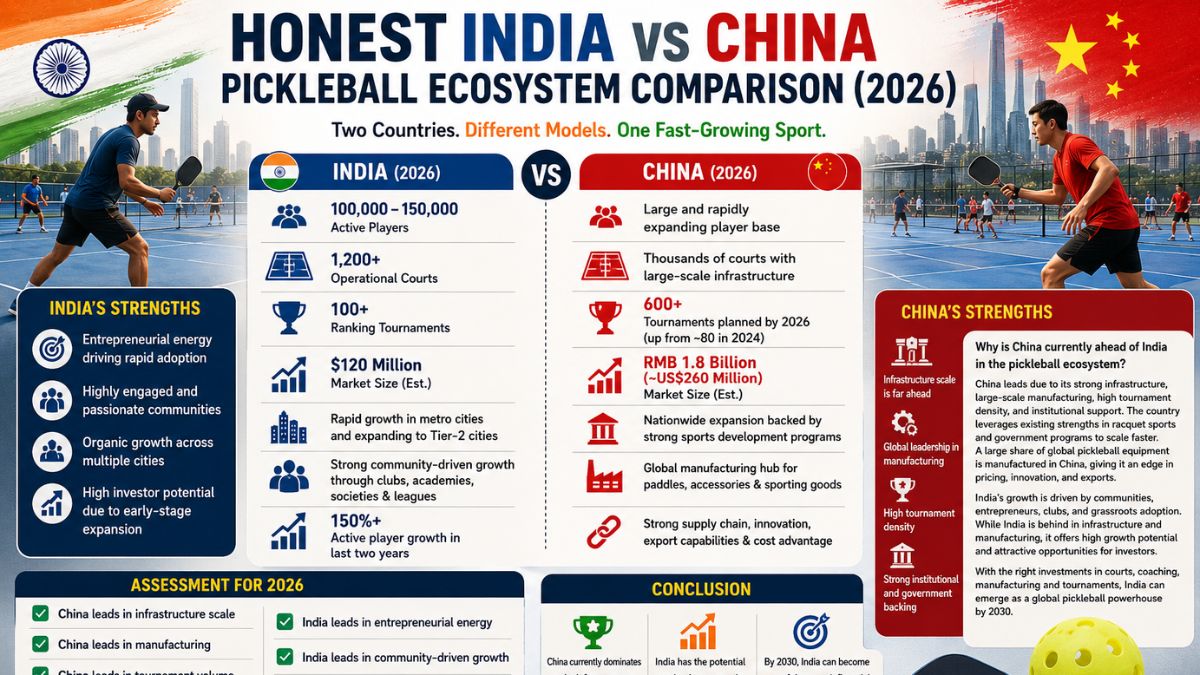
1. The Missing Grassroots Pyramid
India’s biggest advantage is its youth population. Over 250 million children are enrolled in schools. Every year, millions participate in inter-school cricket, athletics, kabaddi, badminton, and football competitions. These sports operate within a structured pathway:
School → District → State → National → Professional
This pyramid converts mass participation into elite talent.
Pickleball currently does not operate at that systemic level.
Even if India builds:
-
5,000 courts
-
10,000 courts
-
20,000 courts
Without structured integration into school sports calendars, those courts largely serve urban recreational users rather than creating a competitive pipeline.
To create 1 million competitive players, you need:
-
Standardised school-level competitions
-
District-level qualifiers
-
State championships
-
A national ranking circuit
-
Age-category divisions (U12, U16, U19, Open, 35+, 50+)
Right now, participation is growing faster than structure.
The danger? India risks building thousands of courts but only a few hundred serious competitive athletes.
Look at cricket. The BCCI ecosystem ensures talent identification starts early. Look at badminton. India’s academy system feeds state circuits, which feed national tournaments. Kabaddi, once seen as rural and unstructured, transformed after leagues aligned with grassroots scouting.
Pickleball needs that same alignment.
If India integrates pickleball into even 10% of its schools over the next five years, that means exposure to 25 million students. Even if just 5% of them pursue competitive play, that’s over 1 million structured players.
Without school integration, however, growth remains confined to urban gated communities and premium clubs — limiting scale.
A sport cannot become globally dominant without institutional depth.
2. Weak Sports-Tech and Community Retention Model
India has over 800 million internet users and more than 600 million smartphone users. It is one of the world’s largest digital-first markets. Yet pickleball’s ecosystem remains fragmented.
Today’s reality:
-
No unified national player ID system
-
No centralised ranking database
-
No integrated tournament calendar
-
No structured digital progression tracking
-
Limited local league ladders connected nationally
This fragmentation creates a serious retention problem.
Most current pickleball participants fall into three categories:
-
Weekend recreational players
-
Corporate league participants
-
Urban fitness enthusiasts
The problem is not attracting them — it is retaining and upgrading them.
Without structured digital tracking:
-
Players don’t see progression
-
Skill development feels random
-
Community depth remains shallow
-
Drop-off rates rise
In modern sports ecosystems, technology is not optional. It is foundational.
Consider what a unified sports-tech system could enable:
-
A national player ID for every registered participant
-
Skill-based ratings updated after every match
-
Weekly hyperlocal leagues feeding state rankings
-
A live leaderboard culture
-
Performance analytics for serious athletes
-
AI-driven match pairing for balanced competition
When players see data, they stay.
When they see rankings, they compete.
When they compete, they commit long term.
India’s startup ecosystem is capable of building this infrastructure. But it requires coordinated thinking — not just isolated court operators running independent tournaments.
Courts create awareness. Data creates ecosystems.
The Numbers India Can Realistically Target by 2031
If structured properly, India could aim for:
-
50,000+ courts nationwide
-
5 million active players
-
1 million competitive participants
-
100+ internationally ranked professionals
-
A $1 billion+ domestic pickleball economy
These numbers are not unrealistic. They align with India’s demographic scale and rising middle-class recreational spending.
But reaching them requires system-building, not just infrastructure expansion.
The Strategic Shift Required
India already has:
-
Youth-heavy demographics
-
Urban recreational demand
-
Real estate integration opportunities
-
Digital penetration
-
Startup and investor appetite
What it lacks is structural conversion.
To convert millions into a movement, India needs:
-
School integration at scale
-
State association alignment
-
National ranking transparency
-
Unified sports-tech ecosystem
-
Annual competitive calendar discipline
Without these, pickleball risks becoming another urban lifestyle trend rather than a generational sporting movement.
The Inflection Point
Global sports markets evolve in phases:
Recreation → Community → Structure → Commercialisation → Professional dominance
India’s pickleball ecosystem is currently between recreation and early community.
The next five years will determine whether it transitions into structured scale or plateaus into fragmented growth.
The demographics are ready.
The digital infrastructure exists.
The urban appetite is visible.
Now the question is simple:
Will India build systems strong enough to convert its 1.4 billion population advantage into a globally dominant pickleball movement
Because in sport, numbers alone don’t create power community does it.