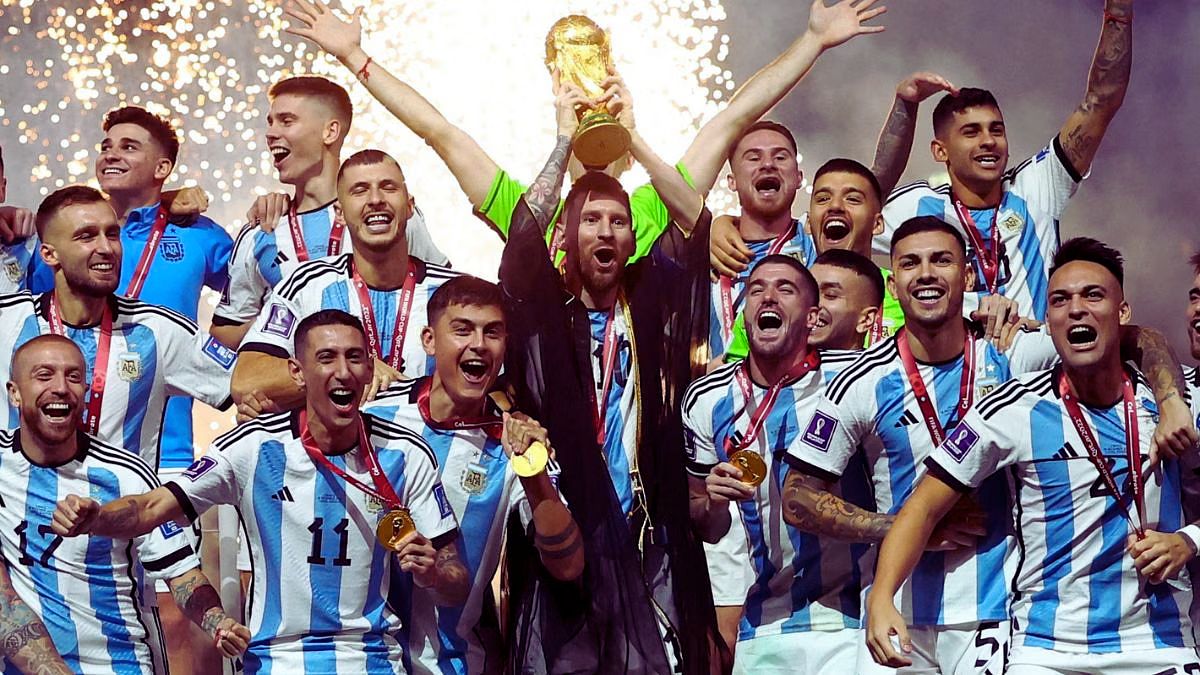
Every four years, the best football teams in the world fight for one goal, to lift the FIFA World Cup Trophy. It is the most famous trophy in sports. But how much do people really know about it? What is it made of? How much does it cost? And who actually gets to keep it?
Let’s break it all down.
What Is the FIFA World Cup Trophy?
The FIFA World Cup Trophy is the official prize given to the team that wins the FIFA World Cup. It is not just a symbol of winning, it is a piece of art with a deep history behind it.
The trophy stands 36 centimetres tall and weighs 6.175 kilograms. It is made of solid 18-carat gold, with two rings of green malachite at its base. Malachite is a natural green stone, and it gives the base a rich, distinctive look.
The base has 20 rectangular spaces where each winning team’s name is engraved. This detail alone tells you something important, the trophy was designed with future winners already in mind.
Who Designed the Trophy?
The current FIFA World Cup Trophy was designed by Silvio Gazzaniga, an Italian sculptor. He won a design competition that FIFA held in the early 1970s after the previous trophy, the Jules Rimet Trophy, was permanently given away.
Gazzaniga built the trophy around one central idea: the globe, held up by two human figures. These figures represent the two competing teams, with their arms stretched upward at the moment of victory. It is a simple but powerful image.
In 2022, Gazzaniga’s son Giorgio confirmed to The Athletic that his father deliberately moved away from the older, decorative style of the Jules Rimet Trophy. Instead, Gazzaniga wanted to create something that felt modern, rooted in abstraction and human achievement.
You can see this in the small details. The continents on the globe are polished gold, while the human figures below are matte (not shiny). This contrast was a deliberate choice to highlight the difference between the goal (the globe) and the effort it took to get there.
The first team to lift this trophy was West Germany, who won the 1974 World Cup held in Munich, Germany. Since then, every World Cup winner has received this same trophy.
Why Was a New Trophy Needed?
To understand why the current trophy was made, you have to go back to the original one, the Jules Rimet Trophy.
Jules Rimet was FIFA’s longest-serving president. When the World Cup competition was first created, Rimet made a rule: the first country to win three World Cups would permanently keep the trophy. The trophy at the time was a gilded statuette designed by French sculptor Abel Lafleur in 1930.
Brazil achieved this milestone in 1970, winning their third title. They took the Jules Rimet Trophy home for good.
FIFA had to act fast. They launched a new competition to find a replacement design. Gazzaniga won the competition, and his trophy has been used at every World Cup since 1974.
How Much Does the FIFA World Cup Trophy Cost?
This is where things get really interesting.
When the trophy was first made in 1974, it cost approximately US$9,390 to produce. In today’s money, that is roughly US$130,500 when you account for inflation.
But times have changed. Gold prices have risen sharply over the decades. Today, the raw gold value of the trophy alone is estimated at around US$713,000. That is just the value of the metal, nothing else.
Now, add in the trophy’s unique history, cultural importance, and the fact that there is only one original in the world. Independent experts place its insured value at over US$20 million.
Here is a quick breakdown:
| Detail | Value |
| Height | 36 cm |
| Weight | 6.175 kg |
| Material | Solid 18-carat gold + malachite base |
| Original Production Cost (1974) | ~US$9,390 |
| Inflation-Adjusted Cost Today | ~US$130,500 |
| Raw Gold Value Today | ~US$713,000 |
| Insured / Total Evaluated Value | Exceeds US$20 million |
The gap between the original production cost and the current valuation is one of the most striking financial contrasts in the world of sports.
Who Actually Keeps the Trophy?
Here is something that surprises many people, the winning team does not keep the original trophy.
Until 2006, the winning country was allowed to hold on to the original for four years. But FIFA ended that practice completely. Now, the original trophy goes straight back to FIFA headquarters in Zurich, Switzerland, where it is kept at the FIFA Museum.
What the winning team actually receives is called the Winner’s Trophy, a gold-plated bronze replica. It looks exactly like the original but is not made of solid gold.
So why does FIFA keep the original? Simply put, the trophy is too valuable and too important to be handed over. It belongs to the history of the game, not to any single country.
Who Is Even Allowed to Touch It?
FIFA has very strict rules about who can touch the real trophy. Only World Cup winners, heads of state, and select dignitaries are permitted to handle it.
This rule became big news at the 2022 World Cup final in Qatar. After Argentina won, a celebrity known as “Salt Bae” was photographed holding the trophy and posing with players on the pitch. He was not a player, a head of state, or a dignitary. This broke FIFA’s rules, and it triggered a formal review by FIFA.
The incident brought global attention to just how seriously FIFA takes the handling of its most prized possession.
Where Is the Trophy Kept?
The original FIFA World Cup Trophy is permanently housed at the FIFA Museum in Zurich, Switzerland. It is not on a national tour. It is not displayed at random events. It stays in Zurich, protected and preserved.
When the World Cup final is held, the original is brought out for the presentation ceremony. After that, it goes back.
A Complete List of FIFA World Cup Winners
Since the first World Cup in 1930, here is every champion, runner-up, and third-place team:
| Year | Champion | Runner-Up | Third Place |
| 2022 | Argentina | France | Croatia |
| 2018 | France | Croatia | Belgium |
| 2014 | Germany | Argentina | Netherlands |
| 2010 | Spain | Netherlands | Germany |
| 2006 | Italy | France | Germany* |
| 2002 | Brazil | Germany | Turkey |
| 1998 | France* | Brazil | Croatia |
| 1994 | Brazil | Italy | Sweden |
| 1990 | West Germany | Argentina | Italy* |
| 1986 | Argentina | West Germany | France |
| 1982 | Italy | West Germany | Poland |
| 1978 | Argentina* | Netherlands | Brazil |
| 1974 | West Germany* | Netherlands | Poland |
| 1970 | Brazil | Italy | West Germany |
| 1966 | England* | West Germany | Portugal |
| 1962 | Brazil | Czechoslovakia | Chile* |
| 1958 | Brazil | Sweden* | France |
| 1954 | West Germany | Hungary | Austria |
| 1950 | Uruguay | Brazil* | Sweden |
| 1938 | Italy | Hungary | Brazil |
| 1934 | Italy* | Czechoslovakia | Germany |
| 1930 | Uruguay* | Argentina | United States |
* = Host country
Brazil holds the record for most World Cup wins with 5 titles (1958, 1962, 1970, 1994, 2002). Germany and Italy each have 4 titles. Argentina and France each have 3.
What Happens When the Trophy Runs Out of Space?
The malachite base of the current trophy has 20 rectangular spaces for engraving winners’ names. Based on the current pace of tournaments, those spaces are expected to be fully filled by the 2030 World Cup.
After that, FIFA will face a choice, commission a brand new trophy or find another solution for the existing one. So far, FIFA has made no official announcement about what it plans to do. The decision, when it comes, will be watched closely by everyone in the football world.
Quick Summary of Key Facts
- The trophy is made of solid 18-carat gold with a malachite base
- It was designed by Italian sculptor Silvio Gazzaniga and first used in 1974
- It replaced the Jules Rimet Trophy, which Brazil won permanently in 1970
- The original cost US$9,390 to make in 1974, now worth over US$20 million
- Winning teams receive a gold-plated bronze replica, not the original
- The original is kept at the FIFA Museum in Zurich
- Only World Cup winners, heads of state, and dignitaries may touch it
- The engraving spaces on the base will be full by 2030
The FIFA World Cup Trophy is more than just gold and stone. It carries decades of football history in its 6.175 kilograms. Every name engraved on its base represents years of hard work, sacrifice, and the highest level of football ever played. And yet, the team that wins it only gets to hold the real one for a few minutes before it goes back to Zurich, waiting for the next champion to claim their moment.