

Career Challenges in Non-Cricket Sports Media: Revenue Problem Explained?
In 2026, choosing non-cricket sports journalism in India still feels like a career risk—and the reason is simple: revenue isn’t there yet.
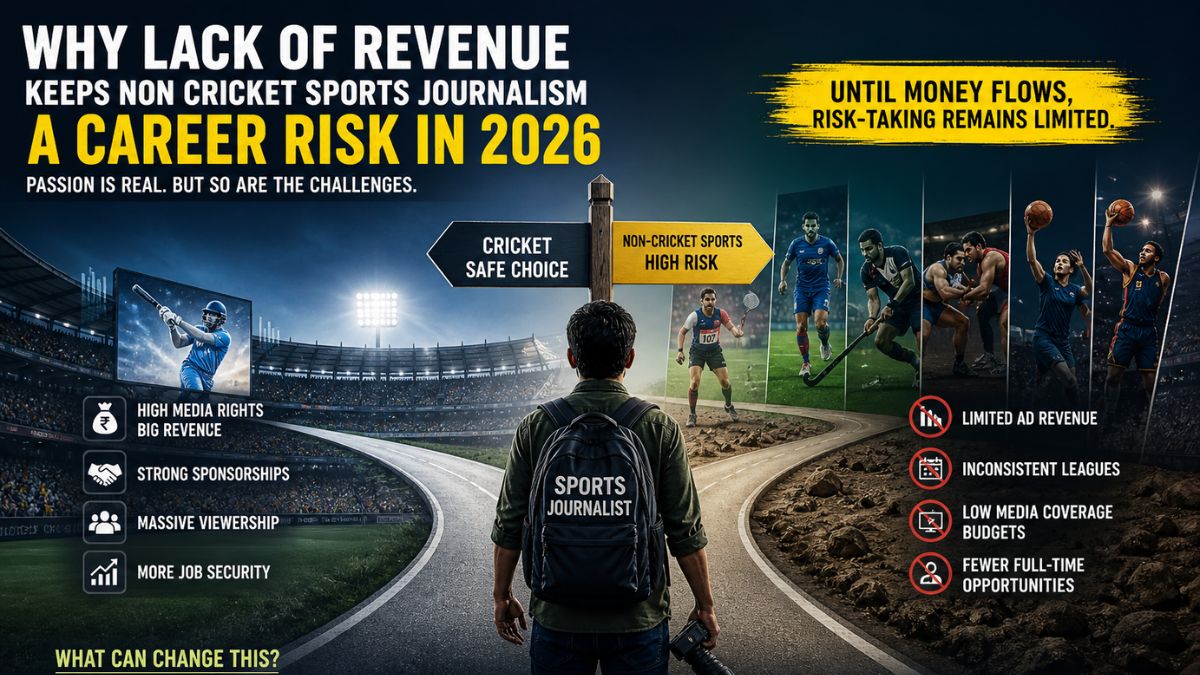
For decades, cricket has operated not just as a sport but as a full-fledged business ecosystem. It commands massive media rights deals, attracts consistent sponsorship investments, and delivers reliable viewership across television and digital platforms.
This financial stability creates a strong foundation for journalists—ensuring jobs, consistent assignments, and long-term career growth.
In contrast, most non-cricket sports are still in the early stages of building sustainable monetization pipelines. While interest and participation in sports like kabaddi, football, athletics, and hockey have grown, the business side hasn’t caught up. This gap directly impacts journalism.

The challenges are structural.
First, limited ad revenue restricts the ability of media houses to invest in dedicated coverage. Brands still prioritize cricket due to its guaranteed reach, leaving other sports with fragmented sponsorship opportunities. Without advertising money, editorial budgets shrink—and non-cricket beats are often the first to be deprioritized.
Second, inconsistent league structures create uncertainty. Many leagues outside cricket struggle with continuity, governance issues, or irregular scheduling. For journalists, this means an unpredictable content cycle. Unlike cricket, where there is year-round coverage—from bilateral series to leagues—non-cricket sports often operate in short bursts, making it difficult to build a stable reporting career.
Third, low media coverage budgets further limit opportunities.
Newsrooms operate with tight resources, and when forced to choose, they invest where returns are visible. Sending reporters, producing features, or creating high-quality storytelling around non-cricket sports often doesn’t justify the cost from a business perspective—at least in the current ecosystem.
Lastly, there are fewer full-time opportunities.
Many journalists covering non-cricket sports work freelance, juggle multiple roles, or rely on passion projects. While this may work in the short term, it becomes difficult to sustain over time—especially when financial responsibilities grow.
For young journalists entering the industry, this creates a very real dilemma:
Should they follow their passion or prioritize financial stability?
It’s a question that doesn’t have an easy answer.
On one hand, non-cricket sports offer some of the most compelling and underreported stories in Indian sport. From grassroots athletes overcoming systemic challenges to emerging leagues trying to disrupt the status quo, the storytelling potential is immense. These are narratives that deserve visibility and depth.
On the other hand, passion alone doesn’t pay the bills.
As a result, many talented journalists who begin their journey covering diverse sports eventually shift back to cricket. Not necessarily because they want to—but because the ecosystem nudges them in that direction. Cricket offers consistency, visibility, and financial security—three things that are hard to ignore in a competitive industry.
This migration of talent creates a cycle.
Less coverage leads to lower visibility.
Lower visibility leads to reduced commercial interest.
And reduced commercial interest further limits revenue.
Breaking this cycle requires systemic change.
To begin with, there is a need for stronger league structures. Stability in scheduling, governance, and long-term planning can help build trust among broadcasters, sponsors, and audiences. A well-structured league creates consistent storytelling opportunities, which in turn supports journalism.
Second, better brand investments are crucial. Brands need to look beyond short-term returns and start investing in the long-term growth of non-cricket sports. Strategic partnerships, grassroots campaigns, and storytelling-driven marketing can help unlock new audiences.
Third, the ecosystem needs consistent storytelling platforms. Digital media has already lowered entry barriers, but what’s missing is scale and sustainability. Platforms that focus on non-cricket sports—through documentaries, features, and data-driven storytelling—can play a significant role in building audience interest.
Finally, a long-term media rights vision is essential. Broadcasting deals are not just about revenue; they signal credibility. When non-cricket sports secure structured and visible media rights agreements, it creates a ripple effect—attracting sponsors, improving production quality, and enabling better coverage.
At its core, the issue is not a lack of stories or talent. India has both in abundance. The real challenge lies in building a business model that supports these stories at scale.
Until money flows consistently into the ecosystem, risk-taking in non-cricket sports journalism will remain limited. Passion will continue to exist—but it will often take a backseat to practicality.
The future of sports journalism in India doesn’t have to be cricket-centric.
But for that to change, stakeholders across the ecosystem—leagues, brands, media houses, and platforms—need to align on one goal: making non-cricket sports commercially viable.
Because only when the business works, the storytelling will truly thrive.
And that leaves us with an important question:
Who will build the business model that supports these stories?
| Section | Key Insight |
|---|
| Core Argument | In 2026, non-cricket sports journalism in India remains a career risk primarily due to lack of stable revenue. |
| Cricket Ecosystem Advantage | Cricket operates as a mature business ecosystem with strong media rights, sponsorships, and consistent viewership—ensuring stable careers for journalists. |
| Non-Cricket Reality | Other sports (kabaddi, football, athletics, hockey) are still building monetization pipelines, creating uncertainty in journalism careers. |
| Challenge 1: Limited Ad Revenue | Brands prioritize cricket for guaranteed ROI → Non-cricket sports receive fragmented sponsorships → Reduced editorial investment. |
| Challenge 2: Inconsistent League Structures | Irregular schedules and governance issues → Unpredictable content cycles → Difficult for journalists to build continuity. |
| Challenge 3: Low Media Budgets | Media houses invest where returns are visible → Limited resources for non-cricket storytelling. |
| Challenge 4: Fewer Full-Time Roles | Journalists rely on freelance or passion projects → Lack of long-term financial stability. |
| Career Dilemma | Young journalists must choose: Passion vs Financial Security. |
| Opportunity Side | Non-cricket sports offer powerful, untold stories from grassroots to emerging leagues. |
| Ground Reality | Passion alone isn’t sustainable → Many journalists shift back to cricket for stability. |
| Industry Cycle Problem | Less coverage → Lower visibility → Reduced commercial interest → Even less revenue (vicious cycle). |
| Solution 1: Stronger League Structures | Stable leagues build trust, consistency, and long-term storytelling opportunities. |
| Solution 2: Better Brand Investments | Brands need long-term vision, not short-term ROI, to grow non-cricket ecosystems. |
| Solution 3: Storytelling Platforms | Need scalable platforms (digital/media) for consistent non-cricket narratives. |
| Solution 4: Media Rights Vision | Structured media rights bring credibility, sponsors, and better coverage. |
| Core Issue | Problem is not lack of talent or stories, but lack of sustainable business models. |
| Conclusion Insight | Until revenue stabilizes, risk-taking in non-cricket journalism will remain limited. |
| Future Direction | Ecosystem players must align to make non-cricket sports commercially viable. |
| Closing Question | Who will build the business model that supports non-cricket sports storytelling? |
Frequently Asked Questions(FAQ):
Q-1: Why is non-cricket sports journalism still considered a career risk in India in 2026?
Answer: Non-cricket sports journalism in India continues to be seen as a career risk in 2026 primarily because the financial ecosystem supporting these sports is still underdeveloped. Unlike cricket, which benefits from massive media rights deals, consistent sponsorships, and year-round viewership, most other sports lack stable and predictable revenue streams. This directly impacts the journalism landscape. Media houses tend to invest where returns are assured, and cricket delivers that consistently. As a result, non-cricket sports often receive limited coverage budgets, fewer dedicated reporters, and less editorial focus.
Additionally, many non-cricket leagues face structural challenges such as inconsistent scheduling, governance issues, or lack of long-term planning. This creates an irregular content cycle, making it difficult for journalists to build a steady career around these sports. Freelancing becomes the default mode of work, with limited full-time opportunities, which adds financial uncertainty—especially for those starting out.
Another key issue is brand investment. Advertisers prefer cricket due to its wide reach and proven engagement metrics, leaving other sports with fragmented and short-term sponsorship deals. Without strong commercial backing, storytelling efforts struggle to scale, and journalists often don’t get the platform or resources needed to produce impactful work.
Despite these challenges, non-cricket sports offer rich, untold stories and growing audience interest. However, until leagues become more stable, media rights improve, and brands commit to long-term investment, the ecosystem will continue to push journalists toward cricket for financial security. This imbalance is why pursuing non-cricket sports journalism still involves significant career risk today.
Related posts:
 Importance of Sports Influencers in Building a Brand
 Have we celebrated our Paralympians in the same way we did with our Olympians post their return from Tokyo?
 Government to Discuss India’s 2028 Roadmap for Los Angeles Olympics; Reports
 International Olympic Committee President Election: Out of these 7 Candidate who will replace Thomas Bach for Presidential Post?