
Wilton Sampaio Made History Twice at FIFA World Cup 2026 Opener
It was not just because of the red cards, though three of them in a single World Cup opening match is something that has never happened before. It was not just because of the controversy, though there was plenty of that too. It was because of one moment, somewhere in the second half at the Azteca Stadium, when a 44-year-old referee from a small town in Brazil raised a microphone to his lips and tried to explain, live, to 80,000 people and millions watching at home, why he had just sent a player off.
Nobody had ever done that at a World Cup before.
Nobody was quite sure what he said.
And yet, by the time the match between Mexico and South Africa was over, Wilton Sampaio had written his name into football history, whether the world wanted him to or not.
A Small Town, A Big Career
To understand who Sampaio is, you have to go back to where he came from.
Teresina de Goiás is a small municipality in the northwest of Goiás state in Brazil. It is the kind of place that most Brazilians would struggle to find on a map. Not a city. Not a famous footballing hotbed. Just a quiet town that happened to produce, somehow, two FIFA-level referees, Wilton and his brother Sávio, both of them operating at the highest level of the game.
Sampaio started refereeing at 15. That is a fact worth sitting with for a moment. While most teenagers are watching football, he was already running lines, making calls, learning how to stand in the middle of arguments and stay calm. By 2012, he was voted the best referee in the Campeonato Brasileiro Série A, the top flight of Brazilian football, which is one of the highest honours a referee can earn in South America.
He was not someone who stumbled into big games. He worked his way there, step by step, over almost three decades.
Russia 2018: Watching From the Bunker
His first World Cup was in Russia in 2018, but he was not on the pitch, not yet. Instead, he was in the VAR bunker, one of the officials watching footage on screens, helping make decisions in the background as football used VAR at a World Cup for the very first time.
It was a strange place to be. The whole sport was in the middle of changing itself. Every decision was now being checked and re-checked. Goals were ruled out. Penalties were given. Players celebrated and then stopped celebrating because they were not sure if the celebration was going to count. VAR made football more accurate and, at the same time, more anxious.
Sampaio sat in that bunker and watched it all happen. He understood how the technology worked, not just as a rule, but as a feeling, the way it slows everything down and forces everyone, referees included, to be more careful.
Four years later, in Qatar in 2022, he was no longer in the bunker. He was on the pitch.
Qatar 2022: The England Match That Changed Everything
In Qatar, Sampaio refereed four matches. That is a significant number. Most referees at a World Cup get two or three. Four means FIFA trusted him.
One of those four was the quarter-final between England and France.
England lost 2-1. Harry Kane missed a penalty. France scored both their goals from open play. And in the noise that followed, something complicated happened to the truth.
What Sampaio actually did: he awarded England one penalty, and then had a second penalty, initially not given, overturned in England’s favour by VAR. France’s goals had nothing to do with any refereeing decision. They were just better in the moments that mattered.
But that is not the story that spread.
BBC Sport called his performance erratic. The Guardian wrote that, at times, it looked like he was guessing. Gary Neville, one of England’s most prominent football voices, called him “awful.” Harry Maguire said the number of decisions he got wrong was “actually incredible.”
And then came the internet.
England fans edited his Wikipedia page. There were jokes about him losing his guide dog, the implication being that he was blind, that he could not see straight, that he had no business being on a football pitch. The jokes were cruel in the way that football jokes often are: not meant entirely seriously, but sharp enough to stick.
His name became a punchline in England. A symbol of injustice for a fanbase that was heartbroken and needed somewhere to put that heartbreak.
FIFA looked at the same match and reached a different conclusion. They gave him Mexico vs South Africa, the opening game of the 2026 World Cup.
Mexico vs South Africa: The Azteca, Shakira, and Three Red Cards
By any measure, the opening game of a World Cup is one of the biggest assignments in football refereeing. The stadium was the Azteca, 80,000 people, one of the most famous football grounds in the world. Shakira had just performed on the stage. The whole world was watching.
Sampaio walked out of the tunnel for his third World Cup.
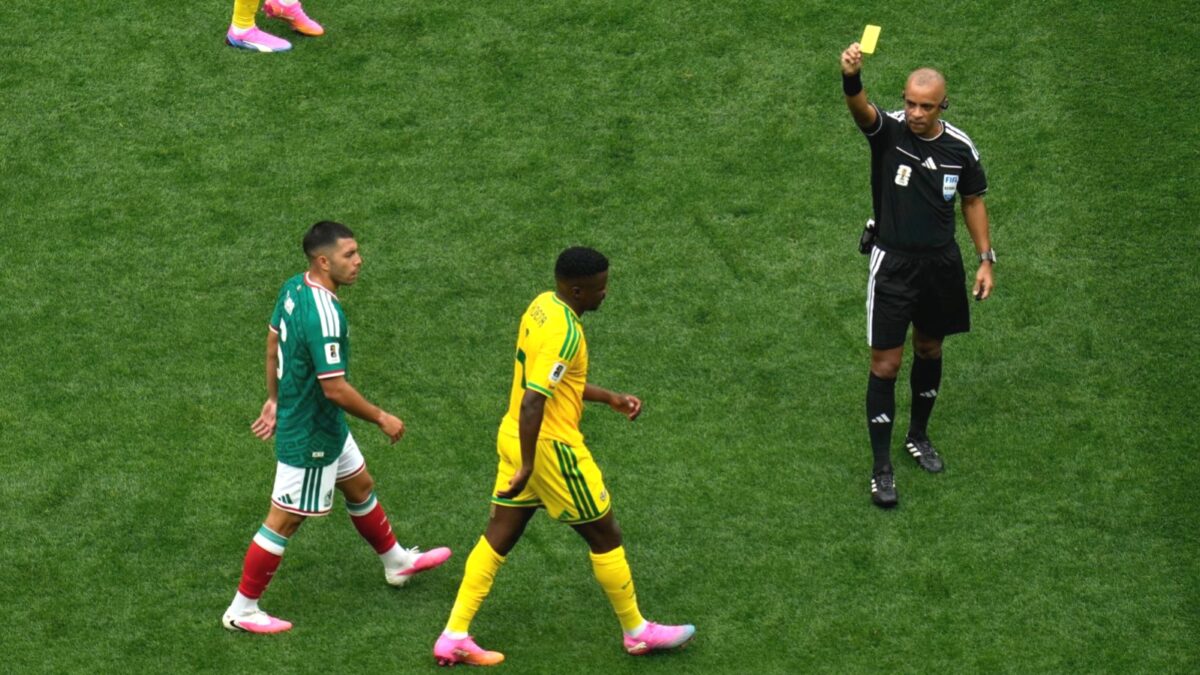
The match produced three red cards, a record for a World Cup opening game.
The first was not controversial. A player denied a clear goalscoring opportunity, a straight red by the rules, no debate. These decisions happen, and this one was clean.
The second was harder. Zwane’s raised hand near Alvarado’s face was the kind of incident that referees across the world would disagree on. Sampaio went to the VAR screen, watched the footage himself, and made his call. Whether it was right or wrong depends on who you ask. But the process was correct, he used the tools available, looked at the evidence, and decided.
The third red card came in stoppage time. It went to a Mexican player, the home side, in their own stadium, with 80,000 of their own supporters watching. The match was already decided. There was no pressure on Sampaio to go soft, to protect the mood of the crowd, to let something go because the atmosphere was tense. He called what he saw.
That is not nothing. Refereeing the home side in a packed stadium, in stoppage time, and still producing the card, that takes a certain kind of steadiness.
The Microphone Moment: A First in World Cup History
And then came the moment that nobody had seen before.
For the first time at a World Cup, a referee raised a microphone to explain a decision live, to the stadium, to the players standing on the pitch, to the millions watching at home.
The idea behind it is simple: transparency. Football has spent years being criticised for decisions that nobody explains. VAR helped, in some ways, but it also added confusion. Showing a replay on a big screen helps fans understand what a referee saw. But actually speaking, saying, in words, why a decision was made, is a different thing entirely. It is more human. It is also much harder.
Sampaio tried it. He spoke. The players on the pitch looked at each other. The commentators fell quiet as they tried to follow. Nobody was completely sure what he had said.
Here is the honest truth about that moment: it did not go perfectly. The words did not land the way a rehearsed speech lands. He was speaking in a language that was not his first, in a stadium that was loud, under pressure that no referee has ever faced in quite that way before.
But consider what he was actually being asked to do. Referees have spent a century saying nothing. Their entire job has been to decide and then move on, absorbing the anger, ignoring the noise. The microphone changed the rules of that job in real time, during the biggest match of the opening night, with the whole world watching.
The first person to try anything new will almost always stumble. That is not failure. That is just the cost of going first.
The moment went viral before the match was even over.
What Brazil Said
In Brazil, while the match was still being played, one word started going around on social media and in group chats: lendário. Legendary.
It was a joke, people laughing at the chaos, at the red cards, at the microphone moment that confused everyone. Brazilian humour is often sharp and quick, and this was a perfect subject for it.
But it was also real. There was genuine pride in there too. A man from a town nobody outside Goiás had heard of, walking out at the Azteca for his third World Cup, making history twice in one night, that is a story worth telling, regardless of how the decisions landed.
Sampaio is 44. He has been refereeing for nearly 30 years. He has been called awful. He has had his Wikipedia page vandalised. He has been used as a punchline by one of football’s biggest fanbases.
He walked out at the Azteca anyway.
The Referee Nobody Forgets
The strange truth about Wilton Sampaio is that he is one of the most recognisable referees in world football right now, not because he wanted to be, but because two very different groups of people decided to pay attention to him.
England remembers him as the man who cost them a World Cup quarter-final, even though the facts of that match are more complicated than the story.
Brazil remembers him as one of their own, a referee good enough to be trusted by FIFA with the biggest assignment of opening night.
And now the whole world knows his name because he picked up a microphone at the Azteca, stumbled through an explanation in front of 80,000 people, and did something no referee had ever done before.
Football has always been full of players making history. Sometimes, just sometimes, it is the man in the middle.