
Praggnanandhaa Beats Carlsen Again at Norway Chess 2026, While Gukesh and Divya Struggle
There are moments in sports when something happens so often that it stops feeling surprising. Magnus Carlsen losing a classical chess game used to be one of the biggest shocks in the sport. But at Norway Chess 2026, it has started to feel almost normal. And that, in itself, is a story worth telling.
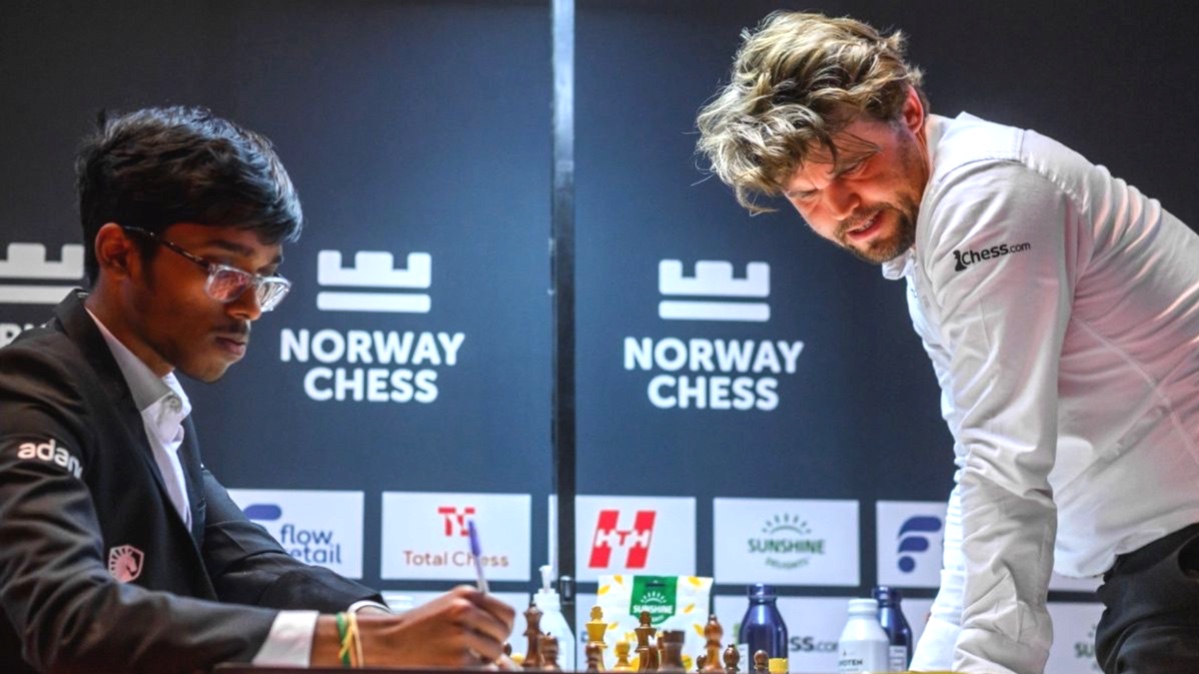
Round 8 of the tournament in Oslo gave us another one of those moments. R Praggnanandhaa, the 20-year-old Indian Grandmaster, beat Carlsen for the second time in two weeks in classical chess. The same tournament, the same opponent, and the same result. Only this time, the surprise was even smaller than the last.
Pragg Does It Again
Let’s talk about what Praggnanandhaa did, because it was not a lucky win. It was not a blunder from Carlsen that handed the Indian a free point. It was a carefully controlled game where Pragg played with confidence, patience, and a clear plan from start to finish.
Carlsen had the white pieces, which usually means the first-mover advantage. He came into this game clearly wanting to correct the result from their previous meeting. But Praggnanandhaa, playing Black in a French Defence, was not interested in making things easy. He accepted some structural damage early in the game, meaning his pawns were not perfectly placed, but in return, he got something more valuable: active pieces and control of the center of the board.
From that point on, the game slowly shifted in Pragg’s favor. Carlsen’s king became unsafe after move 14, and that problem never really went away. Praggnanandhaa kept coordinating his rooks, bishops, and queen, all working together like a well-organized team, to keep the pressure on. Carlsen fought back, as he always does, and the game lasted 50 moves. But in the end, Carlsen made a mistake on move 48, and that was enough. Pragg converted his advantage into a win.
Two weeks. Two classical wins. Against the World No. 1. That is not a coincidence, that is a pattern.
After the game, Praggnanandhaa was calm and focused. “It’s more important for the tournament that I get this win than thinking that it’s Magnus,” he said. “Of course, it’s great to do it against Magnus, but I think winning any game at this stage of the tournament is good.” That kind of thinking, keeping the bigger picture in mind rather than getting carried away, is exactly what separates good players from great ones.
What Is Happening With Carlsen?
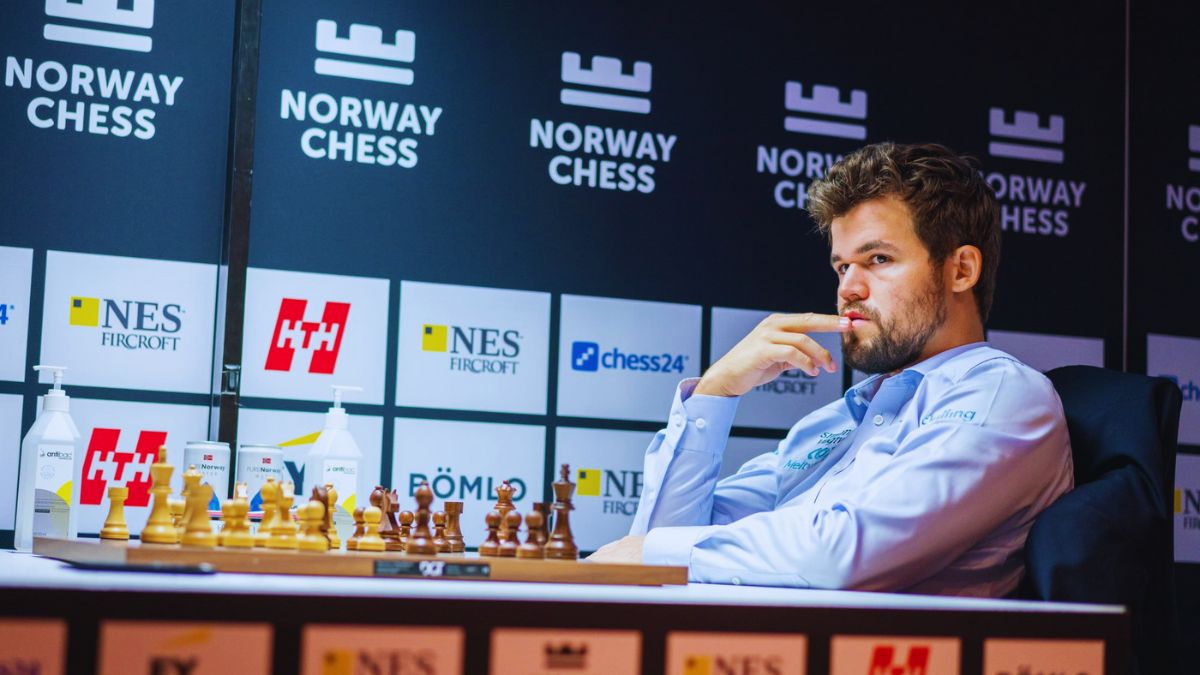
Magnus Carlsen is not just any chess player. He is a five-time World Champion, currently ranked number one in the world, and widely considered the best player of his generation. Losing one classical game in a tournament can happen to anyone. Losing four classical games in the same tournament is something else entirely.
After Round 8, Carlsen stands second-to-last with just nine points. That is a deeply unusual position for someone of his quality. Norway Chess is his home tournament, it is played in Oslo, the country is behind him, and the pressure to perform well is always there. Yet this year, the results have simply not come.
It is worth thinking about why this might be happening. Carlsen has been playing a lot of chess recently, across different formats and different tournaments. Sometimes, even the best players in the world go through rough patches. Their form dips, their concentration wavers, or their preparation does not work out the way they planned. None of that makes Carlsen a bad player, it just makes him human.
But there is also something specific happening here. Praggnanandhaa has beaten him twice in classical chess in this tournament alone. That suggests the young Indian has studied Carlsen’s games very carefully and found ways to make him uncomfortable. Pragg knows how to take away Carlsen’s favorite setups and force him into positions where the Norwegian does not feel at home. That is smart preparation, and it is clearly working.
For Carlsen, the remaining rounds of the tournament are going to be about damage control. Getting back to winning ways, finishing the tournament on a strong note, and making sure this rough patch does not carry forward into his next event.
Gukesh’s Struggles Continue
If Carlsen’s bad form has been one of the talking points of Norway Chess 2026, then D Gukesh’s struggles have been equally hard to watch. The reigning World Chess Champion, he won the title in December 2024 in one of the most dramatic matches in recent memory, has not played his best chess in this tournament. Round 8 brought another classical loss, this time against Alireza Firouzja.
The game lasted 61 moves. Gukesh was playing Black and chose an ambitious opening, going for kingside pawn advances early with moves like g5 and h5. These kinds of moves are exciting and aggressive, but they also leave weaknesses in your position. If your opponent reacts well, those weaknesses can become a serious problem.
Firouzja reacted well. He found the best response to Gukesh’s opening choice and then, according to Gukesh himself, the World Champion forgot his preparation. “I came up with this new 7…Bf5, but I think he reacted in the best way possible, and I just forgot my prep, and I’m pretty sure I mixed up something,” Gukesh said after the game. That admission is an honest one. Chess at the highest level requires players to remember deeply complex lines of theory, and sometimes that preparation simply slips away at the wrong moment.
After winning a pawn with a strong queen move, Firouzja simplified the game, trading pieces to reduce the complexity, and moved into a rook endgame. From there, he was in full control. His king became active, his pieces were better placed, and Gukesh’s attempts to fight back never quite got going. Firouzja won cleanly and well.
With this loss, Gukesh sits last in the open section with just eight points. That is a difficult position. He is the World Champion, and yet he is at the bottom of the table. It is a reminder that being the best player in the world at one point does not guarantee good results at every tournament. Form, preparation, and a bit of luck all play a role, and right now, things are not coming together for Gukesh in Oslo.
Divya Deshmukh’s Painful Reversal
In the women’s section, Divya Deshmukh came into Round 8 in second place. She had been playing solid chess throughout the tournament and was firmly in the race for the title. But Round 8 brought a painful loss against Bibisara Assaubayeva, the tournament leader from Kazakhstan.
What made this loss particularly hard was how it unfolded. Divya actually started the game well. She built queenside pressure early and won material, meaning she had more pieces on the board than her opponent. Going into the middlegame, she had an advantage. At that point, most players in her position would back themselves to convert.
But Assaubayeva did not give up. She stayed active, kept her pieces in the game, and waited for her moment. That moment came when she pushed her central pawn to e4 on move 35 and then to e3 on move 39. Those two moves completely changed the game. Suddenly, Divya’s king was under attack, her pieces were stuck defending, and Assaubayeva’s queen, rook, and bishop were all working together in a coordinated assault.
The attack was sharp and decisive. Divya could not find a way to stop it. Assaubayeva won, and with that win, she extended her lead at the top of the women’s section to 15.5 points. Divya, meanwhile, dropped from second to third with 10 points.
It was a disappointing result, especially because Divya had the game in her hands for a while. But Assaubayeva showed why she is leading the tournament, she stayed patient, stayed active, and took her chance the moment it appeared.
The Bigger Picture: India’s Mixed Day
So what do we make of India’s day at Norway Chess 2026 on Tuesday? It was, honestly, a mixed one. Praggnanandhaa gave Indian chess fans something to cheer about with another brilliant win over Carlsen. He is now in second place with 12 points and very much in contention for the overall title.
But Gukesh and Divya both lost their classical games, and both are now in difficult positions in their respective sections. Gukesh is last, Divya has dropped to third. For two players who were expected to be fighting for top positions, these are not the results they would have wanted.
Still, there are rounds remaining. Chess tournaments can turn quickly. A couple of strong results can change a player’s standing entirely, and both Gukesh and Divya are talented enough to bounce back.
Wesley So Stays on Top, Humpy Picks Up Points
In the broader context of the open section, Wesley So continues to lead the tournament with 14 points. He secured an Armageddon win over Vincent Keymer in Round 8, which kept him one point clear of Alireza Firouzja, who sits second with 13 points. So has been consistent throughout the tournament and looks like the player to beat.
In the women’s section, Koneru Humpy drew her classical game against Anna Muzychuk and then won the Armageddon tie-break. It was a solid, if unspectacular, result for Humpy, who has struggled for form in this tournament. Meanwhile, China’s Zhu Jiner beat Women’s World Champion Ju Wenjun in a classical game, which added another layer of drama to the women’s standings.
Pragg’s Quiet Confidence Is the Real Story
Through all the drama of Round 8, Carlsen’s continued struggles, Gukesh’s slip, Divya’s reversal, the one story that stands out most clearly is Praggnanandhaa’s calm, steady rise.
He is 20 years old. He is playing in one of the strongest chess tournaments in the world. He has beaten the best player on the planet twice in two weeks. And after doing all of that, his response is not to celebrate loudly or talk about how great he is. Instead, he says winning any game at this stage is good, and moves on.
That kind of quiet focus is rare. It is the mark of a player who is not thinking about the noise around him, the headlines, the rankings, the history, but only about the next move, the next game, the next round. If Praggnanandhaa keeps playing this way, Norway Chess 2026 might end with his name at the very top of the table.
Related posts:
 Norway Chess: Praggnanandhaa loses, Ding Liren is stunned, and Magnus Carlsen leads
 Norway Chess: Ding Liren struggles despite scoring a draw
 Norway Chess: Magnus Carlsen wins against Praggnanandhaa in Armageddon, maintains lead
 Norway Chess 2024: Magnus Carlsen wins the Title, Praggnanandhaa finishes 3rd