
India Targets 2038 Asian Games After 2030 CWG and 2036 Olympics Pitch
After making an aggressive push to host the 2036 Olympic Games and already securing the 2030 Commonwealth Games for Ahmedabad, India has now moved one step further by expressing interest in hosting the 2038 Asian Games. The Indian Olympic Association (IOA) has written to the Olympic Council of Asia (OCA) to formally place India’s name in the race for the next available Asian Games slot after 2034.
The proposal focuses once again on Ahmedabad and its growing network of sports facilities, which are already at the centre of India’s Commonwealth Games and Olympics plans. With South Korea and Mongolia also interested in the 2038 edition, the OCA will now send an evaluation team to India to study the bid.
India’s Formal Expression of Interest
According to recent reports, the IOA has sent an official expression of interest (EOI) to the Olympic Council of Asia, signalling India’s wish to host the 2038 Asian Games. The EOI was taken up at the OCA Executive Board meeting held in Sanya, China, where Asian sports leaders gathered during the Asian Beach Games.
IOA CEO Raghuram Iyer confirmed that India has opened formal communication with the OCA and that the two sides are now in regular contact on this matter. Iyer said that India has clearly stated its interest in bringing the Asian Games back to the country and that the IOA will continue its dialogue with the continental body in the coming months.
The OCA, in turn, has decided that an evaluation team will visit India to assess the bid on the ground. This visit is expected to look at planned venues, city infrastructure, transport, accommodation and other key areas needed for an event of this size.
Competing Bids from South Korea and Mongolia
India is not alone in the race for the 2038 Asian Games. South Korea and Mongolia have also shown interest in hosting this edition. South Korea’s plan, first discussed in 2021, is centred around the cities of Gwangju and Daegu, while Mongolia has been exploring its own proposal.
South Korea has a long history with multi-sport events, having hosted the Asian Games in Seoul and Busan as well as the Olympics and Winter Olympics in past decades. Mongolia, on the other hand, would be a new entrant at this level, which makes its interest notable.
However, at this stage, India’s expression of interest is among the most high-profile because it links directly to other big event plans, such as the 2030 Commonwealth Games and the proposed 2036 Olympic Games bid.
India’s History with the Asian Games
India has a deep historical connection with the Asian Games. It hosted the very first edition of the Games in 1951 in New Delhi, at a time when the event itself was still finding its identity in the sporting world. Three decades later, in 1982, the Asian Games returned to New Delhi, which once again served as the host city.
Those two editions helped build key pieces of sports infrastructure in the national capital and left a lasting mark on India’s sports history. Since then, however, the Asian Games have not come back to India, even though the country has regularly sent large contingents of athletes and has improved its performance in several sports.
The 2038 bid therefore represents a chance for India to bring the continent’s biggest multi-sport event back to its shores after more than half a century.
Ahmedabad at the Centre of India’s Mega-Event Plans
Just as with the 2030 Commonwealth Games and the proposed 2036 Olympics pitch, Ahmedabad is at the heart of India’s 2038 Asian Games interest. The Gujarat government and central authorities have been working on a long-term plan to transform the city into a major sports hub.
Two key projects form the backbone of this vision: the Sardar Vallabhbhai Patel (SVP) Sports Enclave in Ahmedabad and the Karai Sports Hub in Gandhinagar. The SVP Sports Enclave is coming up on a large tract of land near the Narendra Modi Stadium and is designed as an integrated sports city, with multiple permanent venues and support facilities.
The Karai Sports Hub, built around the existing Karai Police Academy area, will add an athletics stadium, shooting complex and indoor arenas, supported by nearby riverfront development in Gandhinagar. Together, these two hubs are planned to handle a wide range of sports and can be adapted for different multi-sport events.
Details of the SVP Sports Enclave
The SVP Sports Enclave is one of the flagship projects in India’s long-term sports infrastructure roadmap. Spread across more than 330 acres next to the Narendra Modi Stadium, it is designed to host multiple Olympic-standard venues within a single connected campus.
At its core is the Narendra Modi Stadium itself, which is already the world’s largest cricket ground by seating capacity and a regular venue for major international matches and tournaments. Around it, the enclave will include a large indoor arena, an aquatics centre for swimming and diving events, and a tennis centre.
The design by leading international firms aims to meet the requirements of top-tier global events, including the Olympics and Asian Games. Plans also include training facilities, warm-up areas, and support spaces such as media centres and athlete zones.
Karai Sports Hub and Riverfront Development
The Karai Sports Hub forms the second major cluster in the Ahmedabad–Gandhinagar region. Located around the Karai Police Academy, this complex is being developed as a modern athletics and multi-sport centre.
Current plans include a new athletics stadium that can host track and field events, a shooting complex for rifle, pistol and shotgun competitions, and an indoor arena suitable for sports like basketball, volleyball or gymnastics. The hub is supported by planned improvements to the nearby riverfront, which will add open spaces, training areas and access routes.
This combination of the SVP Enclave and Karai Hub allows organisers to spread events across multiple zones while still keeping them connected by transport corridors and shared services.
2030 Commonwealth Games in Ahmedabad and Beyond
India has already secured the rights to host the 2030 Commonwealth Games, with Ahmedabad chosen as the main host city. The multi-sport event will use several of the venues that are now under construction or redevelopment.
In addition to the Narendra Modi Stadium and facilities within the SVP Sports Enclave, the 2030 CWG is expected to use other venues such as the Veer Savarkar Sports Complex and Eka Arena, along with sites in nearby cities like Vadodara, Gandhinagar and Ekta Nagar.
These Games will be spread across the region to make use of existing grounds while also showcasing the new facilities. This experience will give local authorities and organisers valuable knowledge in running a large, multi-city sports event.
Linking the 2038 Asian Games Bid to the 2036 Olympics Pitch
India’s interest in the 2038 Asian Games is closely tied to its ongoing pitch for the 2036 Olympic Games, for which Ahmedabad has been projected as the proposed host city. Large-scale investments in sports and civic infrastructure in and around Ahmedabad are being planned with these events in mind.
Officials involved in the planning say that hosting the Asian Games in 2038 would be a logical step, especially if India goes ahead with its 2036 Olympics ambition. Since many stadiums, arenas and support facilities would already have been built for the Olympics, the Asian Games could use the same venues with only limited additional cost.
Even if India does not eventually win the 2036 Olympics, the 2038 Asian Games would provide a major multi-sport platform where all this new infrastructure could be used fully and tested against world standards.
Cost and Infrastructure Considerations
One of the main arguments in favour of bidding for the 2038 Asian Games is that the cost of hosting the event could be lower than building everything from scratch. Since the Gujarat government and central agencies are already spending heavily on new stadiums, training centres, roads, metro lines and airport upgrades for the 2030 CWG and possible Olympic bid, much of the basic backbone will already be in place.
This integrated planning approach means that venues can be designed to serve multiple events over time rather than just a single tournament. For example, an aquatics centre built to Olympic standards can easily host Asian Games swimming as well as World Championships or other international meets.
Officials also believe that careful use of existing venues in other cities across Gujarat and India, along with new construction in Ahmedabad and Gandhinagar, can create a balanced and efficient Games model.
Asian Games: Bigger Field and Broader Sports Programme
The Asian Games are often described as larger than the Olympic Games in terms of the number of athletes taking part. Recent editions have seen around 12,000 athletes competing, compared to about 10,500 at the Olympics. The sports programme is also broader, as the Asiad includes several regional sports alongside Olympic disciplines.
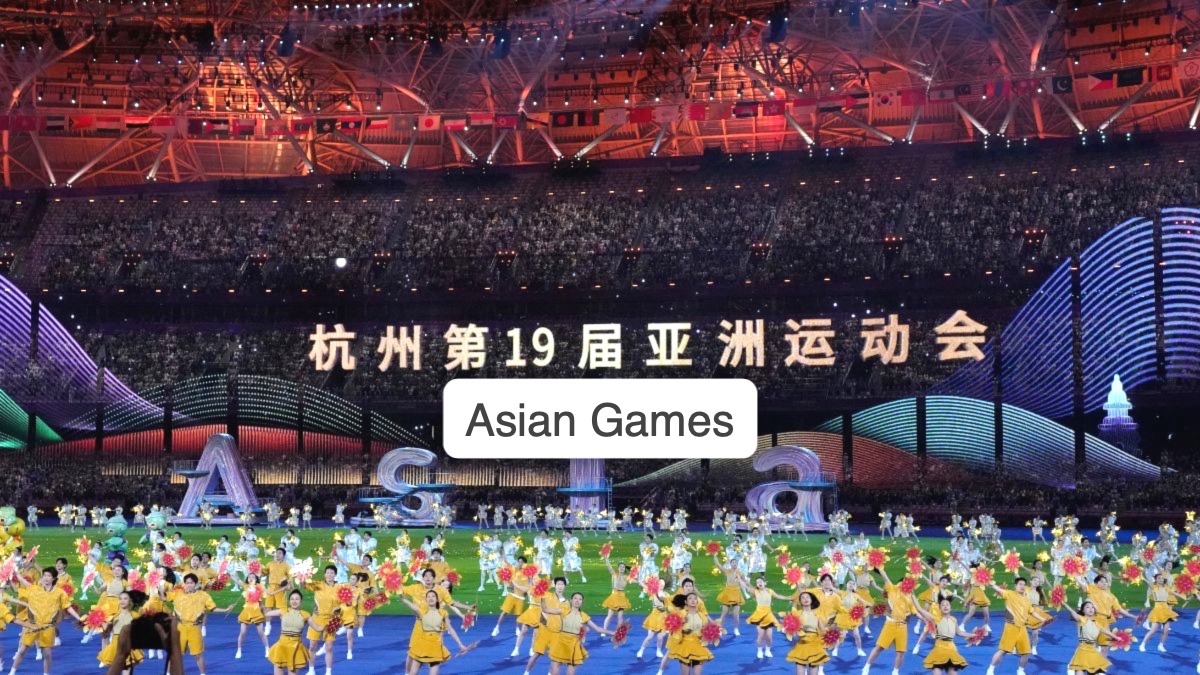
For example, the 2022 Asian Games in Hangzhou featured 40 sports, ranging from athletics and swimming to kabaddi, wushu and sepak takraw. By contrast, the Paris 2024 Olympic Games programme includes 32 sports.
This wider spread of sports means that host cities must prepare for a larger variety of venues and competition formats. It also underlines the importance of having flexible facilities that can handle different kinds of events.
Other Major Events on India’s Calendar
Beyond the 2030 Commonwealth Games and the 2038 Asian Games bid, India is also lined up to host the 2028 World Indoor Athletics Championships in Bhubaneswar. The Odisha capital has already hosted several major athletics competitions in recent years and is being seen as a growing centre for track and field.
This event will be separate from the Ahmedabad-Gujarat cluster of venues and will focus specifically on indoor athletics. Yet, it adds another global-level tournament to India’s sports calendar around the same time frame.
Governance and IOA’s Role
The Indian Olympic Association plays a central role in all these bids and hosting plans. Over the last few years, the IOA has gone through internal changes and governance reforms, including debates and discussions around the appointment of CEO Raghuram Iyer.
These governance issues drew attention from the International Olympic Committee (IOC), which closely monitors the functioning of all national Olympic bodies. However, recent reports suggest that many of these disputes have now been resolved, with Iyer’s appointment ratified and the IOA’s partnership with the IOC and Olympic Solidarity programmes fully restored.
This improved stability has allowed the IOA to focus more strongly on long-term event planning, including the 2030 CWG, the 2036 Olympics pitch and now the 2038 Asian Games expression of interest.
India’s move to express interest in hosting the 2038 Asian Games comes at a time when the country is already deeply involved in planning and bidding for several large international events. With Ahmedabad at the centre of the 2030 Commonwealth Games and the proposed 2036 Olympic Games bid, the Asian Games fit into a wider roadmap driven by new infrastructure such as the SVP Sports Enclave and Karai Sports Hub.
The final decision will rest with the Olympic Council of Asia, which will study India’s plans alongside those of South Korea and Mongolia. For now, India has clearly placed its marker on the table, signalling that it wants to bring the Asian Games back to the country for the first time since 1982.
Related posts:
 India Secures Historic Gold Medal in Equestrian Dressage at the Asian Games 2023
 19th Asian Games 2023: Nepal becomes the first team to register 300-runs in T20 cricket history
 Asian Games 2023 India’s Day 5 Schedule: Time, Sport, and Athletes
 India Dominates Archery Qualification at Asian Games 2023