
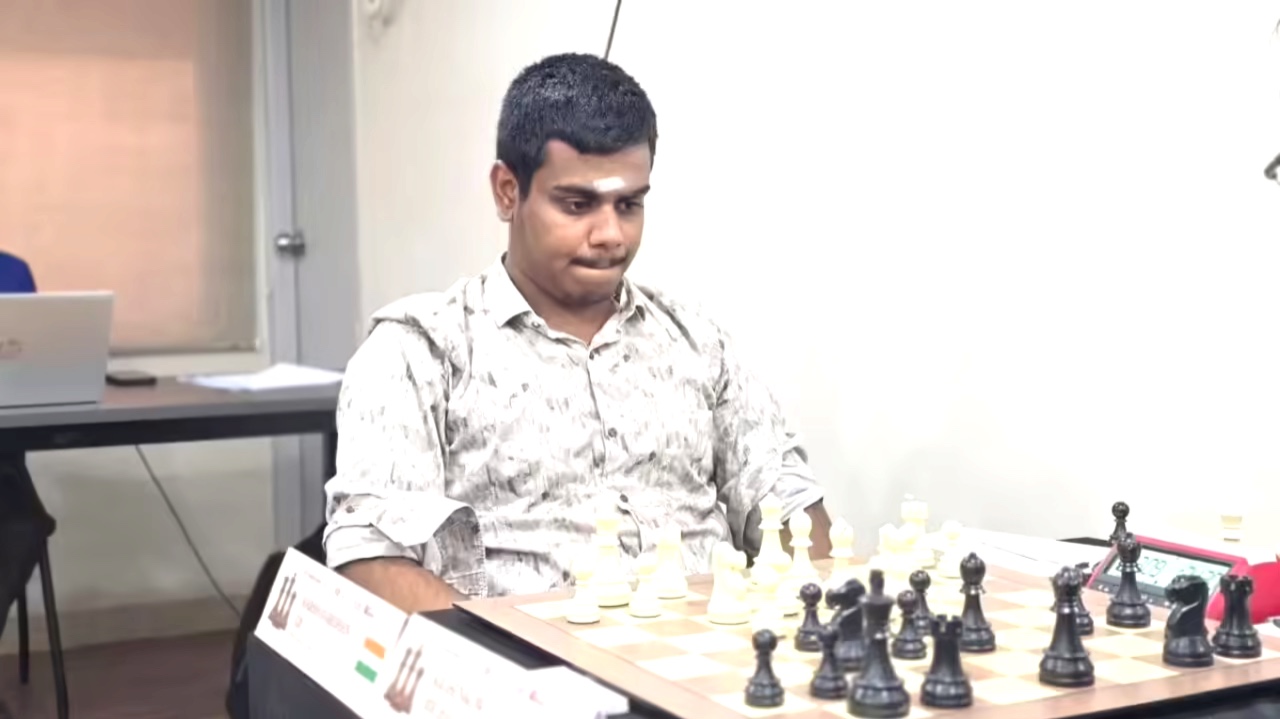
Harshavardhan Becomes India’s 97th Grandmaster
Chess in India has always had a special home, Chennai. The city gave the world Viswanathan Anand, the man who changed how the world looked at Indian chess. Decades later, Chennai continues to write new chapters. On Sunday, a 22-year-old from the same city added his name to one of the most respected lists in Indian chess, the list of Grandmasters. Harshavardhan GB became India’s 97th Grandmaster, and with that, brought India three steps closer to the landmark of 100 Grandmasters.
But this was not just a sporting milestone. It was the end of a long, often painful wait, and the beginning of something even bigger.
A Moment That Said Everything
The final round of the 2nd Chola Chess GM Norm Round Robin Tournament ended with a draw. When the result was confirmed in Harshavardhan’s game against veteran Mihail Nikitenko, the playing hall broke into applause. Players shook his hand. Tournament organisers gathered around him. It was a warm, cheerful scene.
But Harshavardhan did not stay inside for long.
Within minutes, he walked out to the waiting area, where his mother had been sitting, hoping, and waiting. She was trying her best to hold back tears. The two of them met, and in that quiet moment outside a chess tournament hall in Chennai, a six-year journey finally found its ending.
It was a simple, human moment. No big speeches. No dramatic celebration. Just a mother and son, and the kind of happiness that does not need words.
“I’m feeling relieved, first of all, on finally completing it,” Harshavardhan said. “And one more good thing for me is that I took my IM title in Chennai, the last norm. Now, doing my GM title here is also special.”
The Beginning: Chess at Three Years Old
Harshavardhan’s story with chess did not start at a school club or a local tournament. It started at home, when he was barely three or four years old.
His father, Gopalakrishnan K, is a FIDE trainer and a former competitive player who once played for the Indian Bank chess team. Back in those days, Gopalakrishnan regularly held training sessions at their home in Chennai. International Masters and Grandmasters would visit, sit across from each other, and play.
Little Harshavardhan would just watch.
“They used to attend classes at my home. At that age, I just used to watch them,” Harshavardhan recalled. “Then at some time, like around four, I picked up interest and started playing.”
Growing up surrounded by chess meant that the game became second nature to him. He did not have to be pushed toward it. It was always there, on the board, in the conversations at home, in the people who walked through the door.
When his father saw that the young boy was picking up the game quickly, he reached out to a close friend and former Indian Bank teammate, FM Hariharan Venkatachalam, to begin Harshavardhan’s formal training in Anna Nagar, Chennai.
Hariharan noticed something right away.
“He was a very bright student, very fast, and in calculation,” Hariharan said. “In his early years, he showed his interest. He was very good at tactics initially. He was left-handed, so I thought he would be very good at something special.”
‘Legend’, A Name His Friends Gave Him
As Harshavardhan grew older and started attending training sessions with other young players, something stood out about the way he played and thought about chess.
He had a creative side. While other players would go through standard ideas during analysis sessions, Harshavardhan would sometimes come up with unusual, unexpected moves that would leave the group surprised. His friends were not just impressed, they were in awe.
So they gave him a nickname.
They called him “legend.”
“We used to play training games at that time when we were attending classes,” Harshavardhan explained with a smile. “I don’t remember whether I was doing a lot better there, or I came up with some very creative ideas while doing those analyses. So that’s somehow how that name got picked up, and then it started.”
It was a playful name between friends, but it also turned out to be a prediction. Because over the next several years, Harshavardhan backed it up with results.
A Junior Career Full of Wins
Through his teenage years, Harshavardhan built one of the most consistent junior records in Indian chess. He won a bronze medal at the Asian Schools Championship in 2012. He followed that with another bronze at the Asian Youth in 2015, and then a silver for problem-solving at the Asian Championships in 2016.
At the state level, he was almost untouchable. He won championships in nearly every age category, right from under-9 all the way through to under-19.
The wins kept coming as he stepped into senior-level competition. In 2021, he won the FIDE World Youth Online Under-18 gold. In 2022, he won the Asian Juniors gold. He even qualified for the FIDE World Cup, one of the most prestigious chess events in the world.
After his foundational years with Hariharan, he trained under the experienced coach Visweswaran Kameswaran until 2022. He then moved to Grandmaster Deepan Chakkravarthy in 2024.
“They have been really supportive, my coaches,” Harshavardhan said.
The Long Wait for the Final GM Norm
In 2020, Harshavardhan earned his International Master (IM) title, one of the highest honours in chess below the Grandmaster level. At the time, he was on a strong path, and the Grandmaster title seemed to be the natural next step.
What followed, though, was six years of chasing.
To become a Grandmaster, a player needs to earn three GM norms across different tournaments, along with a rating of 2500 or above. Harshavardhan had his rating. But the third and final norm kept slipping away.
“I missed a GM norm in like 10 to 15 tournaments very easily. It will be either the technical part, or I miss by half a point,” he said.
Half a point. In chess, that is often the difference between winning and drawing. And in norm tournaments, where every point counts, a half-point miss can feel crushing. Time after time, Harshavardhan would come close, and then fall just short.
Even having a father who is a FIDE trainer and knows the game inside out could not make the process easier. Harshavardhan understood this clearly.
“You might know what is coming, but you cannot stop what is coming,” he reflected. “You can say that you know you might have to face this, but you cannot avoid facing the challenges.”
Struggles Off the Board
The challenges were not only on the chessboard.
International chess is an expensive pursuit. Players travel to tournaments across the world, pay for flights, accommodation, and food, and in many cases, do all of this without any financial support from sponsors or government bodies.
That was Harshavardhan’s reality.
“I was never in a scholarship, I was never in a sponsorship. I had a scholarship from the Airports Authority for some time, but right now I’m not in anything,” he revealed.
Every trip abroad was paid for by his family. A small, nuclear family, his father, his mother, and him, carrying the full weight of the expenses.
“Every single time you travel, you spend a lot. Not on something you don’t need, but just for tournaments and accommodation, the prices are high,” he said.
There were also practical problems that piled up during international travel. During one event in Kazakhstan, serious flight delays left him stranded for two days. As a strict vegetarian, finding food in several foreign countries was a constant challenge, something many people might not think about, but something that drains both energy and focus when you are trying to prepare for a chess game.
Through all of it, his mother was his steady support. For most of his career, she travelled with him to every single tournament.
“She used to accompany me until like the last three years for every single tournament,” Harshavardhan said.
Over the last two to three years, health and logistical reasons meant he started travelling alone. But his mother’s care never stopped.
“Even when I travel alone, she makes sure that she takes care of everything,” he added.
A Father’s Pride, Years in the Making
While his mother was present at the venue on the day of his final GM norm, his father was at home, watching from a distance.
Gopalakrishnan K has spent years training other players. He has watched many students grow into titled players. But watching his own son cross that line was a different feeling altogether.
“No words can explain his happiness. He is extremely happy,” Harshavardhan said of his father. “He wanted to come immediately after that (the GM norm was secured). He was very excited to be there.”
For a man who built his life around chess, first as a player, then as a trainer, this moment was not just about his son earning a title. It was about watching a child who once sat in the corner of a room, silently watching chess lessons, grow into a Grandmaster.
Three Wins, One Draw, and a Dream Completed
At the 2nd Chola Chess GM Norm Round Robin Tournament, Harshavardhan played with purpose. He pulled off three wins and one draw in his last four games to finish second overall with 6.5 points out of 9. That run secured the third and final GM norm he had been chasing for six years.
The tournament was held in Chennai, the same city where he grew up, where he first touched a chess piece, and where he earned his IM title years earlier.
The full circle was not lost on him.
“I took my IM title in Chennai, the last norm. Now, doing my GM title here is also special,” he said.
After completing his Bachelor’s Degree in Commerce in 2024, Harshavardhan made a clear decision. Chess would not be something he did on the side. It would be his career.
Now a Grandmaster, he has one target in his sights, reaching the level of a super-Grandmaster, with a rating of 2600 or 2700.
“My only thing I’m just hoping is to get to 2600, 2700. Like, become a super GM,” he said.
India’s 97th Grandmaster. A “legend” among friends. A son who made his parents proud. Harshavardhan GB’s story is proof that the road to the top is rarely straight, but with enough patience, enough heart, and a family that never stops believing, it does eventually lead somewhere worth reaching.