In India, we always US based trends considering what will work there will certainly work here and the latest to join the bandwagon is Pickleball.
India is way much bigger and diverse market like US, when it comes to Pickleball however the product which runs successfully in later have failed to grasp attention of people back home in India.
I would have said the same thing if it was a common man perspective as Journalist I am bound to research reality and state facts let me begin.
The simple answer would be Yes Pickleball Hype has substantially decreased in India but that downward fall is for shorter time duration.
This happens all Sport, even Cricket which is extremely popular in India, took several years to gain that popularity as building an ecosystem takes time as it requires system in place.
Likewise, Pickleball has the potential, diverse market, stakeholders and players in order to expect them to become an established and most talked about sport in limited time frame is unfair by all means.
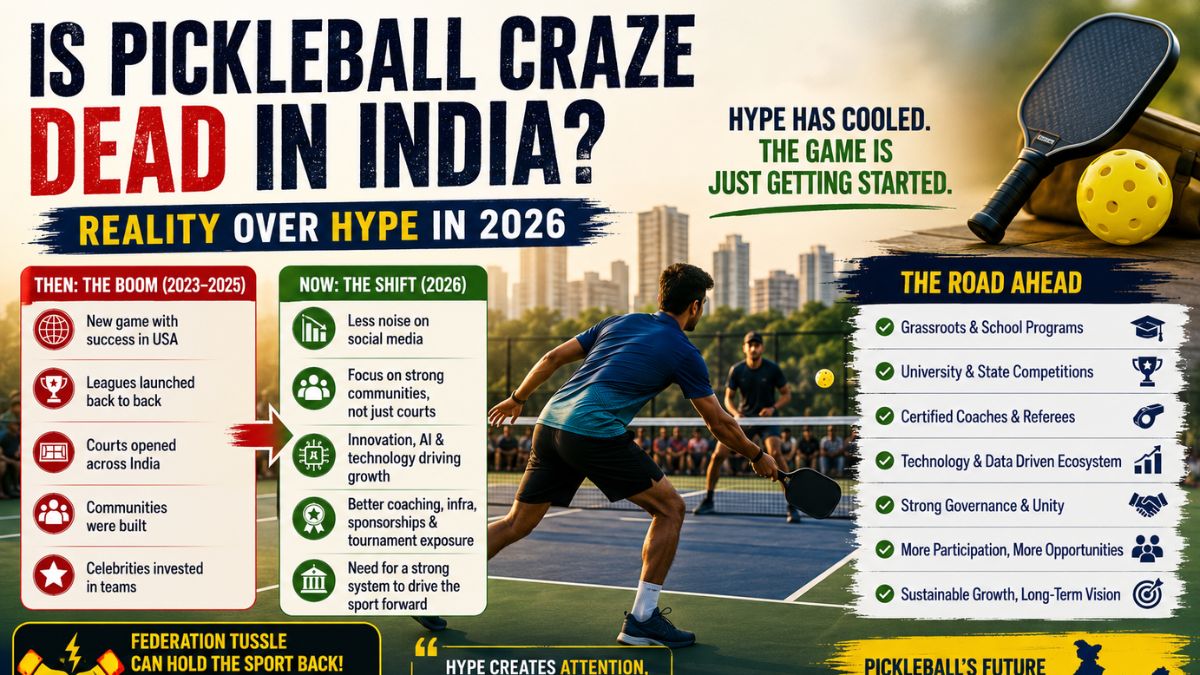
Let me share what was happening before as compare to what is happening now in Indian Pickleball ecosystem:
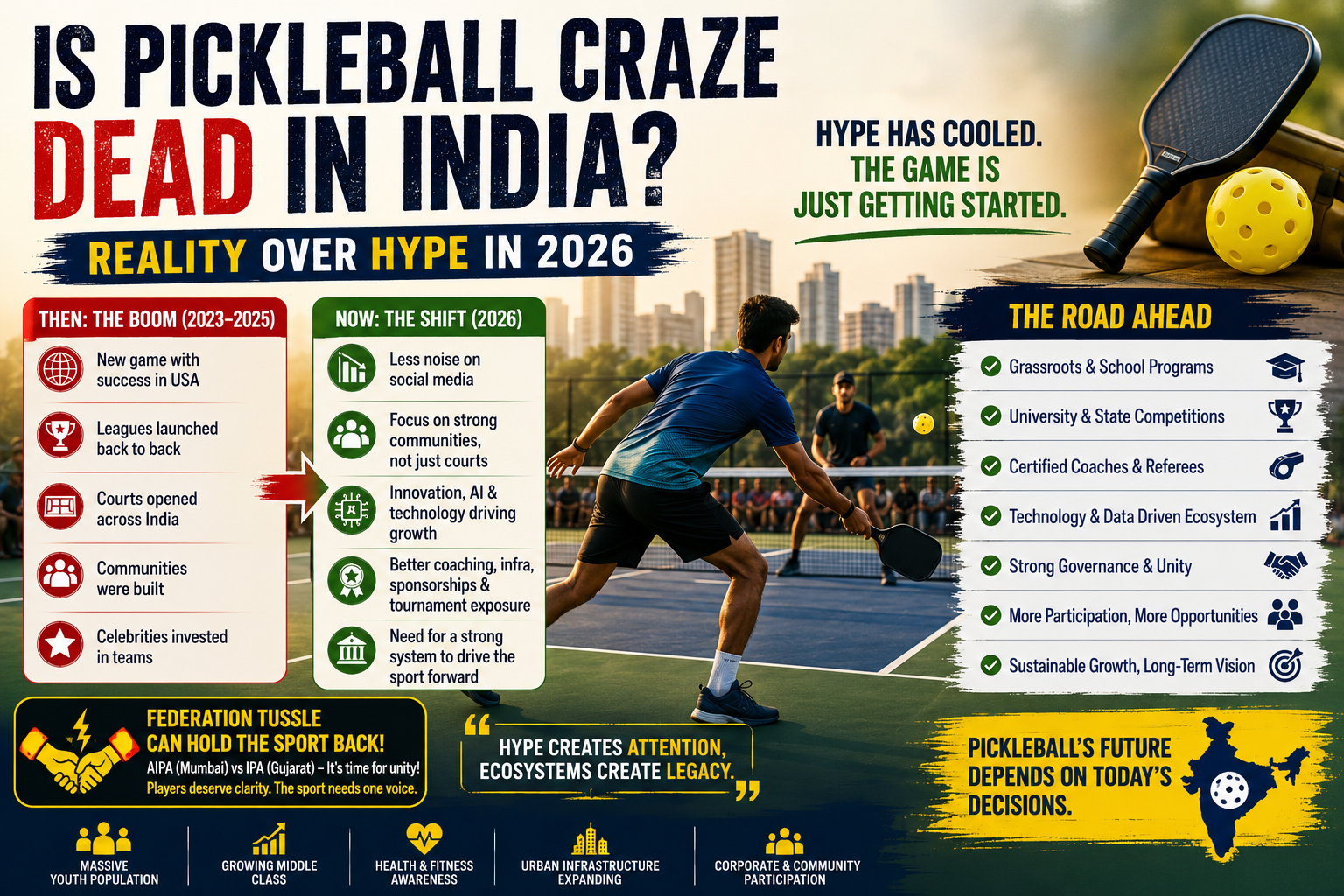
1. Game was pretty new and had tasted success in USA.
2. Leagues started happening back to back.
3. Courts started opening all across India.
4. Communities were build
5. Celebrities Invested by purchasing teams in Leagues.
All these happened couple of years back now let’s move towards what’s happening now
1. Less Noise on Social Media
2. All the stakeholders who operate courts have finally understood, more than distinct courts we need strong communities who can push this game forward with raw and innate experience.
3. The stakeholders have realized they have to bring innovation, AI and technology to build this game forward.
4. Focus has been shifted to provided perennial experience which include- Good Coaching, Infrastructure, Sponsorships, Exposure when it comes to participating in Tournaments.
5. Overall, Pickleball decision makers are realizing the need to build and established system in place in order to drive this sport forward in our country.
Also India needs to realize, Federation Tussle between All India Pickleball Association( AIPA) based in Mumbai and Indian Pickleball Association( IPA) based in Gujarat would not take this beautiful sport ahead the concern authority need to come on consensus to drive functionality related to Sport otherwise future of players would steer in backward direction.
More Details About Pickleball
Understanding the Hype Cycle
Every emerging industry follows a predictable pattern.
It starts with excitement.
Then comes rapid investment.
After that, reality sets in.
Many businesses leave, weaker projects shut down, and public conversations reduce. This often creates the impression that the industry has failed.
But in reality, this phase is where sustainable growth actually begins.
Even cricket, the country’s biggest sport, did not become India’s obsession overnight.
It took decades of domestic tournaments, school competitions, institutional backing, infrastructure development, broadcasting, sponsorship, and community participation before reaching its current status.
Badminton experienced a similar journey.
Kabaddi too witnessed years of grassroots development before the Pro Kabaddi League transformed its commercial appeal.
Pickleball is no different.
Expecting the sport to become India’s next cricket within three or four years is unrealistic.
What Happened During India’s Pickleball Boom?
A few years ago, almost everything surrounding pickleball was driven by excitement.
The ecosystem witnessed rapid developments.
The sport entered India after gaining remarkable popularity in the United States.
Multiple professional leagues were announced in quick succession.
Private investors started opening dedicated pickleball courts across major cities.
Local communities and recreational groups began forming.
Celebrities and entrepreneurs invested in franchises and leagues, creating additional visibility.
Equipment brands entered the Indian market with new products.
Corporate houses started experimenting with pickleball tournaments as employee engagement activities.
Luxury clubs and residential societies began including pickleball courts in their amenities.
For a while, it appeared that pickleball had become India’s fastest-growing sport.
However, growth driven purely by hype is rarely sustainable.
What Has Changed in 2026?
Today’s ecosystem looks very different.
The conversation has shifted from expansion to sustainability.
Here are the biggest changes.
1. Social Media Buzz Has Reduced
There are fewer viral posts compared to two years ago.
Many people mistake this reduced online visibility as a decline in the sport itself.
Social media attention is temporary.
Sports ecosystems are permanent.
Less online noise doesn’t necessarily mean fewer people are playing.
2. Communities Have Become More Important Than Courts
Initially, everyone focused on building courts.
Now, stakeholders understand that empty courts don’t build sports.
Strong communities do.
Successful venues today organise beginner sessions, leagues, coaching camps, family tournaments, women’s events, corporate competitions and weekend social games.
Community engagement has become more valuable than infrastructure alone.
3. Technology Is Becoming a Growth Driver
The conversation is no longer just about constructing more facilities.
Stakeholders are exploring technology-driven solutions including:
AI-powered coaching and performance analysis
Court booking platforms
Player ranking systems
Tournament management software
Smart officiating and match analytics
Digital fan engagement and livestreaming
Technology is slowly becoming an important pillar for long-term growth.
4. The Focus Has Shifted Towards Player Experience
Instead of merely increasing participation numbers, organisers are paying greater attention to quality.
This includes:
Better coaching programmes
Certified referees
Professional tournament management
Improved infrastructure
Sponsorship opportunities
Player development pathways
Junior competitions
Women’s participation
Grassroots engagement in schools and colleges
These are the foundations that create a sustainable sporting ecosystem.
5. Stakeholders Are Thinking Long-Term
Perhaps the biggest shift is mindset.
The discussion has moved beyond “How do we make pickleball popular?”
The question now is:
“How do we build a sport that lasts for decades?”
That change in thinking is a positive sign.
India’s Biggest Opportunity
India offers something the United States cannot replicate.
A massive young population.
An expanding middle class.
Growing urban infrastructure.
Increasing health awareness.
Corporate participation.
Digital-first communities.
And an appetite for recreational sports.
If these advantages are supported by structured planning, pickleball can evolve into one of India’s strongest participation sports over the next decade.
However, achieving that requires more than enthusiasm.
It requires governance, collaboration and patience.
The Federation Challenge Cannot Be Ignored
One of the biggest concerns facing Indian pickleball today is administrative uncertainty.
The ongoing differences between the All India Pickleball Association (AIPA) based in Mumbai and the Indian Pickleball Association (IPA) based in Gujarat have created unnecessary confusion for players, organisers and investors.
No sport grows when its governing structure remains divided.
Players deserve clarity.
Coaches deserve direction.
Sponsors need confidence.
Tournament organisers require consistency.
Parents need assurance before encouraging children to pursue the sport seriously.
The concerned authorities must work towards consensus and establish a transparent governance framework that prioritises athletes over administrative disputes.
Without institutional stability, even the fastest-growing sport can lose momentum.
The Road Ahead
The future of pickleball in India will not depend on viral Instagram reels or celebrity investments alone.
It will depend on the strength of its ecosystem.
Schools introducing pickleball into physical education programmes.
Universities offering structured competitions.
State associations conducting regular championships.
Certified coaching programmes.
Sports science support.
Broadcast partnerships.
Grassroots tournaments.
Corporate participation.
Women’s and junior development.
And above all, collaboration among every stakeholder involved.
Final Thoughts
The pickleball craze may have cooled, but the opportunity certainly hasn’t.
Every major sport experiences a period where public excitement fades and genuine builders remain.
That is exactly where Indian pickleball stands today.
This is no longer the era of chasing headlines.
It is the era of building systems.
Because in sports, hype creates attention, but ecosystems create legacy.
| Topic | Key Insights |
|---|---|
| Introduction | India often adopts trends that become successful in the US, assuming they will work similarly here. Pickleball is the latest example. However, India’s sports ecosystem, demographics, and consumer behaviour are far more diverse and require a different growth approach. |
| Has Pickleball Hype Declined? | Yes. The hype has reduced considerably, but the decline is temporary and part of the natural evolution of every emerging sport. |
| Why Has the Hype Reduced? | Initial excitement has settled, social media conversations have slowed, and stakeholders are now focusing on building a sustainable ecosystem instead of chasing rapid expansion. |
| Does This Mean Pickleball is Dying? | No. Every successful sport goes through a correction phase before achieving long-term growth. |
| Example from Other Sports | Cricket, badminton, and kabaddi took years to establish strong ecosystems through grassroots development, tournaments, infrastructure, broadcasting, and sponsorships. Pickleball is following a similar path. |
| India’s Potential | India has a large youth population, rising health awareness, growing middle class, expanding urban infrastructure, corporate participation, and increasing demand for recreational sports—all of which support pickleball’s long-term growth. |
Phase 1: What Happened During India’s Pickleball Boom?
| Earlier Growth Drivers (2023–2025) | Impact |
|---|---|
| Pickleball gained popularity in the USA | Inspired Indian investors and entrepreneurs. |
| Multiple leagues launched | Increased visibility and commercial interest. |
| Rapid growth of dedicated courts | Improved accessibility for players. |
| Communities started forming | Encouraged recreational participation. |
| Celebrity investments in teams | Generated mainstream attention. |
| Sports brands entered the market | Increased availability of equipment. |
| Corporate tournaments emerged | Expanded participation beyond athletes. |
| Clubs & societies built courts | Improved recreational infrastructure. |
Phase 2: What’s Happening in 2026?
| Current Reality | What It Means |
|---|---|
| Less social media buzz | Reduced hype doesn’t mean reduced participation. |
| Focus shifting towards communities | Active player engagement matters more than court numbers. |
| Technology becoming important | AI coaching, player analytics, digital bookings, smart officiating, and livestreaming are gaining attention. |
| Better player experience | Stakeholders are investing in coaching, referees, tournaments, infrastructure, sponsorships, and exposure. |
| Long-term ecosystem thinking | Focus has shifted from popularity to sustainability. |
The Pickleball Hype Cycle
| Stage | Description |
|---|---|
| Stage 1 | Excitement around a new sport. |
| Stage 2 | Rapid investments and expansion. |
| Stage 3 | Reality check as weaker projects shut down. |
| Stage 4 | Sustainable ecosystem begins to develop. |
India is currently transitioning from Stage 3 to Stage 4.
Communities vs Courts
| Earlier Mindset | Current Mindset |
|---|---|
| Build more courts | Build stronger communities |
| Increase infrastructure | Increase participation |
| Celebrity-driven marketing | Player-centric development |
| Quantity | Quality |
| Rapid expansion | Sustainable growth |
Technology Driving the Next Phase
| Technology | Potential Benefits |
|---|---|
| AI Coaching | Performance improvement |
| Match Analytics | Better player insights |
| Court Booking Apps | Improved accessibility |
| Tournament Software | Efficient event management |
| Smart Officiating | Better officiating standards |
| Livestreaming | Fan engagement and sponsorship opportunities |
Improving Player Experience
| Area | Importance |
|---|---|
| Professional Coaching | Skill development |
| Certified Referees | Fair competition |
| Tournament Exposure | Competitive opportunities |
| Sponsorships | Financial support |
| Junior Development | Future talent pipeline |
| Women’s Participation | Inclusive growth |
| Grassroots Programmes | Long-term sustainability |
| Infrastructure | Better playing experience |
India’s Biggest Opportunity
| Strength | Opportunity |
|---|---|
| Young population | Large player base |
| Expanding middle class | Higher spending on sports |
| Urbanisation | Increased demand for recreational activities |
| Health-conscious lifestyle | More participation |
| Digital-first audience | Faster community building |
| Corporate interest | Sponsorship and events |
Biggest Challenge Facing Indian Pickleball
| Issue | Impact |
|---|---|
| Federation tussle between All India Pickleball Association (AIPA) and Indian Pickleball Association (IPA) | Creates uncertainty for players, organisers, sponsors, and investors. |
| Lack of unified governance | Slows ecosystem development. |
| Confusion over recognition | Affects player pathways and tournament credibility. |
| Administrative disputes | Diverts attention from athlete development. |
What India Needs Next
| Priority | Expected Outcome |
|---|---|
| School Pickleball Programmes | Grassroots participation |
| University Competitions | Youth development |
| State Championships | Structured competition |
| National Ranking System | Clear player pathway |
| Certified Coaches | Better training quality |
| Sports Science Support | Improved athlete performance |
| Broadcast Partnerships | Wider audience reach |
| Corporate Sponsorships | Financial sustainability |
| Women’s & Junior Initiatives | Inclusive ecosystem |
| Unified Governance | Long-term stability |
Final Verdict
| Question | Answer |
|---|---|
| Is Pickleball hype dead in India? | Yes, the hype has reduced. |
| Is Pickleball dying? | No. |
| Current Phase | Ecosystem Building |
| Biggest Opportunity | India’s youth population and recreational sports market. |
| Biggest Challenge | Governance, federation unity, and structured pathways. |
| Future Outlook | Positive, provided stakeholders focus on community building, governance, grassroots development, technology, and long-term planning instead of short-term hype. |
Key Takeaways:
Hype creates attention. Ecosystems create legacy.
India’s pickleball journey is no longer about becoming the next trending sport—it’s about becoming the next sustainable sporting ecosystem.