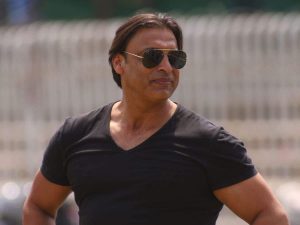
Former Pakistani pace bowler Shoaib Akhtar is celebrating his 48th birthday today, on August 13. Widely recognized as The Rawalpindi Express, Akhtar holds the esteemed distinction of delivering the fastest-recorded ball in the history of international cricket. During the 2003 World Cup, Shoaib Akhtar’s bowling speed soared to 161.3 kmph, as registered on the speedometer, while facing England’s Nick Knight. This feat placed him in the exclusive club of bowlers who surpassed the 100 mph threshold, earning him the title of the world’s fastest bowler.
Also read: Virat Kohli Clarified Misleading Media Reports
Akhtar’s remarkable express pace became the foundation for his remarkable achievements in the realm of international cricket. Over his international career span from 1997 to 2011, he participated in 46 Test matches, 163 ODIs, and 15 T20Is for the Pakistani national team.
In these encounters, Shoaib Akhtar secured 178 Test wickets, 247 wickets in ODIs, and 19 wickets in the abbreviated T20 format. He also took part in the inaugural season of the IPL, contributing five wickets across three matches for the Kolkata Knight Riders.
Beyond his exceptional velocity and adept wicket-taking abilities, Akhtar was equally renowned for his entanglement in controversies both on and off the cricket field. This compilation explores the three most notable controversies encompassing the trajectory of The Rawalpindi Express’ career.

#1 Shoaib Akhtar was found to have tested positive for a banned substance.
In 2006, the Pakistan Cricket Board (PCB) took the decision to suspend fast bowlers Mohammad Asif and Shoaib Akhtar, following their positive test results for a performance-enhancing substance known as Nandrolone. As a consequence of their failed tests, both these pacers were excluded from participation in the ICC Champions Trophy 2006.
Interestingly, former Pakistan captain Inzamam-ul-Haq had also voiced concerns about Akhtar’s potential drug usage; however, these concerns were not formally reported to the PCB. Shoaib Akhtar himself vehemently professed his innocence to his fans, asserting his commitment to fair play and ethical competition. Despite these declarations, Akhtar’s efforts to establish his innocence failed during the hearing with the Pakistan Cricket Board Anti-Doping Committee.
#2 Shoaib Akhtar was sent back from South Africa before the T20 World Cup 2007.
In 2007, the inaugural T20 World Cup took place in South Africa. Shoaib Akhtar was included in the squad but faced the unfortunate situation of being sent back home due to a reported altercation with his teammates, Mohammad Asif and Shahid Afridi.
Rumors circulated during that time, suggesting that Akhtar had even used a bat to strike Asif. The incident stemmed from Akhtar’s comparison of himself to Imran Khan, which prompted a response of ridicule from Afridi and Asif. The situation quickly escalated, ultimately leading to Akhtar being deemed responsible for the altercation. This resulted in a subsequent five-match ban for him.
#3 Shoaib Akhtar alleges that the PCB has no desire for the success of the Pakistan team.
Akhtar made his exit from international cricket following the conclusion of the 2011 World Cup. About a year after his retirement, he voiced allegations against officials within the Pakistan Cricket Board (PCB), asserting that internal politics were tarnishing the organization. According to him, instead of fostering an environment conducive to team success, certain individuals were preoccupied with settling personal vendettas.
In an interview with Express News, Akhtar candidly shared, “It’s the reality. Within the PCB, there are factions that don’t have the team’s victory as their priority. Political maneuvering is rampant. Interestingly, as soon as a player assumes the captaincy, the PCB often turns into an adversary. Rather than seeking retribution or pursuing past grudges, the PCB should actively seek guidance from former cricketers.”
His remarks ignited extensive deliberation within Pakistan’s cricketing community. Moreover, Akhtar has ventured into the digital realm, launching his own YouTube channel. Here, his provocative statements garner considerable attention from his fan base.
Related posts: