Sponsorship does play an important role in driving any Sporting ecosystem as revenue plays pivotal part in establishing it as most important entity.
Here in this article we will reveal current scenario, about Non Cricket Sponsorships in 2026 in the below format:
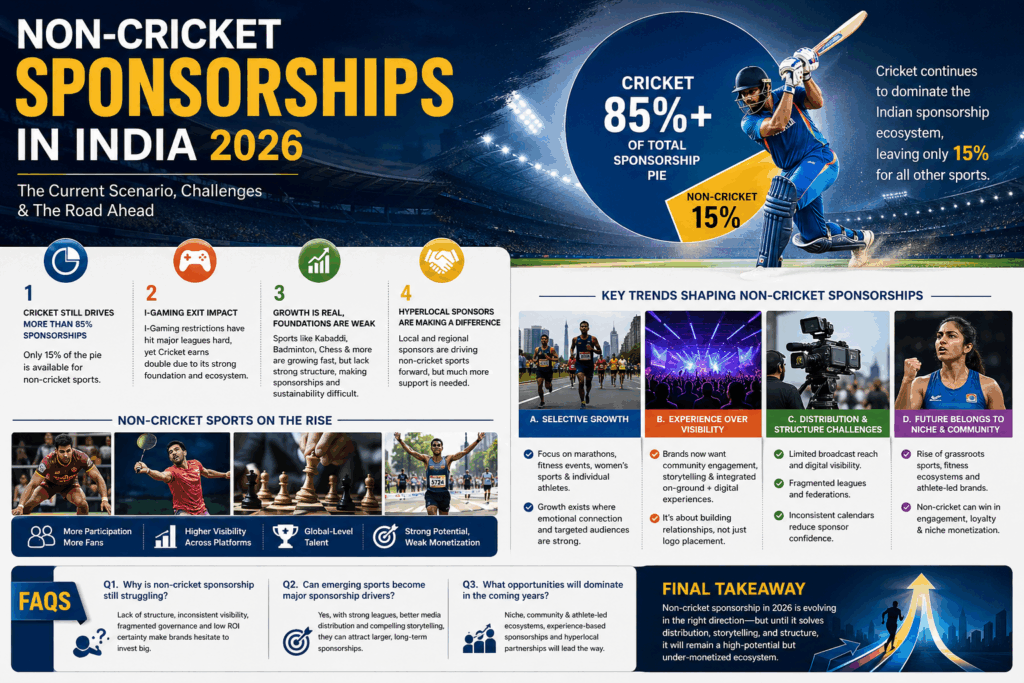
1. Cricket still drive more than 85% Sponsorships, in Indian Sporting ecosystem so remaining pie left for Non Cricket sport remains 15% only.
2. I- Gaming who used to drive major league sponsorships, revenue and miscellaneous things have been stopped still Cricket is making double the amount that they are making due to strong foundations and ecosystem when it comes non cricket that same system fails.
3. There is no denying this fact, non Cricket sport including the likes of- Kabaddi, Badminton, Chess and Many More have grown exponentially only thing which is lacking is strong foundations where people involved in this ecosystem is struggling big time when it comes to bagging sponsorships and sustainability.
4. The Hyperlocal sponsors certainly is helping non cricket sports in India to drive this further but still needs more support from other end.
More Details on Non Cricket Sponsorships in India in 2026
A- Growth Is Real, But Highly Selective
Sponsorship money is flowing into specific areas, not across the board.
Brands are focusing on:
- Marathons and fitness events
- Women’s sports
- Individual athletes with strong stories
Reality: Growth exists, but only where brands see emotional connection and targeted audiences.
B. Sponsorship Has Shifted from Visibility to Experience
The old model of logo placement is fading. Brands now want:
- Community engagement
- Content-driven storytelling
- On-ground and digital experiences
Reality: Sponsorship today is about building relationships, not just visibility.
C. The Biggest Challenge Is Distribution & Structure
Non-cricket sports still struggle with:
- Limited broadcast reach
- Fragmented leagues and federations
- Inconsistent calendars
Reality: Without scale and structure, brands hesitate to invest heavily.
D. The Future Belongs to Niche, Community & Athlete-Led Ecosystems
The next wave of sponsorship growth will come from:
- Grassroots and community sports
- Fitness and lifestyle ecosystems
- Athlete-led personal brands
Reality: Non-cricket won’t beat cricket in scale—but it can win in engagement, loyalty, and niche monetization.
Final Takeaway and Journalistic Perspective:
Non-cricket sponsorship in 2026 is evolving in the right direction—but until it solves distribution, storytelling, and structure, it will remain a high-potential but under-monetized ecosystem.
Non-Cricket Sponsorship Ecosystem in India – 2026 (Tabular Breakdown)
| Section | Key Point | Explanation | Reality Check |
|---|---|---|---|
| Core Insight | Role of Sponsorship | Sponsorship plays a critical role in building any sporting ecosystem, as revenue is the backbone for growth, sustainability, and scalability. | Without strong sponsorship flow, no sport can evolve into a stable ecosystem. |
| 1 | Cricket Dominates Sponsorship Market | Cricket contributes more than 85% of total sponsorship revenue in India, leaving only around 15% for all non-cricket sports combined. | Non-cricket sports are competing for a very limited share of the market. |
| 2 | Impact of I-Gaming Exit | I-Gaming previously contributed heavily to league sponsorships and revenue streams. Even after restrictions, cricket continues to generate strong revenue due to its solid ecosystem, while non-cricket struggles to fill that gap. | Strong foundation gives cricket resilience; non-cricket lacks that cushion. |
| 3 | Growth Without Strong Foundations | Sports like Kabaddi, Badminton, Chess, and others have seen rapid growth in participation and visibility. However, weak structural foundations make sponsorship acquisition and long-term sustainability difficult. | Growth is visible, but monetization remains inconsistent. |
| 4 | Rise of Hyperlocal Sponsorships | Local and regional sponsors are playing a key role in supporting non-cricket sports and keeping the ecosystem running. | Helpful but not sufficient for large-scale growth. |
Detailed Analysis of Non-Cricket Sponsorships (2026)
| Category | Focus Area | Details | Reality Check |
|---|---|---|---|
| A | Selective Growth | Sponsorship investments are concentrated in specific segments like marathons, fitness events, women’s sports, and individual athletes with strong narratives. | Growth exists but is not evenly distributed across all sports. |
| B | Shift to Experience-Based Sponsorship | Brands are moving beyond logo placements to focus on community engagement, storytelling, and integrated on-ground + digital experiences. | Sponsorship is now about engagement, not just visibility. |
| C | Distribution & Structural Challenges | Non-cricket sports face limited broadcast reach, fragmented governance, and inconsistent event calendars. | Lack of scale and structure reduces sponsor confidence. |
| D | Future Growth Drivers | Emerging opportunities lie in grassroots sports, fitness ecosystems, and athlete-led personal branding. | Engagement-driven ecosystems can unlock new sponsorship models. |
Final Takeaway (Journalistic Perspective)
| Summary | Insight |
|---|---|
| Overall Conclusion | Non-cricket sponsorship in 2026 is evolving in the right direction but remains under-monetized due to gaps in distribution, storytelling, and structural consistency. |
| Key Reality | High potential exists, but without systemic improvements, large-scale commercial success will remain limited. |
Frequently Asked Questions (FAQs)
Q1. Why is non-cricket sponsorship still struggling despite visible growth in multiple sports?
Non-cricket sports in India are definitely growing in terms of participation, leagues, and visibility, but sponsorship depends on more than just growth—it depends on scale, consistency, and return on investment (ROI). Cricket has built its ecosystem over decades with structured tournaments, predictable calendars, and massive audience reach across TV and digital platforms.
In contrast, non-cricket sports often face fragmented governance, irregular scheduling, and limited broadcast reach. This creates uncertainty for brands, making it difficult to justify large investments. Even if a sport trends for a short period, the lack of continuity impacts long-term sponsorship confidence.
The reality is simple: growth without structure does not translate into sustainable revenue.
Q2. Can emerging sports like Kabaddi, Badminton, and Chess become major sponsorship drivers in the future?
Yes, but only under certain conditions. Sports like Kabaddi, Badminton, and Chess have already demonstrated strong potential by building loyal fan bases and producing global-level athletes. However, to become major sponsorship drivers, these sports need to focus on strong league structures, consistent storytelling, and better media distribution.
Brands today are not just looking for visibility—they want engagement, relatability, and long-term association. If these sports can create compelling narratives around players, rivalries, and events while ensuring regular visibility, they can attract larger sponsorship deals.
The opportunity exists, but execution will determine whether they can compete at scale.
Q3. What kind of sponsorship opportunities will dominate non-cricket sports in the coming years?
The future of non-cricket sponsorship will be driven by niche, community, and athlete-led ecosystems rather than mass-viewership models. Brands are increasingly investing in areas like grassroots sports, fitness events, women’s leagues, and individual athletes who have strong personal brands and digital presence.
Additionally, there is a clear shift towards experience-based sponsorships, where brands engage directly with audiences through events, content, and community-driven initiatives instead of just placing logos. Hyperlocal sponsorships will also continue to play a crucial role, especially in early-stage ecosystems.
| Question | Answer | Key Insight |
|---|---|---|
| Q1. Why is non-cricket sponsorship still struggling despite visible growth in multiple sports? | Non-cricket sports in India are growing in participation, leagues, and visibility, but sponsorship depends on scale, consistency, and ROI. Cricket benefits from decades of structured tournaments, predictable calendars, and massive reach across TV and digital. In contrast, non-cricket sports face fragmented governance, irregular scheduling, and limited broadcast reach, creating uncertainty for brands. Even short-term popularity does not guarantee long-term sponsorship confidence. | Growth without structure does not lead to sustainable revenue. |
| Q2. Can emerging sports like Kabaddi, Badminton, and Chess become major sponsorship drivers in the future? | Yes, but only if they build strong league structures, ensure consistent storytelling, and improve media distribution. These sports already have loyal fan bases and global athletes, but brands now seek engagement, relatability, and long-term association rather than just visibility. Strong narratives and regular exposure can help attract bigger sponsorship deals. | Opportunity exists, but execution will define scale. |
| Q3. What kind of sponsorship opportunities will dominate non-cricket sports in the coming years? | Future sponsorships will be driven by niche, community, and athlete-led ecosystems. Brands are focusing on grassroots sports, fitness events, women’s leagues, and athletes with strong personal brands. There is also a shift towards experience-based sponsorships involving events, content, and community engagement. Hyperlocal sponsors will continue to support early-stage ecosystems. | Engagement-driven ecosystems will outperform traditional reach-based models. |
The key shift is from “reach” to “engagement,” where smaller but highly connected audiences become more valuable for brands.