
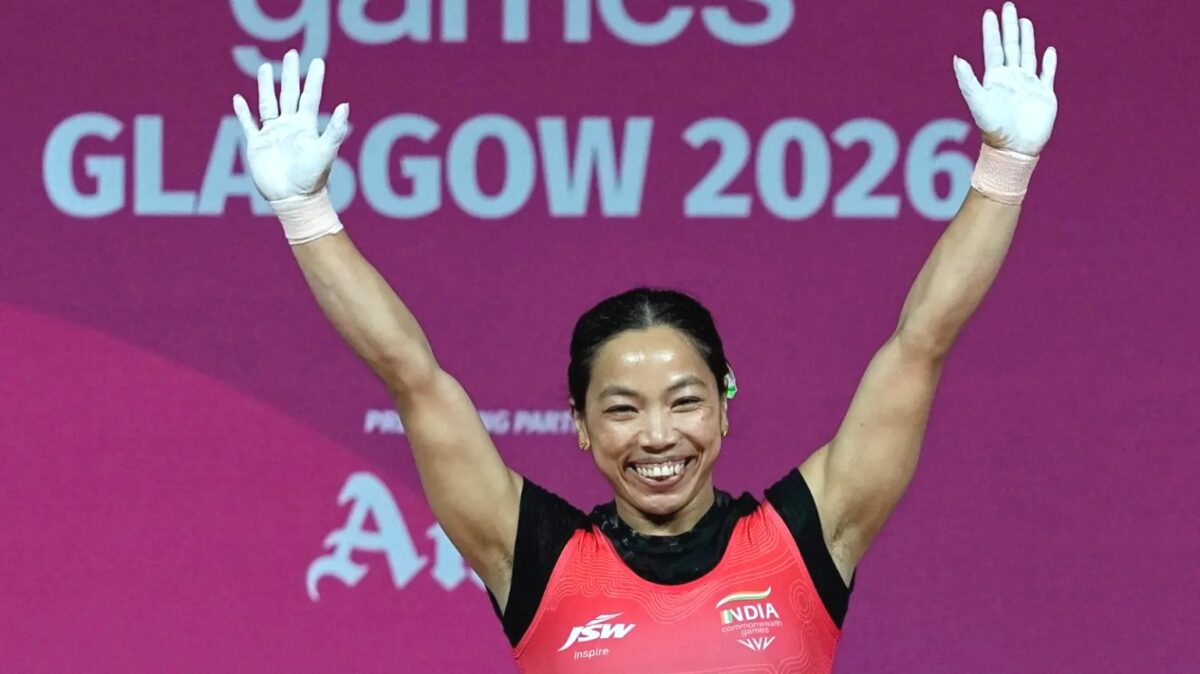
Mirabai Chanu’s 12-Year Journey: From Nervous Teen to Four-Time Commonwealth Games Medal Winner
When Mirabai Chanu stepped onto the platform at Glasgow’s SEC Arena in 2014, she was just 20 years old. Back then, the Commonwealth Games felt like the biggest stage of her life. Every single lift mattered. Every kilogram she added to the bar could change how people saw her future.
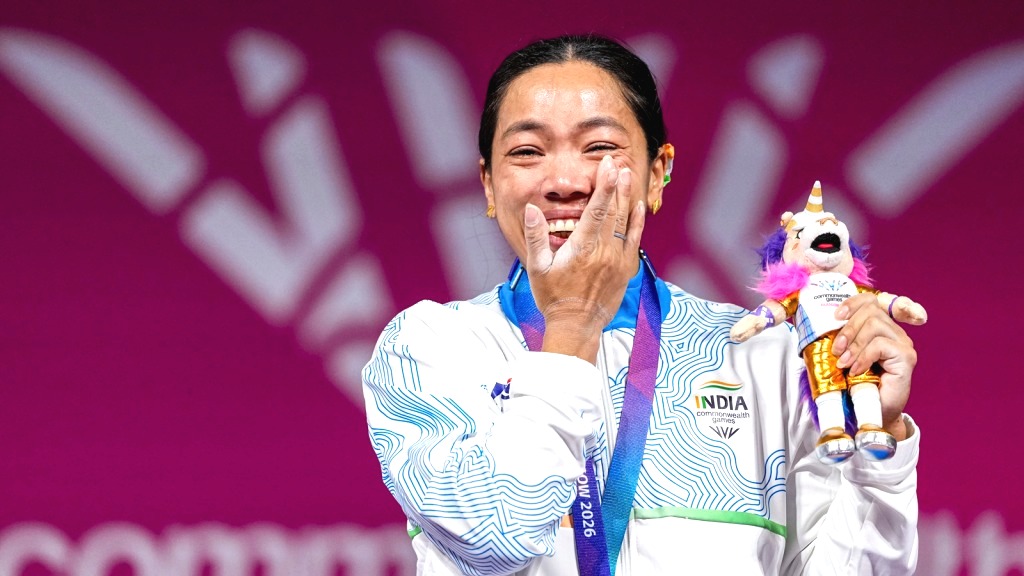
Twelve years later, she walked out of that same city and that same arena with something no other Indian weightlifter has managed. A fourth straight Commonwealth Games medal. A golden hat-trick of three gold medals in a row. This time, there was no real competition pushing her. So Mirabai added her own drama to the contest, missing her first attempts in both the snatch and the clean and jerk. But once she settled down, she went back to ruling the 48kg category like she always does.
On Sunday, she lifted a total of 190kg. That included 85kg in snatch and 105kg in clean and jerk. This gave her the gold medal and completed a streak that no other Indian lifter has ever achieved. But the numbers only tell part of the story. The real story is how much her relationship with this event has changed over the years. What was once the biggest moment of her career has slowly turned into one careful stop on a much longer road.
Glasgow 2014: The Beginning
In 2014, Mirabai was still a new face in the sport. Indian weightlifting needed a fresh star after legends like Karnam Malleswari and Kunjarani Devi had faded from the spotlight. Mirabai, a quiet young woman from Manipur, knew she had the talent to be among the best.
She lifted without fear that day, pushing eventual winner Sanjita Chanu all the way to the end. She finished with a silver medal and a total lift of 170kg. It wasn’t gold, but it didn’t need to be. That medal became the base on which her entire Commonwealth Games career was built. Over the next twelve years, she would deal with changing weight categories, injuries, Olympic pressure, and the constant challenge of staying on top of her sport.
Gold Coast 2018: A Story of Comeback
If Glasgow was about young ambition, Gold Coast in 2018 was about bouncing back from pain. Few athletes carry as much emotional weight into a Games as Mirabai did that year. Less than two years before, she had walked away from the Rio Olympics without a single successful clean and jerk lift. It was one of the hardest days of her career. That failure stayed with her long after the competition ended. Getting her confidence back took as much work as fixing her technique.
By the time she reached Australia for the 2018 Games, she had already become the reigning world champion. This time, there was no doubt in her mind. Mirabai gave one of the best performances ever seen at a Commonwealth Games, lifting a total of 196kg for gold. That was 26kg more than what she lifted in Glasgow just four years earlier.
Even with such a strong win, there was still something to prove. Every good lift felt like a message to the world that Rio had been a bad day, not a true picture of who she was.
Birmingham 2022: Complete Control
By 2022, Mirabai didn’t need to prove anything anymore. In the years between Gold Coast and Birmingham, she had become an Olympic silver medal winner. She had turned into one of India’s biggest sports stars and easily one of the best weightlifters in the entire Commonwealth.
Her win in Birmingham felt calm and almost expected. She defended her title and set a new Games record, lifting a total of 201kg. There was no drama, no doubt. Just quiet, steady control from someone who had already reached the top and stayed there.
Glasgow 2026: A Different Kind of Win
Before she even landed in Glasgow this year, Mirabai had already made her plans clear. She said the Commonwealth Games would not get her full focus this time, because the Asian Games remained her real target. She spoke honestly about not wanting to take unnecessary risks. She talked about not chasing small records, like trying to lift 90kg in snatch, just for the sake of a headline. Instead, she wanted to save her body and her energy for the tougher competition waiting in Aichi-Nagoya, where lifters from China, North Korea, and other strong Asian countries would push her limits much more than anyone at the Commonwealth Games could.
So her fourth medal in a row says less about beating her rivals this time and more about how long she has managed to stay at the top. Twelve years is a long time in any sport, especially one as physically demanding as weightlifting. Over these years, the sport itself has changed a lot around her. Rivals have come and gone. Weight categories have been changed and rearranged. Injuries have slowed her down more than once. New young lifters have shown up with bigger dreams and fresher bodies, ready to take her place. But through all of this, Mirabai has stayed steady. She hasn’t just adjusted her lifting technique. She has also learned how to understand where each competition fits into her bigger journey.
And today, that bigger journey goes far beyond the walls of Glasgow’s SEC Arena.
The Missing Piece: Asian Games
Throughout her long and successful career, one medal has always stayed out of reach for Mirabai Chanu. The Asian Games podium. She already has an Olympic silver medal around her neck. She has a world championship title to her name. Now she also holds three Commonwealth Games gold medals in a row. But an Asian Games medal has never come her way, partly because of injuries at the wrong times, and partly because the level of competition at the Asian Games is much higher than anything the Commonwealth field can offer.
In many ways, the Asian Games has now become what the Olympics once was for her. A big challenge that would make her story complete, rather than just adding another shiny medal to her collection.
This is exactly why her performance in Glasgow this year should be seen differently from her earlier wins. It wasn’t just another competition to win. It was a planned step, a checkpoint on her road to Japan. Every training session she did, every attempt she chose to take on the platform, and every kilogram she lifted in Glasgow was decided with the Asian Games in mind.
Mirabai Chanu’s Commonwealth Games career:
Mirabai Chanu’s Overall Career:
A Different Mirabai, A Different Mindset
The young Mirabai of 2014 chased every single lift because, back then, every lift could shape or break her career. She had nothing to lose and everything to gain. The Mirabai of 2026 is very different. She now understands that true greatness sometimes means knowing exactly what to hold back on, rather than chasing every possible record.
That is a hard lesson for any athlete to learn, especially in a sport where power and aggression usually decide who wins. But Mirabai has shown, again and again, that smart planning and patience can be just as powerful as raw strength on the platform.
Four Commonwealth Games. Four medals. And four very different versions of the same athlete, each shaped by the years, the setbacks, and the lessons that came before it.
From the nervous 20-year-old who fought for silver in Glasgow to the calm, experienced champion who calculated every single lift this time around, Mirabai Chanu’s story is really a story about growing up in public. It’s about learning to deal with pressure, pain, and expectation, one competition at a time, without ever losing the fire that got her started in the first place.
Her fourth medal is not just a number added to her trophy shelf. It’s proof of how far she has traveled, both as an athlete and as a person, since that very first lift in Glasgow back in 2014.
Related posts:
 Mirabai Chanu betters her own record at the National Weightlifting Championship
 Avinash Sable Biography: Personal Life, Career, Playing Style, Age, Height, Girlfriend, Facts & Networth
 K M Chanda Biography: Personal Life, Career, Age, Height, Facts & Networth
 India Clinches Gold in Mixed Relay at Asian Athletics Championship; Rupal Chaudhary Shines Bright