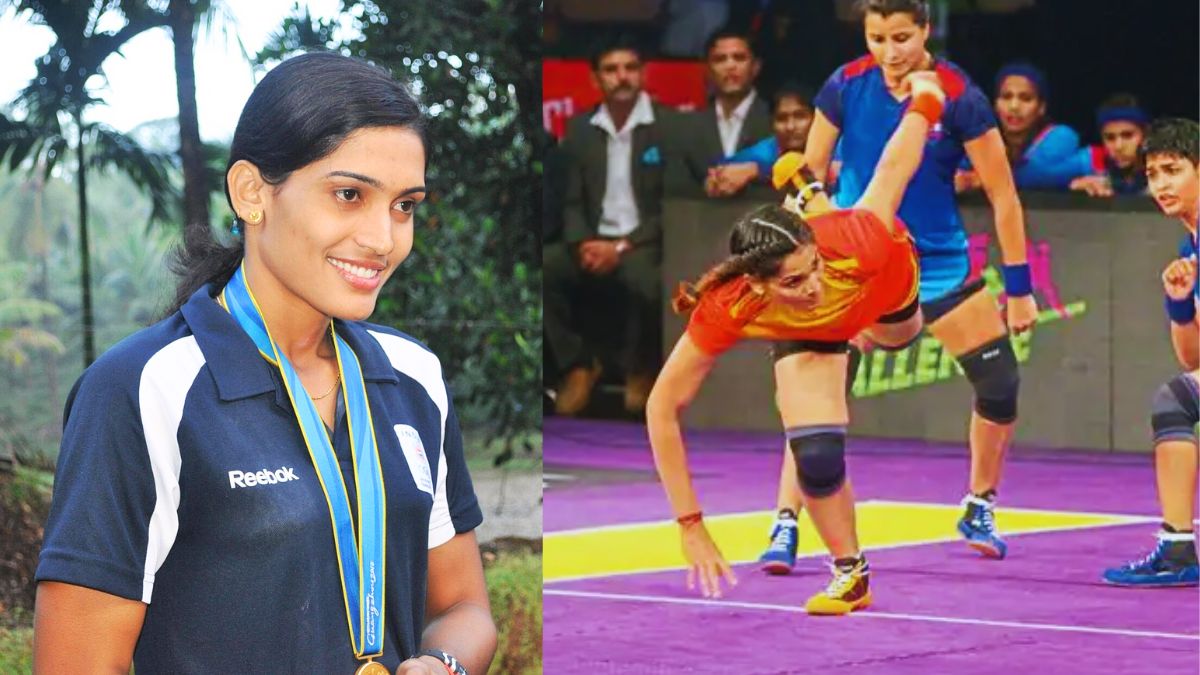
Mamatha Poojary is one of the most respected names in Indian women’s kabaddi. Born in Karnataka, she started her sporting journey with volleyball and athletics before taking up kabaddi during her college days. In a short period, she moved from local competitions to the national team and later became one of the key players and captains of India. She also led India to victory in the inaugural Women’s Kabaddi World Cup in 2012 and won major gold medals at the Asian Games and other international events.
Mamatha Poojary Biography
| Category | Details |
| Full Name | Mamatha Poojary |
| Profession | Kabaddi Player |
| Sport | Kabaddi |
| Nationality | Indian |
| Birth Year | 1986 |
| Age | Around 40 years in 2026 |
| Birthplace | Karkala Taluk, Udupi district, Karnataka |
| Village | Hermunde/Yennehole area near Ajekar |
| Mother Tongue | Tulu |
| Height | Reported around 5 feet 10 inches to 5 feet 11 inches |
| Playing Role | Raider |
| International Debut | 2006 |
| National Debut | 2003 |
| Major Team | India Women’s Kabaddi Team |
| Railway Team | South Central Railway |
| Marital Status | Married |
| Husband | Abhishek Kotian |
| Major Award | Arjuna Award, 2014 |
| State Honour | Karnataka Rajyotsava Award |
| Famous For | Leading India to the inaugural Women’s Kabaddi World Cup title |
| Estimated Net Worth | Not officially disclosed |
Mamatha Poojary Early Life
Mamatha Poojary was born in 1986 in the Karkala area of Udupi district in Karnataka. She came from a farming family, with her parents Boja Poojary and Kitti Poojary working hard to support the family. She grew up in a rural setting where sport was part of school life, but choosing a serious career in kabaddi was not easy for a young girl at that time.
During her school years, Mamatha played several sports instead of focusing only on kabaddi. She was involved in volleyball, kho-kho, athletics, shot put and javelin throw, and she even represented her school in competitions. Her strength, speed and tall frame helped her in different sports, but kabaddi eventually became the game that changed her life.
Mamatha did not start playing kabaddi at a very young age like many professional players. According to interviews, she took up kabaddi around 2003 when she was 17, during her higher-secondary or college years. A sports teacher asked her to join the college kabaddi team because she was already active in other sports and the team needed players.
Her family was initially worried about her playing kabaddi. The sport required her to train on rough grounds, suffer injuries and wear sports clothing that was not easily accepted by some people in her village at the time. However, her teacher and coaches spoke to her parents and convinced them that kabaddi could give her an opportunity to get a job and build a career.
Education and College Life
Mamatha completed her schooling in the Hermunde and Ajekar areas before moving to Mangaluru for higher education. She studied at Shree Gokarnatheshwara College and completed her graduation. Reports say she graduated with subjects including history, political science and economics.
College played an important role in her kabaddi career because that was when she began getting more serious about the sport. She represented Mangalore University and took part in competitions where her performances helped her gain attention. Her progress from college-level sport to national-level kabaddi happened within a few years.
One of the early turning points came when she represented her team in an All India Invitation competition in Mumbai. She helped her side reach the semi-finals and was named the best raider of the competition. This type of performance helped open the door to better teams and eventually to the Indian Railways and Indian national side.
Mamatha Poojary Domestic Kabaddi Career
Mamatha Poojary made her national debut in 2003, only a short time after starting the sport. Her rise was quick because of her strong raiding skills, athletic movement and physical reach. She soon became an important player for Karnataka and later for the Railways team.
Her domestic kabaddi career included several Senior National Championships. Available records list gold medals for her in many national competitions, including the 55th Senior National Championship in 2007, the 56th in 2008, the 57th in 2010, the 58th in 2011, the 59th in 2012, the 60th in 2013, the 61st in 2014 and the 62nd in 2015. She was also named Best All-Rounder or Best Player in several of these tournaments.
Her domestic success also helped her secure a job through the sports quota. In 2006, after representing India at the South Asian Games, she joined South Central Railway in Secunderabad. The railway job gave her financial security while allowing her to continue playing kabaddi at a high level.
By the middle of the 2010s, Mamatha had already built a long domestic career. She had spent more than a decade competing in the sport, while her performances for the Railways and the Indian team made her one of the better-known women kabaddi players of her time. In 2016, she also captained Fire Birds in the inaugural Women’s Kabaddi Challenge, where the team finished as runners-up.
Mamatha Poojary International Kabaddi Career
Mamatha Poojary made her international debut in 2006. That same year, she was part of the Indian team that won gold at the South Asian Games in Colombo, Sri Lanka. Her international career then grew rapidly, and she became a regular part of India’s successful women’s kabaddi team.
One of the biggest achievements of her career came at the 2010 Asian Games in Guangzhou, China. India won the women’s kabaddi gold medal, and Mamatha was part of the team. She also won gold in the 2014 Asian Games in Incheon, South Korea, giving her two Asian Games gold medals in her career.
Mamatha also had a strong record in Asian-level and beach kabaddi competitions. Available career records list gold medals in the Asian Kabaddi Championships, Asian Beach Games and Asian Indoor and Martial Arts Games. Her international medal list includes major gold medals in the 2006 South Asian Games, 2007 Asian Kabaddi Championship, 2008 Asian Kabaddi Championship, 2008 Asian Beach Games, 2010 Asian Games, 2010 Asian Beach Games, 2012 World Cup, 2013 Asian Indoor and Martial Arts Games and 2014 Asian Games.
Mamatha Poojary and the 2012 Kabaddi World Cup
The 2012 Women’s Kabaddi World Cup in Patna is one of the most important parts of Mamatha Poojary’s career. She was the captain of the Indian women’s team during the inaugural tournament. India played Iran in the final and won the match 25–19 to become the first Women’s Kabaddi World Cup champions.
Winning the World Cup as captain gave Mamatha an important place in Indian kabaddi history. She had already represented India at major Asian competitions, but leading the team to the first Women’s World Cup title added another major achievement to her career. She was also widely known by the nickname “Kabaddi Queen” during this period.
Mamatha’s role in the 2012 title was also a sign of how far she had come since her first kabaddi match. Just a few years earlier, she was a young college student who had only recently taken up the sport. By 2012, she was leading the national side on one of the biggest stages available in women’s kabaddi.
Mamatha Poojary Career Stats and Major Achievements
Because kabaddi does not have one central public database covering every match from Mamatha Poojary’s full career, her complete raid points, tackle points and match appearances are not reliably available. Therefore, a medal and tournament record gives a more accurate picture of her overall career. Available records list 11 international gold medals along with multiple national titles and individual awards.
Mamatha Poojary Overall Career Stats
| Competition/Achievement | Year | Result/Record |
| National debut | 2003 | India domestic level |
| South Asian Games | 2006 | Gold |
| Asian Kabaddi Championship | 2007 | Gold |
| Asian Kabaddi Championship | 2008 | Gold |
| Asian Beach Games | 2008 | Gold, Captain |
| Asian Games | 2010 | Gold |
| Asian Beach Games | 2010 | Gold, Captain |
| Women’s Kabaddi World Cup | 2012 | Gold, Captain |
| Asian Indoor & Martial Arts Games | 2013 | Gold |
| Asian Games | 2014 | Gold |
| Asian Beach Games | 2014 | Gold, Captain |
| Senior Nationals | Multiple years | Several gold medals |
| International gold medals listed in career records | — | 11 |
| Arjuna Award | 2014 | Awarded |
| Karnataka Rajyotsava Award | 2014 | Awarded |
The national records also list Mamatha as Best Player or Best All-Rounder at several Senior National Championships. She was named Best All-Rounder at the 56th Senior Nationals in 2008, the 58th in 2011 and the 59th in 2012, while she was also listed as Best Player in other editions.
Mamatha Poojary Awards and Honours
One of the biggest individual honours of Mamatha Poojary’s career came in 2014 when she received the Arjuna Award for her contribution to kabaddi. The Government of India’s official list of Arjuna Award winners includes Mamatha Poojari under kabaddi for 2014. President Pranab Mukherjee presented the award during the national sports awards ceremony.
She was also selected for the Karnataka Rajyotsava Award in 2014. Mamatha said at the time that she was happy that the award had also brought recognition to kabaddi. The state honour added to a year in which she had already been part of India’s Asian Games gold-winning team.
Her list of honours also includes the Ekalavya Krida Award, according to contemporary reports about her awards. These honours came after years of national and international success and reflected the importance of her contribution to Karnataka and Indian kabaddi.
Mamatha Poojary Personal Life
Mamatha Poojary married Abhishek Kotian in 2013. Abhishek, who was working as a software professional in Bengaluru, supported her decision to continue playing kabaddi after marriage. At one point Mamatha was unsure whether she would be able to continue her sporting career, but her husband encouraged her to keep playing.
Her family played an important role in her early journey as well. Her elder brother Vishwanath supported her during her difficult college years and would meet her at the bus stop and walk with her when she returned home after practice. Her parents were initially worried about her choosing kabaddi, but their attitude changed as her career developed and her achievements brought pride to the family.
Mamatha has often spoken about how her sporting career helped her family financially. She has said that the Railway job gave her security and that after India’s 2010 Asian Games gold, she was able to build a proper house for her family. Her journey therefore brought changes not only to her own career but also to her family’s living conditions.
Mamatha Poojary Hobbies and Interests
There is limited reliable public information about Mamatha Poojary’s hobbies outside sport. However, her early years show that she had a strong interest in several physical activities, especially volleyball, kho-kho, athletics, shot put and javelin throw. These activities were an important part of her school and college life before kabaddi became her main sport.
Mamatha Poojary Professional Life After Major Success
Mamatha’s professional life was closely linked with Indian Railways, where she worked with South Central Railway. She joined through the sports quota around 2006 and later worked as an office superintendent, according to a Times of India report. Her Railway career provided her with a stable profession alongside her kabaddi career.
She also continued to appear in competitive kabaddi after her major international achievements. In 2016, she was the captain of the Fire Birds team in the Women’s Kabaddi Challenge. Fire Birds reached the final but finished as runners-up, giving Mamatha another opportunity to play in a major women’s professional kabaddi event.
At the same time, Mamatha openly spoke about the physical demands of a long kabaddi career. In 2015, she said she had already spent around 15 years in the sport and 11 years at the international level. Her comments showed how long her journey had been and how much physical work was involved in reaching and remaining at the highest level.
Mamatha Poojary Net Worth
There is no reliable official figure available for Mamatha Poojary’s net worth. Unlike some modern professional athletes, her earnings from salary, tournament winnings, endorsements and other sources have not been publicly listed in a way that allows a dependable net-worth calculation.
Mamatha did, however, earn a stable job with South Central Railway through the sports quota, and she also received financial benefits and recognition connected with her sporting achievements. She has spoken about how her Railway job helped provide financial security and how her kabaddi career helped her improve her family’s living conditions.
Interesting Facts About Mamatha Poojary
Mamatha Poojary started playing kabaddi only around the age of 17, which is later than many athletes who begin the sport during childhood. Before kabaddi became her main game, she was active in volleyball, kho-kho and athletics. This makes her rise to the Indian team within only a few years particularly notable.
She made her national debut in 2003 and international debut in 2006. In the same year as her international debut, she became part of the Indian team that won gold at the South Asian Games in Colombo. She also joined South Central Railway around that time through the sports quota.
Mamatha captained India to the first Women’s Kabaddi World Cup title in 2012. India defeated Iran 25–19 in the final in Patna. She also won Asian Games gold medals in 2010 and 2014.
She received the Arjuna Award in 2014, making her one of the recognised Indian athletes in the national awards list that year. She was also honoured with the Karnataka Rajyotsava Award in the same year.
Mamatha Poojary: A Kabaddi Career Built Step by Step
Mamatha Poojary’s story started in a small village in Karnataka, where she first became known for playing volleyball and other sports. Kabaddi was not her first choice, but a chance opportunity during her college years helped her discover a sport in which she could build a career. Her coaches noticed her speed, height and raiding skills, and she gradually moved from local competitions to the national stage.
Her rise continued after she represented India for the first time in 2006. From there, she collected gold medals across the South Asian Games, Asian Championships, Asian Games, Asian Beach Games and Asian Indoor and Martial Arts Games. Her biggest moment came when she captained India to victory in the first Women’s Kabaddi World Cup in 2012.
Mamatha also built a career outside the kabaddi court through her work with South Central Railway. Her marriage to Abhishek Kotian did not end her playing career, as she received support from him to continue competing. Later, she remained involved in competitive kabaddi and captained Fire Birds in the Women’s Kabaddi Challenge in 2016.