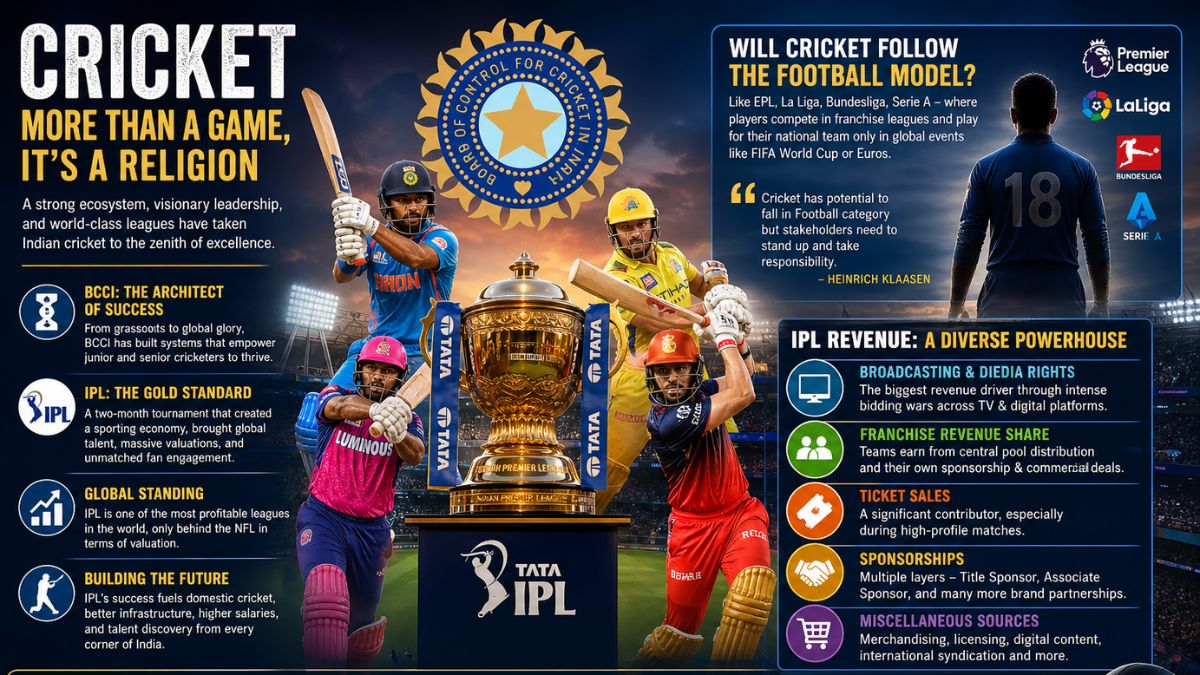
Cricket is regarded as religion in this country, where stakeholders should need to give credit where they have build systems in place, which is so perfectly laid out that anyone being part of ecosystem will flourish
BCCI Deserve huge credit with the way they have taken this sport to next level also the ways in which they have empowered life of Junior cricketers at senior and junior level make the most out of it.
The Indian Premier League is another perfect example on how cricket in India have flourished and reached at zenith of excellence.
Indian Premier League currently falls in the category of most profitable league with high valuation only falls behind NFL( National Football League)
The Biggest question which arises whether Cricket will follow Football Model where Players are competing in distinct leagues which include- EPL(English Premier League). La Liga. Bundesliga, Serie A and Many More all they do is play for their national team when it comes to Participating FIFA and Euro Cup.
Recent statement from Henrich Klassen, where he said ” Cricket has potential to falls in Football Category but the biggest question which pops in everyone’s mind whether stakeholders need to stand up and take responsibility where BCCI and ICC would need to play huge role in it”
Considering huge potential IPL have where despite playing it for 2 months only it still became one of the most successful franchise with massive valuation hike.
Considering my Journalistic Perspective, it is certainly going to happen where Cricket will follow football model as ICC still makes huge revenue from their own events as well as bilateral and tri nation series so there is no chance this is going to happen however nothing is impossible considering the potential it has to offer.
Let’s Understand from Commercial Point of View on how (IPL) make revenue in distinct format:
- They make money via brodcasting and media rights
- They make money via franchise profit revenue percentage
- They make money via audience ticket sales
- They make money around sponsors who are associated with the leagues( Title Sponsor, Associate Sponsor and Many More)
- They make money via miscellaneous sources to make this revenue.
More Details on Cricket Following Football Model:
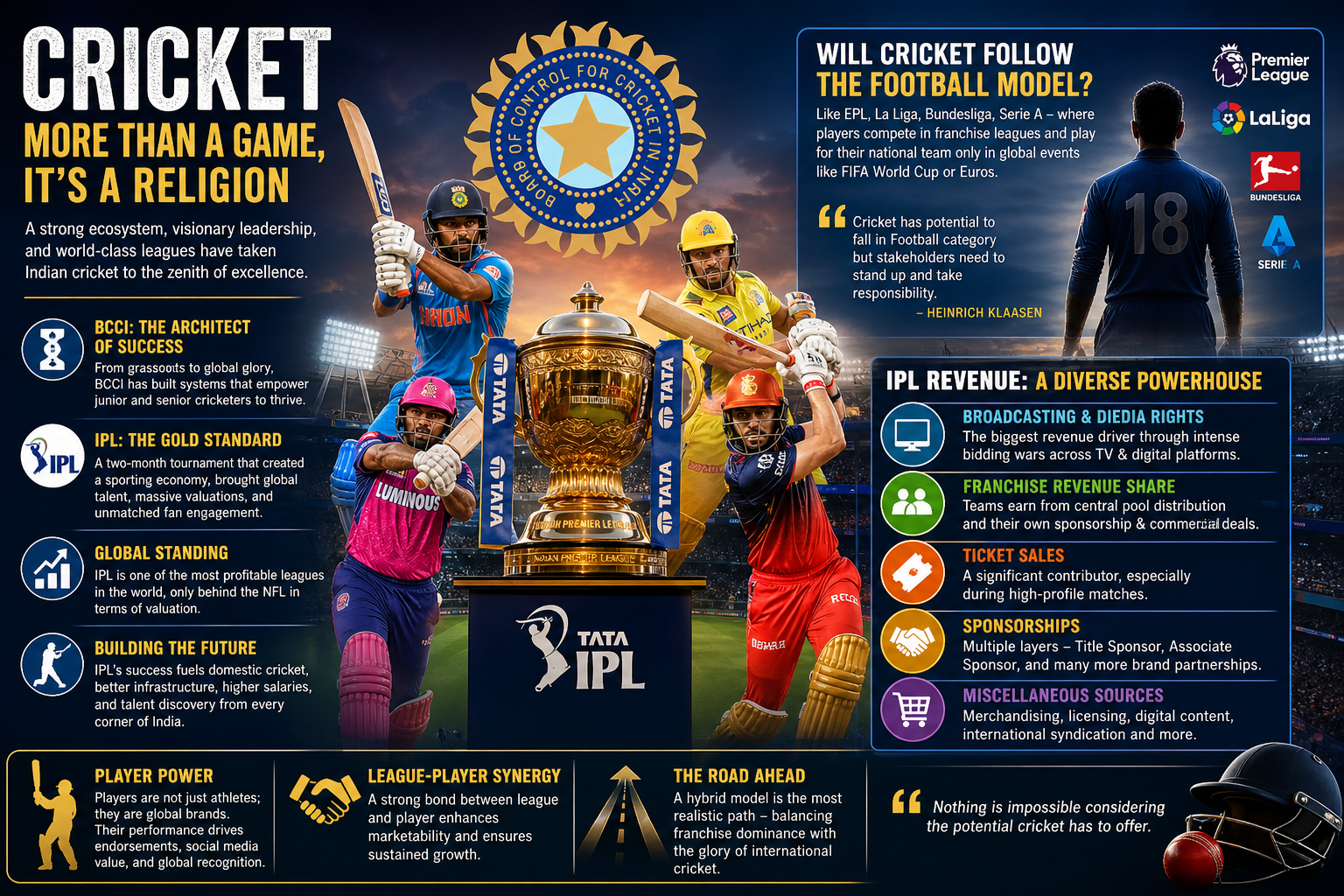
Cricket is regarded as religion in this country, where stakeholders should need to give credit where they have built systems in place so meticulously that anyone being part of the ecosystem has a genuine pathway to flourish.
The BCCI deserves huge credit for the way it has taken this sport to the next level. From grassroots structures to elite high-performance systems, and from domestic tournaments to financial security, Indian cricket has created a pipeline where junior cricketers are not just surviving but building sustainable careers. The exposure, match frequency, and financial backing ensure that players at both senior and junior levels can maximize their potential.
The Indian Premier League is another perfect example of how cricket in India has flourished and reached a zenith of excellence. It is not just a tournament; it is a sporting economy in itself. The IPL currently falls in the category of the most profitable leagues globally, only behind the NFL in terms of overall valuation and commercial dominance.
The biggest question that arises is whether cricket will follow the football model, where players primarily compete in franchise leagues such as the EPL, La Liga, Bundesliga, and Serie A, and only represent their national teams during global tournaments like the FIFA World Cup or the Euros.
A recent statement from Heinrich Klaasen highlighted this possibility, suggesting that cricket has the potential to move in that direction. However, the real question is whether stakeholders are ready to take responsibility. For such a shift to happen, both the BCCI and the ICC would need to play a transformative role in restructuring the global calendar.
Considering the immense potential of the IPL, despite being a two-month tournament, it has already become one of the most successful sporting franchises globally with exponential valuation growth. From a journalistic perspective, while the possibility exists, the current structure of cricket—where the ICC generates significant revenue from global events and bilateral series—makes a complete transition unlikely in the near future. However, the trajectory clearly indicates a hybrid model could emerge.
From a commercial standpoint, the IPL operates on a highly diversified revenue model. Broadcasting and media rights form the backbone, contributing the largest share of revenue, driven by intense bidding wars among networks and digital platforms. Franchise revenue sharing is another critical pillar, where teams earn through central pool distribution as well as their own sponsorship deals. Ticket sales, although a smaller percentage compared to media rights, still contribute significantly, especially during high-profile matches.
Sponsorship remains a massive revenue driver, with title sponsors, associate partners, and team-level brand integrations creating a multi-layered commercial ecosystem. Beyond this, merchandising, licensing deals, digital content monetization, and international syndication further expand revenue streams.
Another crucial dimension is the role of player branding within the IPL ecosystem. Cricketers are no longer just athletes; they are commercial assets. Their performances directly influence endorsement deals, social media value, and global recognition.
This symbiotic relationship between league and player enhances overall marketability and ensures sustained growth.
Moreover, the IPL has successfully created a trickle-down effect on Indian domestic cricket. Increased revenues allow better infrastructure, improved salaries for domestic players, and enhanced scouting systems. This ensures that talent from smaller towns is identified and nurtured, strengthening the overall cricketing structure.
If cricket does move toward a football-like model, leagues like the IPL will become even more central to the sport’s economy. However, balancing international cricket with franchise dominance will remain the biggest challenge for governing bodies going forward.
| Section | Key Points |
|---|---|
| Cricket Ecosystem in India | Cricket is regarded as a religion in India. Strong systems are in place, allowing individuals within the ecosystem to flourish. Structured pathways ensure growth from grassroots to professional levels. |
| Role of BCCI | The Board of Control for Cricket in India (BCCI) has played a crucial role in transforming the sport. It has built strong grassroots and elite systems, provided financial security, and created sustainable career opportunities for junior and senior cricketers. |
| IPL as a Growth Engine | The Indian Premier League (IPL) represents the peak of cricket’s commercial and sporting success in India. It functions as a full-fledged sporting economy and has significantly elevated the global stature of Indian cricket. |
| IPL Global Standing | IPL is among the most profitable sports leagues globally, second only to the National Football League (NFL) in valuation and commercial dominance. |
| Football Model Comparison | The football model includes leagues like EPL, La Liga, Bundesliga, and Serie A, where players primarily play franchise cricket and represent national teams only during global tournaments like FIFA World Cup and Euros. |
| Key Question | Can cricket transition into a football-like model where franchise leagues dominate and international cricket is limited to global events? |
| Heinrich Klaasen’s View | Heinrich Klaasen stated that cricket has the potential to follow the football model. However, this would require strong decision-making and responsibility from stakeholders like BCCI and ICC. |
| Feasibility Analysis | While IPL’s success shows strong potential, a complete shift is unlikely in the near future due to ICC’s revenue dependency on bilateral and global events. A hybrid model is more realistic. |
| IPL Revenue Streams | IPL earns revenue through broadcasting and media rights, franchise revenue sharing, ticket sales, sponsorships (title and associate), and miscellaneous sources such as merchandising and licensing. |
| Broadcasting & Media Rights | The largest revenue contributor, driven by competitive bidding among TV and digital platforms. |
| Franchise Revenue Model | Teams earn through central revenue distribution and their own sponsorship and commercial deals. |
| Ticket Sales | Contributes a smaller but significant portion, especially during high-profile matches. |
| Sponsorship Ecosystem | Multi-layered revenue through title sponsors, associate sponsors, and team partnerships. |
| Additional Revenue Streams | Includes merchandising, licensing, digital content monetization, and international syndication. |
| Player Branding Impact | Players act as commercial assets. Their performance influences endorsements, social media presence, and global recognition. |
| League-Player Synergy | Strong relationship between player success and league growth enhances overall marketability and long-term sustainability. |
| Impact on Domestic Cricket | IPL revenue improves infrastructure, increases domestic player salaries, and strengthens scouting systems across India. |
| Grassroots Development | Talent identification from smaller towns has improved, creating a stronger and wider talent pool. |
| Future Outlook | If cricket adopts a football-like model, franchise leagues like IPL will dominate. However, balancing international and franchise cricket will remain a major challenge for governing bodies. |
Cricket has the potential to partially move toward a football-style structure, but a complete shift is unlikely in the near term. Unlike football, where club leagues dominate and international tournaments are limited, cricket still relies heavily on bilateral series and ICC events for revenue and relevance. Boards like BCCI generate massive value through leagues like the IPL, but they also benefit from international cricket. A more realistic scenario is a hybrid model, where franchise leagues gain more prominence while international cricket continues to coexist in a structured calendar.