Every four years, the world does not just watch football. It also tries to guess who will win it. From animals picking between flags to supercomputers running simulations millions of times, the art of predicting the FIFA World Cup has come a long way. And with the 2026 World Cup now underway across the United States, Canada, and Mexico, the prediction game has never been more serious, or more interesting.
Let us take a trip through how it all started, how it evolved, and where it stands today.
Paul the Octopus: The Original Predictor
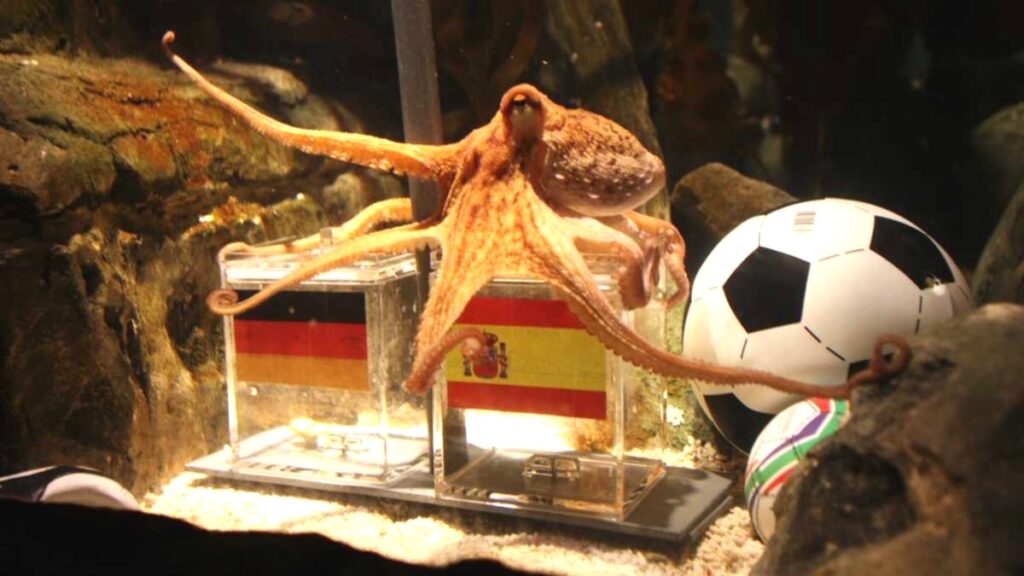
Long before ChatGPT and Claude and Copilot entered the picture, there was Paul. A common octopus, hatched in Weymouth, England, and housed at the Sea Life Centre in Oberhausen, Germany, Paul became the most famous animal in football during the 2008 UEFA European Championship and the 2010 FIFA World Cup.
The method was simple. Two boxes, each carrying a mussel or oyster and a national flag, were placed in Paul’s tank. Whichever box he opened first was considered his pick for the winner. Out of 13 matches involving Germany across both tournaments, Paul got 11 right. That is an accuracy rate that most human pundits would be happy with.
But Paul did not just pick winners quietly. He picked them in a way that stirred up real controversy. When he chose Spain over Germany in the 2010 World Cup semi-final, German football fans were furious. There were public calls to cook him. Restaurants suggested recipes. His tank needed extra security.
Things went even further when he picked Spain to beat Germany in the final. The reaction was so strong that the Spanish Prime Minister reportedly offered to send official protection for Paul from Germany. A sea creature had somehow managed to create what could only be described as a minor diplomatic situation between two European nations.
On the other side, when Paul picked Germany to beat Argentina in the quarter-final, which Germany did, an Argentine chef publicly announced a plan to cook Paul. The recipe was already being discussed in detail.
Beyond the drama, Paul was also a marketing phenomenon. A transfer fee of 30,000 pounds was reportedly proposed for him. He had competition from other animals, German porcupines, pygmy hippos, and tamarins all tried to match his prediction record and failed. A Singapore parakeet came close in terms of accuracy, but Paul had already become the face of football prediction.
Paul died in October 2010, peacefully, in his tank, not on anyone’s dinner plate. Even after his death, he lived on through iPhone apps, Google Doodles, and even a Chinese movie. For a few years, he was the most talked-about World Cup analyst in the world.
The Gap Between Paul and AI
After Paul, the world tried many other animals. Elephants, cats, dogs, camels, and various other creatures were placed in front of flags or food bowls to make predictions. Some got lucky. None came close to matching Paul’s fame or accuracy.
The truth is that animal predictions were never really about accuracy. They were fun, lighthearted, and gave people something to talk about between matches. But as the World Cup grew larger and the stakes around football, both sporting and financial, grew higher, people started looking for something more reliable.
That something turned out to be data. And the tool that processes data best today is artificial intelligence.
How AI Is Now Predicting the 2026 World Cup
The jump from Paul’s mussel-filled tank to AI-powered prediction models is enormous. Today, computers are not just guessing, they are analysing tens of thousands of matches, scoring systems, squad values, coaching records, and historical patterns to come up with their answers.
Copilot’s Take
USA Today used Microsoft’s Copilot to generate a World Cup prediction. To their credit, they were upfront about an important limitation, large language models do not always keep up with the latest sports results and live match data. This means the predictions can sometimes be based on outdated information.
Even so, Copilot produced a detailed bracket. It had France knocking out Argentina in the round of 16. It had Morocco reaching the semi-finals. It predicted Canada beating South Korea, and France defeating Brazil in the final. Whether any of this comes true remains to be seen, but the depth of the output alone shows how far prediction tools have come from a two-box tank setup.
Claude’s Deep Analysis
AI developer Frank Andrade, writing on Artificial Corner, used Anthropic’s Claude in a more detailed way. He fed the model data from 49,000 matches. Crucially, he weighted recent matches more heavily than older ones, so a result from 2005 counted for less than a result from 2024. He also used the Elo scoring system, which gives fewer points for beating weaker opponents, making the rankings more accurate.
After running simulations 50,000 times, yes, fifty thousand, Claude came out with Spain as the most likely winner at 27% probability, followed by Argentina at 21%, with France and England in the semi-finals. To test how reliable this method was, Andrade ran the same approach on the 2018 and 2022 World Cups after they had already happened. The AI got 52% of results correct, better than a coin flip, and comparable to or better than most expert pundits.
ActionNetwork’s 25-Variable Model
ActionNetwork.com went a different route. Instead of feeding match history into a language model, their system used 1,200 data points across 25 different variables. These included national team form, World Cup history, the total market value of squads, and even coach profiles. Their system picked France as the winner.
One interesting part of their analysis was the spotlight on Norway as a potential surprise team, a nation not known for deep World Cup runs but flagged by the data as worth watching. France’s squad market value, according to their research, was €1.48 billion, the highest of any nation in the tournament.
Opta and ChatGPT
Opta, the sports data company, uses AI to run simulations as well. Depending on how the question is phrased and which variables are prioritised, Opta’s AI can return either France or Spain as the tournament favourite. Interestingly, it also slots Norway into the top 10, supporting ActionNetwork’s surprise pick.
ChatGPT, when asked directly, lines up Spain, France, Argentina, England, Portugal, and Brazil as its top contenders in that order. This is not dramatically different from what most football analysts would say, which either means AI is sensible or that it is just reflecting the mainstream consensus fed into it during training.
Grok and the USA
Grok, the AI built by xAI, reportedly gave a notable push to the United States’ chances, calling them “disruptors” in the tournament. Given that the US is one of the three host nations and will play in front of enormous home support, this is not a completely unreasonable position. However, it also led some to joke that Grok may have been a little patriotic in its assessment.
Mathematicians Weigh In
It is not just AI tools making predictions. Mathematicians have also been building their own models. Several mathematical approaches have pointed to the Netherlands as a left-field pick, with Portugal closely behind. These models tend to focus more on statistical patterns and probability trees than on squad value or form.
China Takes It Further: Humans vs AI
Perhaps the most creative take on World Cup prediction in 2026 is coming from China. Tech company Lenovo, working with streaming platform Migu, has set up a “human-versus-AI” prediction event around the tournament.
Lenovo’s Tianxi AI agent is bringing together 12 different Chinese AI models to compete with real people in match-by-match predictions. The models involved include some of the biggest names in Chinese AI, DeepSeek, Kimi, ERNIE Bot, Qwen, and China Mobile’s Jiutian, among others. Rather than just producing a single bracket at the start, these models will update and predict throughout the tournament, match by match.
The idea is to make AI prediction something that people take part in rather than just read about. It turns a background technology process into an active part of watching the tournament. Fans can compare their own picks to those of the AI models and see who does better as the competition progresses.
It is a smart idea. It brings together the fun, participatory spirit of Paul the Octopus, everyone wanted to watch which box he would open, with the serious processing power of modern AI.
Paul vs the Machines: Who Actually Does Better?
It is worth stepping back and asking a fair question: does AI actually predict football better than an octopus?
In terms of pure accuracy, yes. Claude’s retrospective 52% success rate across two previous World Cups is solid. Paul’s 84% across his two tournaments was extraordinary, but it was also a small sample size, 13 matches, and statistical luck plays a big role over such a short run.
Over thousands of matches and multiple tournaments, AI models are more consistent. They do not have bad days, they do not get distracted by shiny objects, and they do not retire when they feel like it. On the other hand, they can only be as good as the data they are given, and football, with all its upsets, injuries, and moments of individual brilliance, does not always follow patterns.
Paul never claimed to understand data. He just opened a box. And yet for a brief, beautiful period around the 2010 World Cup, he had half the world holding its breath waiting to see what a small sea creature would do next.
The Prediction Landscape in 2026
So where does all of this leave us heading into the 2026 World Cup? The most common picks across AI tools and mathematical models are Spain, France, Argentina, Brazil, England, and Portugal, the usual names that appear in most serious discussions about who can win the tournament.
Norway keeps appearing as a potential surprise package. The United States, as hosts, are being watched closely. And Morocco, who reached the semi-finals in 2022, are not being dismissed by the data models either.
What is clear is that prediction has become a serious part of how the World Cup is covered and discussed. Data companies, AI developers, sports betting platforms, and independent researchers are all running their own models. The outputs are not always the same, because the inputs and methods differ. But the overall picture they paint is fairly consistent.
Sixteen years after Paul dipped his tentacles into a box and changed football prediction forever, the game has moved on. The tools are smarter, the datasets are bigger, and the methods are more rigorous. But the basic human desire behind all of it, to know what is going to happen before it happens, remains exactly the same.
RIP Paul. Machines 1, Mollusk 0. But it was never really a fair fight.
Related posts: