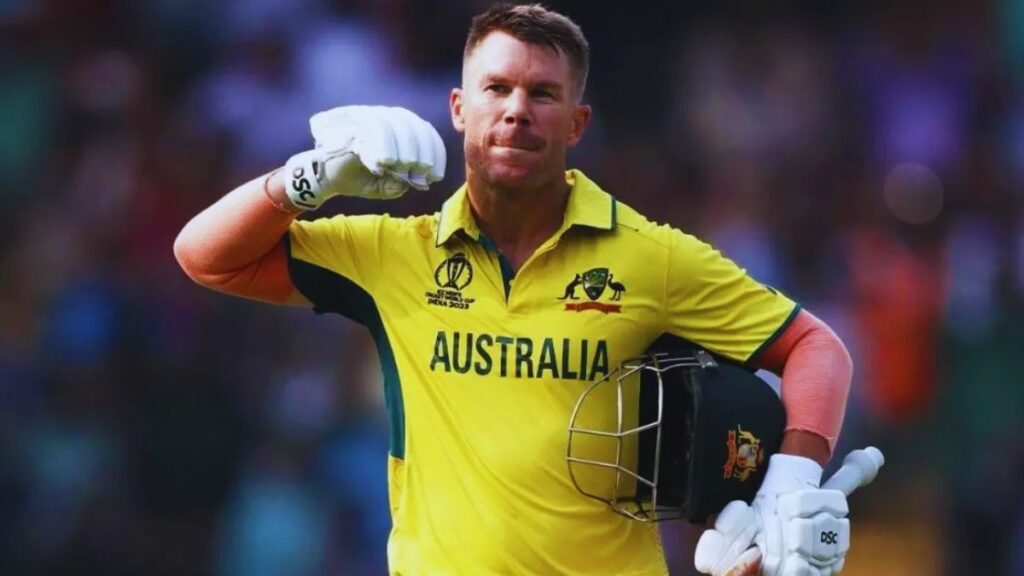
David Warner’s international cricket career came to a close on a somber note, mirroring the anti-climactic exit of his Australian team from the T20 World Cup. While Afghanistan celebrated their semi-final berth after a nail-biting win over Bangladesh, Warner could only watch on, his dream of a fairytale farewell dashed.
The 37-year-old opening batsman had long announced his intention to retire from international cricket after this World Cup. He leaves behind a legacy that’s both remarkable and controversial. Widely regarded as Australia’s greatest ever three-format player, Warner’s statistics speak for themselves.
Also Read: Rashid Khan becomes the player with most 4-wicket hauls in T20
He is the leading run-scorer for Australia in T20 cricket, amassing a staggering 3,277 runs in 110 matches. His exploits extend to Test cricket as well, where he plundered a mammoth 8,786 runs at an impressive average of 44.60 across 112 matches. One-day cricket was no different, with Warner accumulating 6,932 runs from 161 matches. His fielding prowess was equally noteworthy, with his consistent performances as a slip fielder making him a valuable asset on the field.
“He is probably our greatest-ever three-format player,” Australian coach Andrew McDonald acknowledged recently. “He’ll be a loss.” McDonald highlighted Warner’s consistent contributions and the value he brought to the team, despite facing criticism from some quarters.
However, Warner’s cricketing achievements are undeniably overshadowed by the infamous “Sandpaper-gate” scandal of 2018. He was identified as the central figure in the ball-tampering incident in Cape Town, where he instructed teammate Cameron Bancroft to alter the condition of the ball using sandpaper. A subsequent attempt to conceal the evidence further tarnished his reputation.
David Warner has retired from international cricket.
– A legendary career comes to an end, Thank You Davey! ❤️ pic.twitter.com/ny4SUiWivG
— Mufaddal Vohra (@mufaddal_vohra) June 25, 2024
The fallout was severe. Warner, along with then-captain Steve Smith, received a one-year ban from international cricket by Cricket Australia, effectively ending his chances of ever leading the national team. Warner himself admitted this month that the “Sandpaper-gate” scandal would forever be a stain on his career.
“I think it’s going to be inevitable that when people talk about me in 20 or 30 years’ time, there will always be that sandpaper scandal,” he said. He also expressed a sense of unfair targeting, feeling singled out for criticism compared to others involved in the incident.
This negativity undoubtedly contributed to his decision to retire from international cricket. “One can only absorb (so much),” he stated. He finds solace in the fact that he won’t be subjected to the constant scrutiny anymore.
Warner’s fiery personality has always been a double-edged sword. His aggressive approach on the field, evident in the “Sandpaper-gate” incident, wasn’t his first brush with controversy. In 2013, a bar brawl with England’s Joe Root resulted in a suspension and fine. Similar incidents involving public spats with journalists further cemented his image as a hothead.
Despite these controversies, Warner’s talent and resilience were undeniable. He bounced back from setbacks, time and again. Former Australian skipper Ricky Ponting believes there’s more to Warner than his on-field persona. “You’ll see a totally different side to him” once he ventures into the media world, Ponting remarked.
David Warner’s international career is over, leaving behind a complex legacy. A statistical giant of the game, his achievements are undeniably impressive. However, the “Sandpaper-gate” scandal will forever be a part of his story, a stark reminder of the consequences of poor judgment. Only time will tell how future generations will choose to remember David Warner – the cricketing titan or the flawed figure embroiled in controversy.
Related posts: