The All India Football Federation, fans finally will take sigh of relief after Supreme Court passed judgment, regarding the betterment of this sport which include several things let me share the same in the below format:
1. Politician and Government Job Employee will not given a chance in administration going forward.
2. The current administration under the leadership of Kalyan Chaubey will continue till September 2026 post that transparent elections could be done so that right set of people could be selected.
3. The Supreme Court have passed judgment very similar to 2018, where any BCCI official will not remain part of administration, post 70 years old.
4. The concept of Promotion and relegations should come in handy going forward where ISL(Indian Super League) being India’s Top Tier league apart from I-League(2nd Top Tier League) where the teams who have done well in 2nd Tier should get a chance to do well in 1st Tier.
5. Another meeting will be held on 14th October 2025, to chalk out everything in reality.
Due all these 5 clauses once he gets implemented on 14th October 2025, the fear will be eradicated as FIFA have said they will ban AIFF until they don’t hold their issues and make sure elections and policies are implemented such a way so that it could develop grassroot development so that best players could come up the ranks.
Supreme Court Bench who passed the Judgment said eminent football players in the AIFF General body would have voting rights and they have rejected the plea from State Association, as it lacked Merit where the full statement stated “The Argument of State Associations regarding transgression of FIFA statue lacks merit in as much as the Standard Statues 2005 itself suggest that inclusion of experienced players with Voting Rights” bench said.
Also one major thing as per AIFF going forward will have general body will comprise one representative from every member association which will comprise of 15 eminent players including five person will hail from national sports body, three club representatives from ISL and also players , I-league and Indian women’s league which will comprise both Male and Female from among coaches.
The policies should be build in such a way so that best talent could be inducted from grassroot level to Top most level.
| Point | Details |
|---|---|
| 1. Politician & Govt. Employee Ban | Politicians and government job employees will not be allowed in AIFF administration going forward. |
| 2. Current Administration Tenure | The current AIFF administration under Kalyan Chaubey will continue till September 2026. After that, transparent elections will be conducted to select the right people. |
| 3. Age Cap Rule | Following the 2018 BCCI model, no AIFF office bearer will remain in administration beyond the age of 70 years. |
| 4. Promotion & Relegation System | ISL will remain India’s Top Tier League, while I-League will act as the Second Tier League. Successful I-League teams will get a chance to play in the ISL. |
| 5. Next Meeting | Another meeting is scheduled on 14th October 2025 to chalk out practical implementation. |
| FIFA Warning | FIFA had warned of a ban if AIFF fails to resolve issues, conduct elections, and ensure transparent policies to boost grassroots football development. |
| SC on Voting Rights | Supreme Court stated that eminent football players will have voting rights in the AIFF General Body. The plea from State Associations was rejected as lacking merit. |
| AIFF General Body Structure | The new body will comprise: • One representative from each member association • 15 eminent players (5 from national sports body) • 3 ISL club representatives • Representatives from I-League and Indian Women’s League (both male & female) • Coaches |
| Policy Focus | Policies should be built to ensure best talent is nurtured from grassroots to top level. |
More stats in Detail
| Category | Details / Stats |
|---|---|
| 1. Politicians & Govt. Employees | ❌ Not eligible for AIFF administration. ✅ Ensures only professionals and football-specific administrators handle operations. |
| 2. Current Administration | 👤 Kalyan Chaubey (President) continues till Sept 2026. 🗳 Transparent elections post-2026. |
| 3. Age Cap | 📌 No office bearer can continue after 70 years of age. 📝 Rule mirrors the BCCI constitution (2018). |
| 4. Promotion & Relegation | ⚽ ISL → Top Tier League (Tier 1). ⚽ I-League → Second Tier League (Tier 2). 🔼 I-League teams performing well will get promotion to ISL. 🔽 Underperforming ISL teams could face relegation. |
| 5. Next Meeting | 📅 14th October 2025 → To finalize structure, elections, and reforms. |
| 6. FIFA Warning | 🌍 FIFA had cautioned AIFF: 🚨 Ban possible if reforms & elections not completed. 🎯 Focus on grassroots football & player development. |
| 7. Supreme Court Decision | ⚖️ Bench of Justices P.S. Narasimha & Joymalya Bagchi. 📝 Ruled that eminent players must get voting rights in General Body. 📌 Plea from State Associations was rejected. |
| 8. AIFF General Body – New Structure | 👥 Representation breakdown: • 1 representative from each state association. • 15 eminent players, incl. 5 from national sports body. • 3 ISL club representatives. • Players from I-League & Women’s League. • Both male & female coaches included. |
| 9. Player Development Focus | 🎯 Policies aimed at: • Grassroots to top level pathway. • Better scouting & training facilities. • Inclusion of women’s football & coaches.
|
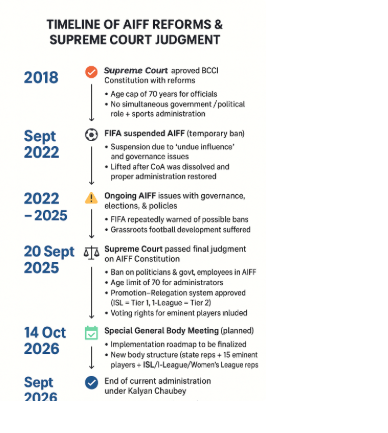
Timeline of AIFF Reforms & Supreme Court Judgment
| Year / Date | Event / Reform | Key Outcome |
|---|---|---|
| 2018 | Supreme Court approved BCCI Constitution with reforms. | • Age cap of 70 years for officials. • No simultaneous government/political role + sports administration. 📌 This model now applied to AIFF in 2025. |
| Sept 2022 | ⚽ FIFA suspended AIFF (temporary ban). | • Suspension due to “undue influence” and governance issues. • Lifted after CoA was dissolved and proper administration restored. |
| 2022 – 2025 | Ongoing AIFF issues with governance, elections, & policies. | • FIFA repeatedly warned of possible bans. • Grassroots football development suffered. |
| 20 Sept 2025 | ⚖️ Supreme Court passed final judgment on AIFF Constitution. | • Ban on politicians & govt. employees in AIFF. • Age limit of 70 for administrators. • Promotion–Relegation system approved (ISL = Tier 1, I-League = Tier 2). • Voting rights for eminent players included. |
| 14 Oct 2025 | 📅 Special General Body Meeting (planned). | • Implementation roadmap to be finalized. • New body structure (state reps + 15 eminent players + ISL/I-League/Women’s League reps). |
| Sept 2026 | End of current administration under Kalyan Chaubey. | • Transparent elections to be held. • First election under the new constitution & reforms. |
Future Impact
-
Clear governance = ✅ FIFA compliance.
-
Transparent elections = ⚽ Fair administration.
-
Promotion–Relegation = 🔼 Stronger domestic league ecosystem.
-
Player voting rights = 👥 Direct role for footballers in shaping policies.
-
Grassroots → Top Tier pathway = 🌱 More opportunities for young Indian talent.

Important Questions(FAQ):
Q1. What are the key reforms introduced by the Supreme Court for AIFF’s governance?
The Supreme Court has finally cleared the path for a fresh beginning in Indian football administration by passing a much-awaited judgment on the constitution of the All India Football Federation (AIFF). A major highlight of the reforms is the complete exclusion of politicians and government employees from AIFF’s administration. This move is expected to bring professionalism and football-centric governance into the system.
Another significant decision is the continuation of the current AIFF administration under Kalyan Chaubey until September 2026. Once this term ends, transparent elections will be conducted to ensure that the right set of people are chosen to lead Indian football.
The Court has also introduced an age cap for officials, a provision already implemented in the Board of Control for Cricket in India (BCCI) since 2018. No AIFF office bearer will be allowed to remain in administration beyond 70 years of age. This ensures that leadership remains dynamic and forward-looking, paving the way for younger, more progressive administrators.
Finally, the Court endorsed the concept of promotion and relegation between leagues. The Indian Super League (ISL) will remain India’s top-tier competition, while the I-League will serve as the second tier. Teams that perform exceptionally well in the I-League will have the opportunity to move up to the ISL, while underperforming ISL clubs could be relegated. This model is expected to create a more competitive and merit-based ecosystem.
Q2. Why is the October 14, 2025 meeting important, and what role does FIFA play in these reforms?
The Supreme Court has scheduled a crucial General Body meeting on October 14, 2025, where the practical implementation of these reforms will be discussed and finalized. This meeting will serve as a roadmap for the federation’s future, including electoral processes, league structures, and grassroots programs.
FIFA has already raised concerns about AIFF’s governance and had even threatened a ban if the federation failed to resolve its internal issues and hold proper elections. The world body has stressed that policies must align with international standards and encourage grassroots football development. By ensuring compliance with FIFA’s guidelines, India will safeguard its international participation and open the door for better investment and exposure for young footballers.
Thus, the October 2025 meeting is not just a formality but a turning point. It is the moment when AIFF must translate the Court’s directives into actionable policies, or risk facing global sanctions that could derail the progress of Indian football.
Q3. What changes will the Supreme Court’s order bring in the structure of AIFF’s General Body?
One of the most notable aspects of the judgment is the inclusion of eminent football players in the AIFF General Body with voting rights. The Court categorically rejected the plea from State Associations, which argued that such inclusion violated FIFA statutes. The bench clarified that FIFA’s own guidelines (Standard Statutes 2005) encourage the participation of experienced players in decision-making processes.
The revamped General Body will now have a balanced structure. It will feature one representative from each member association, 15 eminent players (including five from the national sports body), three representatives from ISL clubs, as well as players and coaches from the I-League and Indian Women’s League. This ensures that both male and female voices are represented, and the interests of players and coaches are directly heard in governance.
By giving voting rights to players, the Court has effectively shifted power closer to the game itself, ensuring that those who have lived and played football at the highest level can influence policy decisions.
Indian Football needs policies should be implemented in such a way so that grassroot development should be done in such a way so that best in he business could get an opportunity for Play for Senior National Men’s Team
Related posts: