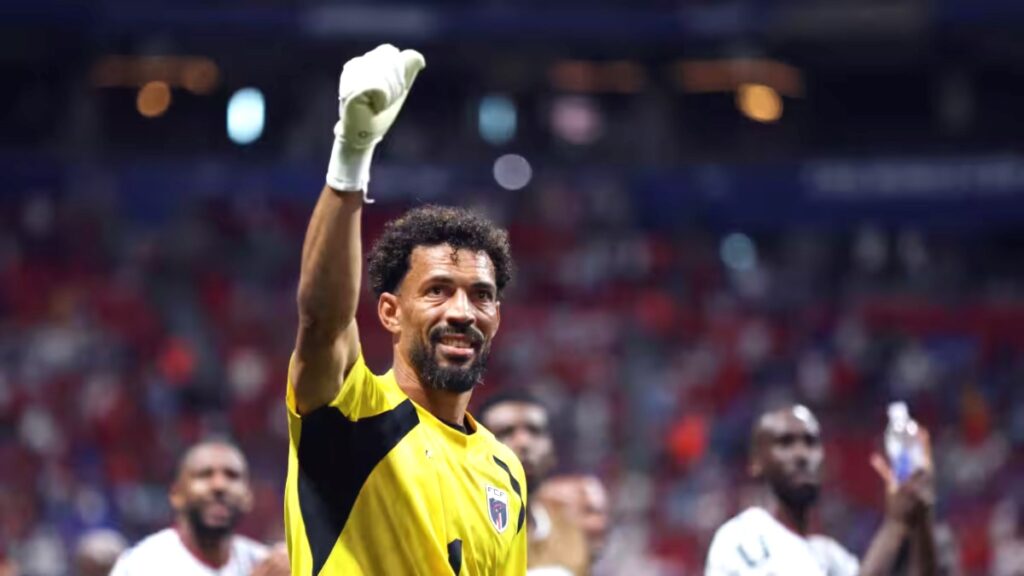
A 40-year-old goalkeeper playing in the second division of Portuguese football just held Spain to a 0-0 draw at the 2026 FIFA World Cup. Seven saves. Man of the Match. A historic result for Cabo Verde on their World Cup debut. Josimar José Évora Dias, the man the world now knows as Vozinha, became one of the biggest stories of the FIFA World Cup 2026 opening week.
But back in India, the conversation quickly moved from admiration to frustration. Because when people looked up Vozinha’s market value on Transfermarkt, they found something that was very hard to digest, the goalkeeper who just stopped Spain at the FIFA World Cup 2026 is valued at just Rs 40 lakh. Meanwhile, Indian footballers, who have never played at a World Cup and are nowhere close to qualifying for one, are valued at Rs 80 lakh, Rs 1.4 crore, and even Rs 2 crore.
So how does that happen? How is a FIFA World Cup 2026 hero valued at less than half of what an Indian goalkeeper is worth on paper? Let’s break it down.
What Vozinha Did at the FIFA World Cup 2026
Before getting into the numbers, it is important to understand what Vozinha actually did at the FIFA World Cup 2026 to get everyone talking.
Cabo Verde, a small island nation off the coast of West Africa, made their FIFA World Cup debut in 2026. In their very first group-stage match, they were up against Spain, one of the most technically gifted football teams in the world. On paper, it was a mismatch. In reality, it was a football lesson for Spain.
Vozinha made seven saves in that match. Seven. He kept Spain out completely, and Cabo Verde walked away with a 0-0 draw against one of the tournament favorites. It was a result no one expected, and it was built almost entirely on the back of one goalkeeper’s brilliant performance.
Vozinha, who plays his club football for GD Chaves in the Portuguese second division, earned the Man of the Match award. He became an overnight sensation around the world. Clips of his saves went viral, and people across the globe were asking, who is this man, and why haven’t we heard of him before?
The answer, sadly, is simple. Cabo Verde is a small country. Their league does not have the money or the attention of bigger leagues. Vozinha has spent most of his career in the lower tiers of European football. And because of all that, his market value on Transfermarkt sits at just Rs 40 lakh.
What Indian Players Are Valued At
Now, here is where the comparison gets uncomfortable for Indian football.
The Indian national team recently played Tajikistan in a friendly series under head coach Khalid Jamil. The squad that was picked for those matches carries an average market value of Rs 1.46 crore per player. The lowest-valued players in that squad, defenders like Rahul Bheke and Pramveer, are still valued at Rs 80 lakh each.
India’s goalkeepers tell a similar story. Gurpreet Singh Sandhu, India’s number one goalkeeper, is valued at Rs 1.4 crore. Albino Gomes is also valued at Rs 1.4 crore. Young goalkeeper Hrithik Tiwari is valued at Rs 1.8 crore.
To put it simply, all three Indian goalkeepers are valued between three and four times more than Vozinha, a goalkeeper who just held Spain to a draw at the FIFA World Cup 2026.
That is the comparison that has caused so much debate in Indian football circles. And honestly, it is a fair debate to have.
How Does Transfermarkt Calculate Market Value?
To understand why this gap exists, you first need to understand how Transfermarkt actually puts a number on a player.
Transfermarkt is one of the most widely used football databases in the world. It tracks player statistics, transfer history, contract details, and market valuations for footballers across the globe. But the way it calculates market value is not based purely on how good a player is on the pitch.
Instead, Transfermarkt uses what it calls the “wisdom of the community.” This means that the platform relies on its community of users to evaluate and update player values. These community members look at a range of factors, not just performance, but also things like the player’s age, their club’s transfer history, how much demand there is for the player in the transfer market, and the financial strength of the league they play in.
In short, Transfermarkt market value is more about what a club would realistically pay for a player in the current transfer market, rather than how talented that player actually is.
So when Vozinha’s value is set at Rs 40 lakh, it is not because Transfermarkt thinks he is a bad goalkeeper. It is because he is 40 years old, plays in the second division of Portuguese football, and no top club is going to spend big money to sign him. The demand simply is not there in the transfer market, even if his quality on the pitch is clearly very high.
On the other hand, Indian players playing in the ISL, a league that has growing club investment, higher domestic transfer fees, and competitive bidding between clubs like Mohun Bagan Super Giant and East Bengal FC, will naturally have higher market values, because Indian clubs are actually paying those amounts.
Robin Singh: It’s the Clubs’ Responsibility
Former Indian international Robin Singh has a clear view on who is responsible for this valuation gap.
Speaking about the Vozinha comparison, Singh said that the question of market value is really a question for the clubs, not the players themselves.
“I’m very happy for Vozinha, who had a great performance. The comparison to the Indian market, I feel, is a question that is relevant to the clubs,” Singh said. “It depends on how much a player is in demand and how much money the club is willing to pay for him. If the club in the Indian market feels a goalkeeper is worth a lot more, I think they’re the ones that have to be asked this question about the market valuation.”
Singh makes a solid point. Players do not set their own transfer values. Clubs do, through what they are willing to spend. If ISL clubs are paying Rs 1.4 crore for a goalkeeper, then that is what the goalkeeper’s market value will reflect. It is a supply-and-demand situation, and right now, the demand for Indian players in the ISL is pushing their values up, regardless of what is happening at the FIFA World Cup 2026.
Mehtab Hossain: Some Indian Valuations Are Inflated
Former India midfielder Mehtab Hossain agrees that the comparison between Vozinha’s value and Indian player values is interesting, but he also adds important context.
First, the age factor. Vozinha is 40 years old. His best years as a footballer are behind him. On Transfermarkt, a player’s value naturally goes down as they get older, even if they are still performing well. Vozinha himself had a peak market value of Rs 4.8 crore when he was 31 years old. That is actually higher than most current Indian players. Now, at 40 and in the second division, that value has dropped to Rs 40 lakh.
A similar pattern can be seen with India’s own Sandesh Jhingan. His current market value is Rs 2 crore, but three years ago it was Rs 2.4 crore. Values go up and down based on age, form, and club situation.
So part of the Vozinha valuation is simply about where he is in his career, not a direct measure of how good he is as a goalkeeper.
But Hossain also admits that there is a real problem with inflated valuations in Indian football. And he points directly at the competitive pressure between ISL clubs as a major reason.
“The football money depends on many factors,” Hossain said. “And here, for clubs like East Bengal or Mohun Bagan, what is happening now, especially with the pressure of signing a particular player, I think player valuations are increasing. There is pressure that we have to build a good team, we have to fight for championships, and what happens to the country’s football doesn’t matter. What matters is that if I want this player, I will take him at any cost, and that inflates the price.”
The Agent Problem in Indian Football
Hossain goes even further and points to player agents as another big factor behind inflated valuations in Indian football.
According to him, agents in Indian football sometimes create fake bidding wars to push a player’s value higher. An agent might tell Club A that Club B has already made an offer for a player, even when no such offer exists, just to get Club A to pay more. And when clubs pay more, the player’s market value on Transfermarkt goes up to reflect that.
“The player agent will say, ‘My player has an offer from East Bengal’, although there may not be any offer in reality,” Hossain explained. “Agents also earn from this. Some of the damage has been caused because of agents. You are filling your pockets, but only the clubs know how much they are suffering.”
This kind of agent activity is not unique to Indian football, it happens in many leagues around the world. But in a market like the ISL, where clubs are still building their structures and some are under heavy pressure from their supporters to sign the best available Indian talent, these tactics can push valuations far beyond what the quality of football actually justifies.
The Bigger Picture for Indian Football
The Vozinha valuation debate is not really about one goalkeeper’s market price. It is about what market value actually measures, and what it does not.
Market value, as calculated by Transfermarkt, is a reflection of local club spending habits, player age and career stage, league financial strength, and transfer market demand. It is not a direct score of footballing quality. Vozinha’s Rs 40 lakh valuation does not mean he is a worse goalkeeper than Gurpreet Singh Sandhu. It means he is 40, plays in a lower-division European league, and no club is going to spend big money to sign him right now.
At the same time, the fact that Indian players carry valuations of Rs 1.4 crore and above does reflect a real issue, ISL clubs are spending big, agents are sometimes driving prices up artificially, and the competitive pressure among India’s top clubs is creating a market where values can get disconnected from actual football quality.
Vozinha stopping Spain at the FIFA World Cup 2026 with seven saves is one of the great goalkeeper performances of this tournament. His Rs 40 lakh market value tells you about the transfer market reality for a 40-year-old in the Portuguese second division. It does not tell you anything about whether he is better or worse than Indian goalkeepers.
Both things can be true at the same time. And Indian football, if it wants to close the gap between its players’ market values and their actual performance on the international stage, needs to address the structural problems, from agent practices to club spending decisions, that are creating this disconnect.