There is a certain kind of player who reaches their late thirties and starts to fade. Their numbers drop, their role shrinks, and slowly they become a name from the past rather than a force in the present. Virat Kohli, it turns out, is not that kind of player.
In IPL 2026, Kohli did something that very few cricketers his age have managed to do. He looked at the game around him, a game that had become faster, younger, and more aggressive than ever before, and instead of resisting it, he joined it. Not by throwing away everything he had built over two decades, but by adding something new on top of it.
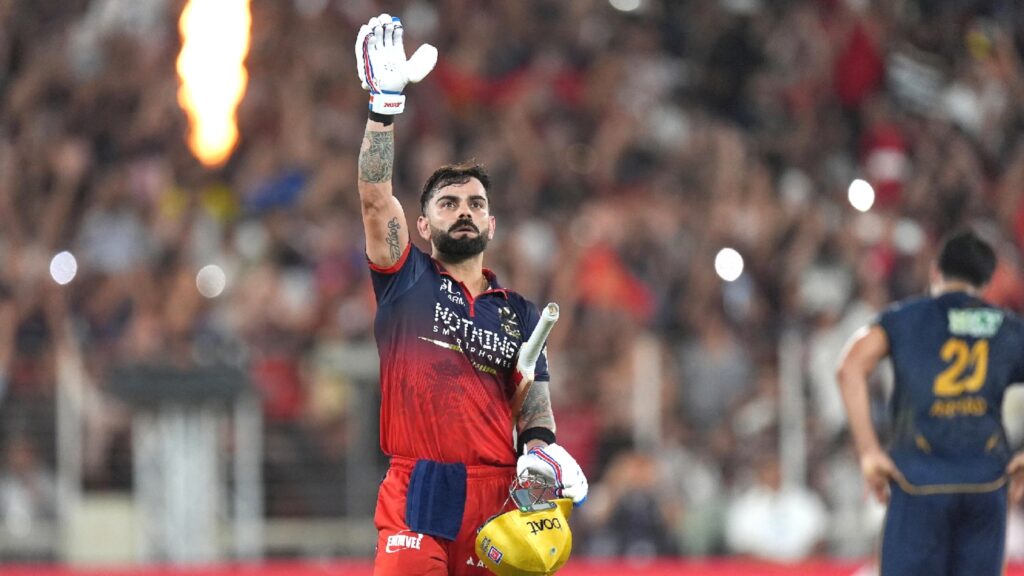
The result? A season that will be remembered as one of his best in the IPL, capped by a match-winning unbeaten 75 in the final against Gujarat Titans that sealed RCB’s title defence in Ahmedabad.
The Game Changed Around Him
To understand what Kohli did in IPL 2026, you first need to understand what the IPL has become in recent years. The tournament has always been aggressive, but the arrival of players like Vaibhav Sooryavanshi and Abhishek Sharma has pushed that aggression to a completely different level.
Sooryavanshi scored 521 Powerplay runs in IPL 2026 at a strike rate of 233.63. Abhishek scored 369 Powerplay runs at 214.53. These are not just good numbers, they are numbers that redefine what is possible in the first six overs of a T20 game. When teenagers and young players are scoring at these rates at the top of the order, every other batter in the league is forced to ask themselves a simple question: am I keeping up?
For a long time, Kohli’s answer to that question was to keep doing what he does best. His method, building an innings, rotating the strike, finding boundaries without throwing his wicket away, was still producing runs. In 2023, he scored 639. In 2024, he scored 741. In 2025, he scored 657. These are excellent numbers for any batter, let alone someone playing in their late thirties.
But Kohli is not someone who is satisfied with just being good. He watched the game change, he watched younger players raise the bar, and he decided he wanted to be part of that shift rather than a bystander to it.
A Mental Switch, Not a Technical One
Here is the most important thing to understand about Kohli’s transformation in IPL 2026: he did not rebuild his batting from scratch. He did not suddenly start slogging the ball over midwicket or trying shots that are not part of his game. What he changed was his mindset, the way he thought about batting, especially in the Powerplay overs.
Kohli himself explained it clearly after the final. “You need to get those 20-30 extra runs. I had to change my mindset, not my game so much, to hit the shots I hit, but more often and take the bowlers on, probably the best bowlers in the opposition.”
That is a subtle but very important distinction. Changing your technique means learning new shots or reworking your batting stance. Changing your mindset means deciding to be more aggressive with the shots you already own. Kohli has always been able to drive through the covers, pull the short ball, and hit through the off side with great timing. What changed in 2026 was that he chose to do these things earlier in the innings, more often, and against better bowlers.
The numbers back this up. In IPL 2026, over half of all the balls Kohli faced, 50.61 percent, came in the Powerplay. That is an all-time high for him. Of his 675 total runs, 360 came in the first six overs, which works out to 53.33 percent of his runs from the Powerplay alone. He scored those 360 runs at a strike rate of 174.76, which is his best Powerplay strike rate across any IPL season.
The Pace Bowling Takedown
One of the most striking parts of Kohli’s 2026 season was how he handled fast bowling. Over 80 percent of his runs, 542 out of 675, came against pace bowlers. His strike rate against pace was 177.7, which is the best he has ever managed against quicks in any IPL season.
To put that in perspective: in 2016, which many people consider Kohli’s greatest IPL season, he scored 609 runs against pace. That was the only time he scored more against pace in a single season. But his strike rate against pace that year was lower than 177.7. So in terms of how quickly he scored against fast bowlers, 2026 was actually his best ever.
The moment that really captured this new version of Kohli came in the final itself. Kagiso Rabada, one of the best fast bowlers in the world, bowled the second over of RCB’s chase. Kohli took 21 runs off that over. That was the most runs he had scored off a single over of pace bowling in 13 years. And this was against a bowler who had dismissed him five times in the past.
Over the full season, Kohli scored 88 runs against Rabada at a strike rate of 237. That number, 237, is not the kind of strike rate you expect from someone described as a classical, anchor-style batter. It is the kind of number you expect from the most aggressive hitters in the game. Yet Kohli produced it while staying completely true to his own style.
Different From Sooryavanshi and Abhishek, But Just as Effective
It would be wrong to say that Kohli batted like Sooryavanshi or Abhishek in IPL 2026. He did not. The way these three players score runs is quite different.
Sooryavanshi and Abhishek hit a lot of sixes. Sooryavanshi hit 46 sixes in the Powerplay alone this season. Abhishek hit 29. Kohli hit 11. By that measure, Kohli looks far less aggressive than the two young guns.
But here is what makes Kohli’s method so interesting: while Sooryavanshi faced 82 dot balls in the Powerplay and Abhishek faced 61, Kohli faced just 58. That means Kohli was actually hitting fewer dot balls than either of the two big hitters, even though he was hitting far fewer sixes than them. He was keeping the scoreboard moving through a different route, finding gaps, rotating the strike, and picking boundaries with placement rather than pure power.
This is what makes Kohli’s batting unique at this stage of his career. He is not going to out-hit Sooryavanshi. He is not going to match Abhishek’s six-hitting count. But he can score at close to the same rate by being smarter, more precise, and more consistent. His non-boundary strike rate in the Powerplay, meaning how quickly he scored runs that were not fours or sixes, was 71.6. That is an exceptionally high number for running between the wickets and taking ones and twos, and it is a big reason why his overall strike rate stayed so high despite hitting fewer sixes.
The Final Was the Perfect Summary
If you want one moment that captures exactly what Kohli did in IPL 2026, look at his innings in the final. RCB needed 156 to win the tournament. Kohli walked in and immediately went after Rabada, taking 21 off the second over. He reached his fifty off just 25 balls, the fastest IPL half-century of his entire career.
But then, when things got tricky, when the target was still some way away and wickets were falling, Kohli did something that only he can do. He slowed down, held the innings together, and made sure RCB did not lose the plot. His last 25 runs took 17 balls. He finished unbeaten on 75 and sealed the win with a six.
Two different styles of batting in the same innings. First the aggressor, then the anchor. That ability to switch between the two, to know exactly when to attack and when to hold, is something that cannot be taught. It comes from experience, and Kohli has more of it than almost anyone playing the game today.
After the match, he said something that made the whole season make sense. “You can have all the excitement and slam-bang in the world, but come the big situations, you need the big boys to step up.” That was not arrogance. That was simply the truth, stated plainly by someone who had just proved it.
He Did Not Trade His Old Self
What makes this whole story even more compelling is that Kohli did not become a different batter in 2026. He did not decide that aggression meant abandoning everything he stood for. He took what he already had and found a way to squeeze more out of it.
His technical foundations, the straight bat, the precise footwork, the ability to hit through the line, stayed exactly the same. What changed was the intention behind those shots. Instead of waiting for the bad ball to punish, he started going after good balls too. Instead of letting a bowler settle into a rhythm, he disrupted that rhythm from the very first over.
This approach also worked because of the team around him. With a strong middle order behind him at RCB, Kohli had the freedom to take more risks in the early overs knowing that if he got out, the innings would not fall apart. That security allowed him to play with greater freedom than in previous seasons, when he sometimes had to be more careful because the batting depth was less reliable.
The Young Players Pushed Him There
Kohli was honest about the role that younger players played in this transformation. “You have these super young players pushing you all the time and really asking you to change your game and up the ante. It’s exciting because it gives you something to work towards,” he said.
That is a refreshing way to look at what could easily have been a source of stress. Younger, more aggressive players entering the IPL and changing the standards could have made Kohli feel outdated or under pressure to keep up. Instead, he chose to see it as motivation, as a new challenge to rise to.
And rise to it he did. Four straight 600-plus seasons in the Impact Player era. A Powerplay strike rate of 174.76. A strike rate of 177.7 against pace. A 25-ball fifty in an IPL final. At 37, Virat Kohli is not slowing down. He is, somehow, still getting better.