Pickleball vs Padel: Which Sport Will Dominate the Next 5 Years?
The global racket sports landscape is undergoing a fascinating transformation. While tennis continues to enjoy its established position, two emerging sports—Pickleball and Padel—are rapidly capturing attention across the world. Both sports have witnessed remarkable growth over the last decade, attracting players, investors, clubs, and content creators alike.
As participation numbers continue to rise, one question is increasingly being asked: Which sport is better positioned for growth over the next five years?
The answer is not as straightforward as choosing a winner. Both Pickleball and Padel possess unique strengths that appeal to different audiences and business models. Let’s take an honest look at how they compare.
Court Cost
One of the biggest advantages Pickleball enjoys is affordability.
A Pickleball court can be built at a fraction of the cost required for a Padel court. Existing tennis courts, badminton courts, and multipurpose surfaces can often be converted into Pickleball courts with minimal modifications. This significantly reduces entry barriers for schools, residential societies, sports clubs, and local communities.
Padel, on the other hand, requires dedicated infrastructure. The glass walls, specialized fencing, lighting systems, and specific dimensions make construction considerably more expensive. While the premium setup creates a unique playing experience, it also limits the speed at which courts can be developed.
Learning Curve
When it comes to ease of learning, Pickleball has a slight advantage.
Many beginners can start rallying and enjoying matches within their first playing session. The smaller court, slower ball speed, and simple rules make the sport extremely welcoming for newcomers.
Padel is also beginner-friendly, but players must learn how to use the walls strategically. Understanding rebounds, positioning, and court geometry takes additional time. While this complexity adds excitement and tactical depth, it creates a steeper learning curve compared to Pickleball.
Infrastructure Requirements
Infrastructure plays a crucial role in determining how quickly a sport can expand.
Pickleball’s flexibility allows it to be played almost anywhere. Community centers, schools, apartment complexes, and sports facilities can integrate Pickleball with relative ease.
Padel requires dedicated courts that cannot easily be replicated using existing facilities. This means expansion is often dependent on investors, private clubs, and specialized sports operators willing to make significant capital investments.
As a result, Pickleball can spread more rapidly at the grassroots level.
Accessibility
Accessibility is where Pickleball truly shines.
The sport appeals to children, adults, senior citizens, and individuals who may not have extensive sporting backgrounds. The physical demands are moderate, allowing people of varying fitness levels to participate comfortably.
Padel is accessible as well, but its growth often revolves around premium sports clubs and urban centers where dedicated courts exist. This naturally restricts access compared to Pickleball’s broader community-based model.
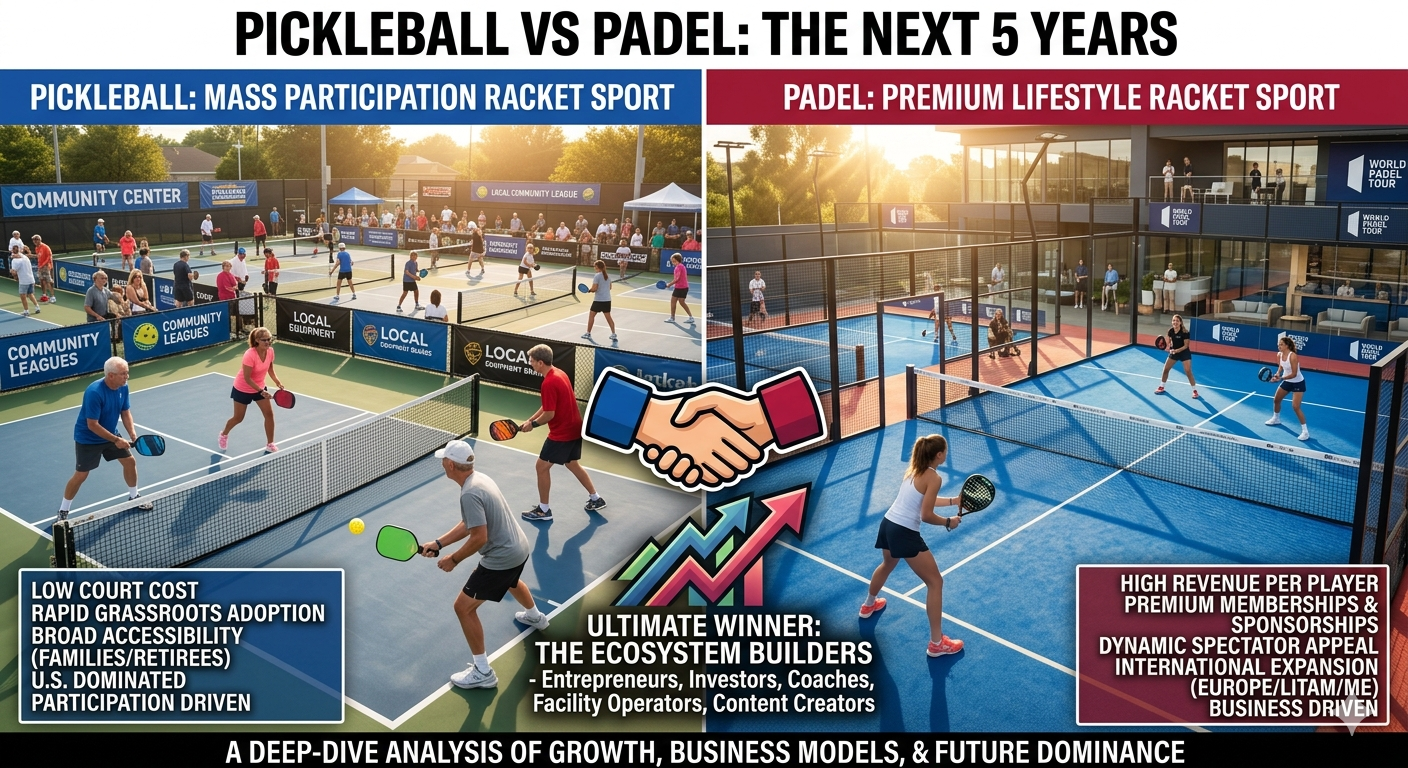

Over the next five years, accessibility could be one of the biggest drivers behind Pickleball’s participation boom.
Player Demographics
The two sports attract different audiences.
Pickleball has become particularly popular among families, retirees, recreational players, and those looking for a social sporting experience. Its inclusive nature has helped create large communities across various age groups.
Padel generally attracts younger participants, fitness enthusiasts, former tennis players, and individuals seeking a more competitive environment. The sport’s dynamic rallies and strategic gameplay often appeal to athletes looking for a challenging yet social experience.
Both demographics offer tremendous growth opportunities, but they represent different market segments.
Global Growth
Pickleball’s explosion has largely been fueled by the United States, where participation numbers have increased dramatically in recent years. The sport has become a cultural phenomenon, attracting celebrities, professional leagues, and significant media attention.
Padel’s growth story is more geographically diverse. It has experienced explosive expansion throughout Spain, Argentina, Sweden, Italy, the Middle East, and several Latin American nations. International federations and governing bodies continue to invest heavily in expanding the sport worldwide.
From a global perspective, Padel currently enjoys stronger international penetration, while Pickleball dominates participation growth in North America.
Commercial Potential
From a business standpoint, both sports present attractive opportunities.
Pickleball thrives on volume. More courts, more players, and larger communities create opportunities for equipment sales, coaching, events, and local sponsorships.
Padel often generates higher revenue per participant. Premium club memberships, specialized coaching, corporate events, tournaments, and luxury sporting experiences allow operators to command higher pricing.
For investors, this distinction is important. Pickleball offers scale, while Padel offers premium monetization.
Media and Spectator Appeal
Spectator value is becoming increasingly important in modern sports.
Padel’s fast-paced rallies, dramatic wall-play, and tactical exchanges create a highly entertaining viewing experience. The enclosed court environment also enhances camera angles and broadcast quality, making it particularly attractive for television and digital audiences.
Pickleball has made significant strides in improving its professional product and spectator appeal, but it remains largely participation-driven rather than entertainment-driven.
As professional circuits continue to evolve, Padel may hold an advantage in attracting broadcasters and sponsors.
The Indian Perspective
India presents a unique opportunity for both sports.
Pickleball’s low infrastructure costs and community-friendly nature make it well-positioned to become the country’s mass-participation racket sport. Schools, residential societies, and recreational clubs can adopt it relatively quickly.
Padel, meanwhile, has the potential to emerge as a premium lifestyle sport concentrated in metropolitan cities and high-end sports clubs. Its appeal among urban professionals and affluent consumers could drive strong commercial growth.
Final Verdict
If the next five years are judged by participation numbers, Pickleball may emerge as the winner. Its affordability, accessibility, and ease of learning create a strong foundation for widespread adoption.
However, if success is measured through business value, media appeal, premium experiences, and revenue generation, Padel may hold the upper hand.
Ultimately, the real winners may not be the sports themselves. Entrepreneurs, investors, coaches, facility operators, and content creators who build sustainable ecosystems around these sports are likely to benefit the most from this growing racket sports revolution.
What do you think? Will Pickleball dominate through participation, or will Padel become the premium racket sport of the future? Share your thoughts in the comments.
| Category | Pickleball | Padel |
|---|
| Overview | One of the fastest-growing participation sports globally, known for simplicity and accessibility. | A rapidly expanding racket sport combining elements of tennis and squash, known for dynamic gameplay and premium club culture. |
| Court Cost | Significantly cheaper to build and maintain. Existing tennis, badminton, or multipurpose courts can often be converted easily. | Requires specialized glass-enclosed courts, fencing, and dedicated infrastructure, making initial investment substantially higher. |
| Learning Curve | Extremely beginner-friendly. Most players can enjoy rallies and matches within a single session. | Beginner-friendly but requires understanding wall play, rebounds, and positioning, creating a slightly steeper learning curve. |
| Infrastructure Requirements | Can be played on converted courts and community facilities, enabling rapid expansion. | Requires dedicated courts and substantial investment, limiting expansion speed. |
| Accessibility | Accessible to all age groups, including children, families, recreational players, and senior citizens. | Generally concentrated in clubs and urban sports facilities, making access comparatively limited. |
| Player Demographics | Appeals to families, retirees, recreational athletes, and social players seeking fun and fitness. | Attracts younger audiences, former tennis players, fitness enthusiasts, and competitive athletes. |
| Global Growth | Growth primarily driven by the United States, where participation has surged dramatically. | Experiencing strong expansion across Europe, Latin America, the Middle East, and emerging markets worldwide. |
| Market Reach | Broad grassroots adoption with strong community engagement. | Strong international presence with growing professional structures and federation support. |
| Commercial Potential | Generates value through high participation numbers, equipment sales, coaching, local leagues, and community events. | Generates higher revenue per player through premium memberships, coaching, tournaments, and luxury club experiences. |
| Business Model | Volume-based growth driven by large player communities. | Premium-based growth driven by higher spending per participant. |
| Media & Spectator Appeal | Improving rapidly but remains primarily participation-focused. | Offers exciting rallies, wall-play, and superior broadcast appeal, making it highly attractive for spectators and media partners. |
| Professional Ecosystem | Emerging professional leagues and increasing sponsorship interest. | More developed professional circuits and growing international tournament ecosystem. |
| India Growth Potential | Likely to become a mass-participation racket sport due to affordability and ease of setup. | Likely to evolve as a premium lifestyle sport centered around metropolitan cities and upscale clubs. |
| Strength in India | Schools, housing societies, community centers, and recreational clubs can adopt it easily. | Appeals strongly to urban professionals, luxury sports clubs, and premium fitness communities. |
| Biggest Advantage | Low cost, easy learning curve, and widespread accessibility. | Premium experience, stronger spectator appeal, and higher commercial value per player. |
| Biggest Challenge | Building a sustainable professional ecosystem and media product. | High infrastructure costs and limited accessibility. |
| Next 5 Years Prediction | Likely to lead in total participation numbers globally and especially in emerging markets like India. | Likely to lead in business value, premium memberships, sponsorships, and spectator engagement. |
| My Verdict | The probable winner in participation and grassroots growth. | The probable winner in revenue generation and premium sports experiences. |
| Final Takeaway | Pickleball could become the “Mass Participation Racket Sport.” | Padel could become the “Premium Lifestyle Racket Sport.” |
| Ultimate Winner | Neither sport alone. The biggest beneficiaries may be entrepreneurs, investors, coaches, facility operators, and content creators who build ecosystems around these rapidly growing sports. | Neither sport alone. The biggest beneficiaries may be entrepreneurs, investors, coaches, facility operators, and content creators who build ecosystems around these rapidly growing sports. |
Related posts: