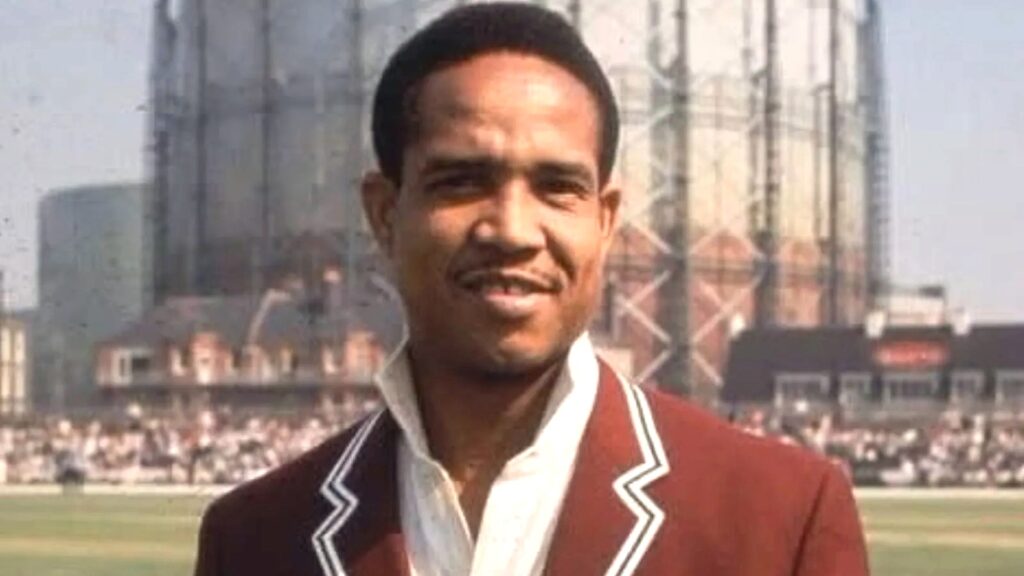
Sir Garry Sobers, one of the greatest all-round cricketers to ever play the game, died on Friday, just 11 days short of his 90th birthday. He was West Indies’ most complete player, someone who could bat, bowl in three different styles, field brilliantly, and lead the team, all in one body. This article looks back at his life, his cricket, and the simple man behind the greatness.
Garfield St Aubrun Sobers was born in a small wooden house on Walcott Avenue in Bridgetown, Barbados, in July 1936. He was born with an extra finger on each hand, which he later removed himself as a boy using catgut and a sharp knife. His father was a merchant seaman who died in January 1942 when his ship was torpedoed during World War II. Garry was just five years old at the time.
Life was not easy for young Garry. By the age of 14, he was already running errands in a furniture factory to help support his family. Nobody ever coached him formally. He learned all his cricket skills playing street games in St Michael, Barbados. This makes his later rise to the top of world cricket even more special, because he built his game on instinct and hard work, not formal training.
Rising To The Top Fast
Sobers made his first-class debut for Barbados at just 16 years old in 1953, and he played his first Test match for West Indies the very next year, in 1954, against England. At just 21 years old, something extraordinary happened. His very first Test century turned into an unbeaten 365 against Pakistan in 1958. This broke the world record for the highest individual score in Test cricket at the time, and the record stood for 36 long years until Brian Lara passed it in 1994.
Think about that for a moment. Most young players need to play many innings before they learn how to build a huge score. Sobers did it in his very first Test hundred. This early achievement showed the world that normal rules did not apply to him.
A Bowler With Three Different Skills
What made Sobers truly unique was not just his batting. He could bowl in three completely different styles: fast-medium pace, orthodox left-arm spin, and left-arm wrist-spin. Most all-rounders have one bowling style they are known for. Sobers had three, and he was good enough at each one to be picked as a specialist bowler in any of them.
This gave his team huge flexibility. A captain could use Sobers as an opening bowler with the new ball, then switch him to spin later in the innings, all without needing to bring in another bowler. Richie Benaud, a respected cricketer and commentator himself, once called Sobers the greatest all-round cricketer the world had ever seen, praising his skill with the bat, ball, and in the field.
Six Sixes In One Over
One moment from his career became world famous. On August 31, 1968, while playing for Nottinghamshire against Glamorgan at Swansea, Sobers hit bowler Malcolm Nash for six sixes in a single over. He was the first man in first-class cricket history to do this. Five of the sixes flew clean out of the ground, and the sixth was actually caught near the boundary, but the fielder’s own momentum carried him over the rope, so it was ruled a six too.
Interestingly, Sobers later said the goal was never to chase a personal record. He simply wanted to score quickly for his team. This shows how team-first his thinking always was, even during a moment that made him immortal in cricket history.
The Tragedy That Changed Him
Behind the cricket, there was deep personal pain. In September 1959, Sobers was driving through the night to a charity match in London when his car came around a bend straight into the headlights of a large cattle truck. His close friend and teammate Collie Smith was asleep in the back seat, and fast bowler Tom Dewdney sat in the front. The crash broke Smith’s spine, and even in that state, Smith told Sobers not to worry about him and to look after Dewdney instead. Smith died three days later at the age of just 26.
Sobers was fined for careless driving and began drinking heavily afterward. But he soon realized that losing himself to alcohol would be a second betrayal of his friend. He made a promise to himself: from then on, he would bat for two people, Garfield Sobers and Collie Smith. This personal vow may explain why he later scored three centuries in a single home series against England, driven by grief and love for his lost friend.
His Best Innings, According To Bradman Himself
In 1971-72, while playing for a World XI against Australia in Melbourne, a young fast bowler named Dennis Lillee bowled Sobers out for a duck. That evening, Sobers walked into the Australian dressing room and told Ian Chappell, “You’ve got a boy here called Lillee. Tell him I can bowl quick too.” The next time they met, Sobers bounced Lillee back so hard that Lillee reportedly smashed his bat against a wall in anger.
In the innings that followed, Sobers made a stunning 254 runs, playing shots so powerful that his straight drives reached the sightscreen almost before Lillee had even finished his bowling action. Sir Don Bradman, the man most people consider the greatest batsman ever, called it the greatest innings he had ever seen on Australian soil. That is one of the highest compliments any cricketer could receive.
Career Numbers That Still Amaze
Sobers played international cricket mainly in the Test format, since ODI cricket had only just begun near the end of his career and T20 cricket did not exist yet. Here is a summary of his overall stats:
| Format | Matches | Runs | Batting Average | Centuries | Wickets | Catches |
| Test | 93 | 8,032 | 57.78 | 26 | 235 | 109 |
| ODI | 1 | 12 | 12.00 | 0 | 0 | 0 |
| T20I | Did not play | — | — | — | — | — |
His Test numbers alone put him among the very best players in cricket history. In first-class cricket overall, he scored more than 28,000 runs and took more than 1,000 wickets, which shows that his brilliance was not just a few big moments but a long career of steady excellence.
When Wisden picked its five Cricketers of the Century in 2000 after asking 100 experts, Bradman received all 100 votes, and Sobers came second with 90 votes, far ahead of the third-placed player who got only 30 votes. This shows how widely respected he was across the whole cricket world, not just in the West Indies.
Life Was For Living
Sobers had a simple way of looking at life and cricket. “Life is for living,” was how he put it. He would walk off the field without waiting for the umpire’s decision if he knew he had nicked the ball. He also could not stand sledging or unfair behavior on the field. At Lord’s in 1973, after attending a party that went on until half past nine in the morning, he still showered, padded up, and scored an unbeaten 150. This turned out to be his 26th and final Test century.
A Kind Teacher In Later Years
In the early 1980s, Sobers coached the Sri Lankan cricket team, where a young Arjuna Ranatunga was just starting his career. Ranatunga once shared a memory from a match in England where the pitch was helping the bowlers and batsmen kept getting nicks. Sobers stormed onto the field, called for gloves, and even used a plain stump instead of a bat. He faced six balls with just the stump and hit every single one perfectly, showing the younger players there was no excuse for poor batting.
Ranatunga always called him “Sir Garry,” never just Sobers, out of deep respect. In February 1975, Sobers was knighted at the Garrison Racecourse, which was just a short distance from the small wooden house on Walcott Avenue where he grew up. It was a full circle moment for a boy who once had nothing to a man honored by the whole cricket world.
Charlie Davis, who batted alongside him for years, once said Sobers was “not normal,” describing how he could catch a blur of a ball while standing close to the batsman at leg slip. Indian all-rounder Salim Durani, who played against him through the 1960s and 70s, remembered him simply as “such a simple man.” That, in the end, may be the best way to remember Sir Garry Sobers: a man who did extraordinary things on the field but never lost his simple, humble nature off it.