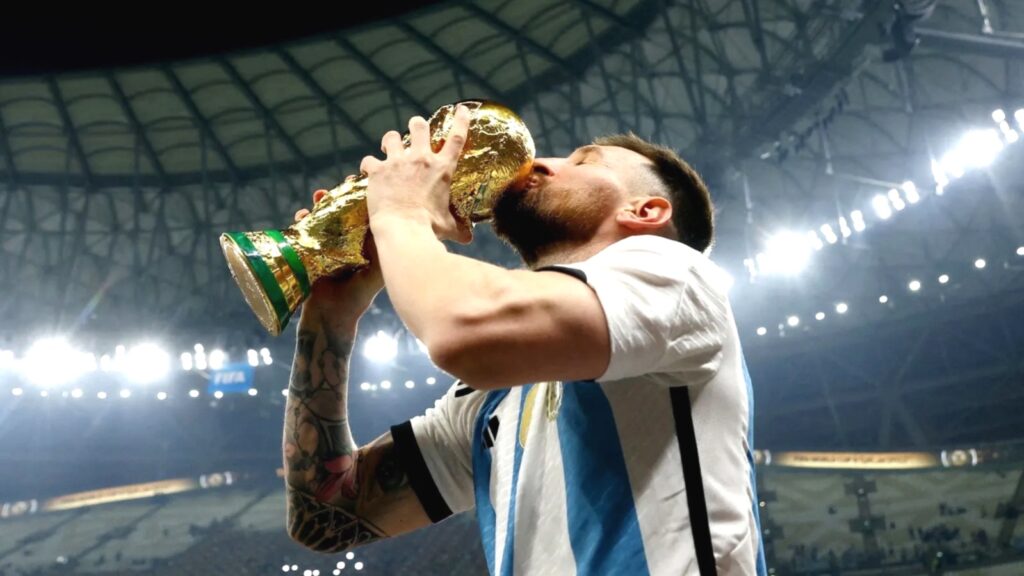
It was a night that felt like the end of a very long story. In Lusail, Qatar, under golden confetti and fireworks, Lionel Messi stood wrapped in a black bisht, a traditional Arabian cloak, holding the FIFA World Cup trophy. Around him, his Argentina teammates screamed, hugged, and collapsed to the ground in tears. Back home in Buenos Aires, millions of people poured into the streets. An entire country seemed to breathe out at once after decades of waiting.
For most people watching, that image felt final. It felt like the perfect full stop to the greatest football career ever. Messi had everything, the World Cup, the Copa Americas, the Ballon d’Or trophies, the Champions League titles. What more could there possibly be left to do?
And yet, four years later, Lionel Messi is preparing to play at another FIFA World Cup. This time, the tournament is spread across three countries, the United States, Mexico, and Canada. And somehow, at 39 years old, Messi is still at the very centre of it all.
From Qatar to America, A Move That Changed Everything
After winning the World Cup in December 2022, Messi’s next big decision came in 2023 when he joined Inter Miami in Major League Soccer (MLS) in the United States. At first, many people saw this as the beginning of the end, a comfortable move to wind down a great career. After all, America has long been a soft landing spot for football legends in their final years. Pelé came to New York Cosmos. David Beckham played for LA Galaxy. The pattern was familiar.
But Messi’s move to the United States felt different from the start. He did not arrive as a fading player looking for an easy last contract. He arrived as the reigning World Cup champion, the best player on the planet coming to a country that had spent decades trying to grow its football culture.
The effect was immediate. MLS stadiums that once had half-empty stands were suddenly sold out. Celebrities began showing up to watch games. Children across American cities who had never closely followed football were wearing pink Inter Miami shirts and screaming Messi’s name. The sport felt new, exciting, and suddenly relevant in a market that FIFA had always wanted to fully win over.
In a way, the timing could not have been better, or more perfectly arranged. The world’s most famous footballer moved to the continent that was hosting the next World Cup, just as football there was reaching a turning point in its popularity. America had been trying to import football prestige for years. Messi delivered it almost overnight.
The Long Road of Argentina’s Pain
To understand why Messi’s 2026 World Cup appearance means so much, it helps to understand the long and painful road that came before Qatar 2022.
For most of Messi’s international career, playing for Argentina was connected to disappointment. Tournament after tournament, the country came close but never won the biggest prize. The 2014 World Cup final in Brazil ended in defeat to Germany. Then came back-to-back Copa America final losses in 2015 and 2016. Each defeat added to what felt like a national heartache.
Messi, as the face of the team, carried much of that weight. He was seen as football’s saddest genius, a player who had won everything at club level with Barcelona but could never bring his country the one trophy they wanted most. The criticism was often unfair, but it was loud. At one point in 2016, after another Copa America final defeat, Messi even announced his retirement from international football. It was a moment that felt symbolic, a great player exhausted by the endless cycle of near-misses.
But then, slowly, things began to change.
How Argentina Finally Became a Real Team
Head coach Lionel Scaloni took over Argentina and changed the way the team worked. Under him, Argentina stopped trying to rely on Messi to perform miracles every single game. Instead, the team became more balanced, more organised, and emotionally healthier.
Younger players grew into important roles and stopped treating Messi as someone to admire from a distance. Julian Alvarez pressed and fought for every ball like a street-level competitor. Rodrigo de Paul became Messi’s closest ally on the pitch, working hard to protect him and create space. Enzo Fernandez brought energy and confidence. Goalkeeper Emiliano Martinez brought a wild, competitive spirit that the team had been missing for years.
For the first time, Argentina looked and felt like a modern, complete football team, not just a group built around one player.
And Messi himself changed too. The younger Messi was an explosive dribbler who would take on entire midfields on his own. But as the years passed, he evolved into something different. He stopped trying to control every moment and instead learned to influence matches with small, clever actions, a perfectly timed pause, a disguised pass, a glance before playing a ball through a gap that nobody else had spotted.
This shift is exactly why Messi at 39 can still be relevant at a World Cup. He will not be the fastest player on the field. He will not be the most athletic. But he may still be the smartest, the player who reads the game better than anyone else and finds the right moment to make a difference.
The Burden Is Gone, and That Changes Everything
One of the most interesting things about Messi heading into the 2026 World Cup is the change in pressure surrounding him.
In Qatar, every single touch carried enormous weight. Every match felt like it could be his last chance. The pressure of an entire country’s football history sat on his shoulders for every game. Even when Argentina were winning, there was tension, a fear that it could all fall apart again, as it had so many times before.
In 2026, that weight no longer exists. The story is already complete. Messi has the World Cup. Argentina has the World Cup. The long wait is over.
So if Messi walks onto the pitch in America, Mexico, or Canada this summer, he will do so as a free man in many ways. There is nothing left to prove. There is no burden of history chasing him. He can simply play football, and perhaps enjoy it more openly than at any point in his international career.
That freedom, oddly enough, could make him even more dangerous.
A Career Arc Like No Other
Most great athletes follow a similar path toward the end of their careers. They slow down, make fewer appearances, and eventually fade out. Their final tournaments can be difficult to watch because the gap between what they once were and what they have become is too obvious.
Messi’s journey after Qatar 2022 has been different. Rather than declining in the expected way, he has moved into a strange and special place, somewhere between active footballer and living legend. He is not just a great player anymore. He has become a symbol, a reference point, a shared language for an entire country.
His personal story adds another layer to all of this. Messi left Argentina as a 13-year-old boy to travel to Spain for growth-hormone treatment that would allow him to grow properly and pursue a football career. He spent the next three decades building one of sport’s greatest stories on European soil. Now, at the very end of that journey, he has returned to the Americas, first to Miami, and soon to a World Cup tournament spread across the same continent.
There is a full-circle quality to the whole story that feels almost like something from a film.
Where the Final Chapter Is Being Written
The 2026 World Cup has a geography that connects perfectly to Messi’s career and football’s history. Mexico carries the memory of Diego Maradona’s legendary 1986 World Cup campaign, the last time Argentina won the trophy before Qatar 2022. The United States represents football’s commercial future and its push toward becoming a truly global sport. Canada represents the expanding reach of the game into new territories.
Messi, in a way, connects all three of those ideas at once. He is the link between football’s past and its future. He bridges history and the modern game. He is both an Argentine icon and a global figure whose face is recognised in every corner of the world.
At 39, he is unlikely to be the player who carries Argentina on his back for six games. But he does not need to be. The team around him is strong enough now. What Messi brings in 2026 is different, it is experience, calmness, and the kind of football intelligence that only comes from having played at the highest level for more than two decades.
Argentina’s Last Dance With Their Greatest Player
For Argentina as a nation, Messi is no longer just their best footballer. He has become something bigger, a shared emotional experience that connects generations. Grandfathers who watched Maradona in 1986 lived to see Messi in 2022. Children who were born after Messi had already won multiple Ballon d’Or awards grew up watching him finally lift the one trophy that had been missing.
That connection between a player and a country runs very deep. And so, when the 2026 World Cup kicks off, the image of Messi in an Argentina shirt will carry all of that history with it, not as a burden this time, but as something to celebrate.
Sport almost never gives its greatest players a perfect ending. Most legends retire with a quiet whimper rather than a final moment of glory. What makes Messi’s situation so rare and so worth watching is that his story already had its perfect ending in Qatar, and yet, here he is, ready to write one more chapter.
Not because he has to. Simply because football, even now, still cannot quite imagine its biggest stage without him.