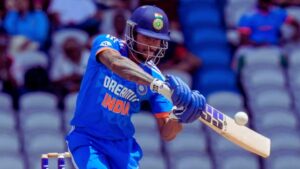
Much like his debut IPL season in 2022, and subsequently in 2023, Tilak Varma made a remarkable impression on the international stage, catching the attention of many. In the face of a spirited West Indian bowling attack and in conditions that weren’t particularly favorable for batting, he secured scores of 39, 51, and an unbeaten 49 in his initial three T20I innings. The quality of his shots and his composed demeanor led to contemplation: Could he potentially be expedited into the ODI squad for the 2023 World Cup?
Also Read: West Indies vs India, 2nd T20I: Brilliant fifty by Tilak Varma Goes in Vain
Former Indian opener Wasim Jaffer echoed this sentiment in a recent interview. While at first glance, the notion of including a batter with only a few T20Is under his belt in the World Cup squad might seem audacious, there exist certain justifications that make this consideration plausible.
Outlined below are three of these rationales:
The situation might just warrant it
KL Rahul’s recovery progress for the upcoming World Cup is reportedly positive, and he could even be ready for the Asia Cup commencing on August 31. However, there remains uncertainty surrounding the availability of Shreyas Iyer, a pivotal component of India’s middle-order strategies.
Iyer notched up two centuries while occupying the number four batting position, maintaining an average of 47.35. During his absence, India experimented with various candidates including Rahul, Suryakumar Yadav, Ishan Kishan, Axar Patel, and even Hardik Pandya himself. Unfortunately, no one managed to cross the half-century mark until the third ODI against West Indies, wherein Sanju Samson contributed 51 runs from 41 balls.

Should Shreyas fail to regain fitness in time, the problematic number four slot, which also stirred discussions prior to the 2019 World Cup, could once again become a point of contention. Given India’s recent hesitancy in trusting Sanju Samson, there is a possibility that Tilak might be selected for the Asia Cup, offering a trial in that role. Who knows what this opportunity might unveil?
Tilak has the record and form to back him
Our exposure to Tilak has been primarily in T20Is, yet he’s certainly no novice when it comes to the 50-over format, which he favors in domestic cricket. In the span of 25 matches, he has accumulated 123 runs with an impressive average of 56.18, maintaining a strike rate of 101.64. Notably, during the Vijay Hazare Trophy 2022-23, he showcased his prowess by amassing 402 runs at a remarkable average of 80.40, coupled with a nearly 120 strike rate.
His predominant batting position has been at number three throughout his career, demonstrating a consistent ability to time his innings effectively – a pivotal attribute in the realm of 50-over batting. This proficiency is also evident in his List-A statistics: an impressive count of five centuries and five half-centuries.
The transition from number three to number four isn’t an overly daunting one in cricket. The situations you encounter are often comparable, possibly demanding slightly enhanced skills against spin to navigate the middle overs. In the IPL 2023, Tilak maintained a reasonable strike rate of 136.19 against spin. Although notably lower than his 192.30 strike rate against pace, it’s important to acknowledge his role during death overs where an aggressive approach against fast bowlers is requisite.
Considering Rishabh Pant’s unavailability, the top and middle order of India’s batting lineup for the Asia Cup might predominantly comprise right-handers, with the exception of Ravindra Jadeja. To be specific: Rohit Sharma, Shubman Gill, Virat Kohli, Sanju Samson, KL Rahul, and Hardik Pandya. Ishan Kishan has also been considered as a backup opener.
The team’s batting order, heavily skewed towards right-handers, has faced challenges against both left-arm pace and left-arm spin in previous matchups. Additionally, the absence of a capable bowling option among the top order has persisted as an issue since 2019.
Tilak, a left-handed batsman and a proficient off-spinner, offers an interesting prospect. Although deploying him at No. 4 for India entails certain risks, the potential upside could indeed be substantial.
We’ve seen this script before
Ambati Rayudu had showcased consistent performances at the number four position prior to the 2019 World Cup. However, the influence of recency bias prompted Indian selectors to opt for Vijay Shankar and Rishabh Pant, both of whom had demonstrated strong performances in the preceding IPL season.
Similarly, in preparation for the 2021 T20 World Cup, India selected Rahul Chahar and Varun Chakravarthy, who were both riding high on excellent form leading up to the tournament. Nevertheless, they lacked experience in playing significant international matches.
Consequently, the third rationale behind considering Tilak as a dark horse for the 2023 World Cup resides in the established tendencies of selectors. The prevailing demand, combined with recency bias, might combine to position him as India’s unanticipated asset at the grand event.
Related posts: