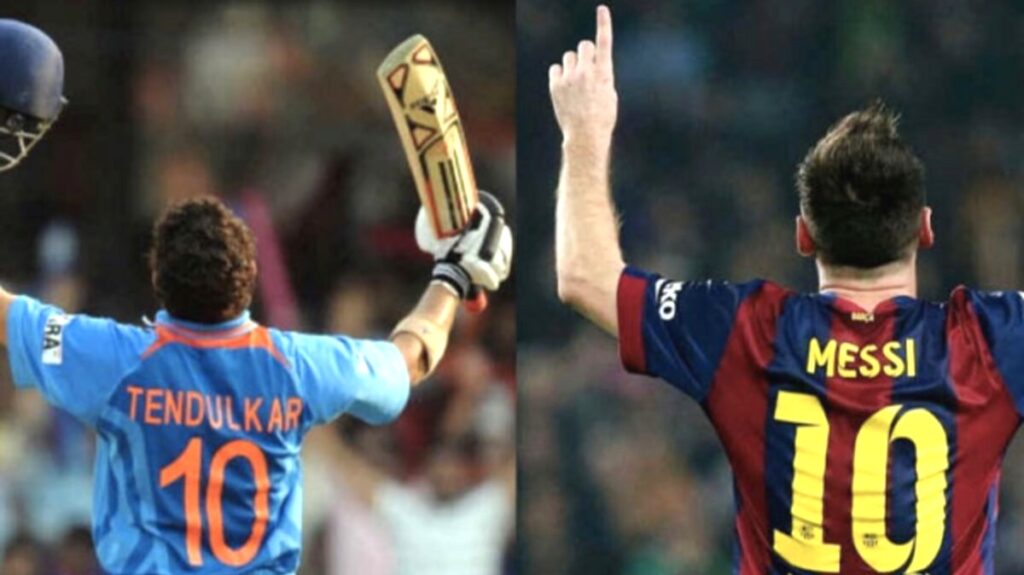
Every four years, the FIFA World Cup arrives and, with it, the same old debate comes roaring back to life, especially across the Indian subcontinent. Is Cricket a global sport, or is it just Football pretending to be? And this time, with the 2026 FIFA World Cup playing out across North America, the argument has gotten louder than ever on social media.
But here is the thing: asking which sport is “better” is a rabbit hole with no end. The real question worth asking is simpler and far more interesting, what does it actually mean for a sport to be truly global?
Let’s break it down with numbers, honesty, and a little bit of common sense.
The Population Battle: Cricket’s Big Claim
If you look only at the raw population numbers, cricket fans have a surprisingly strong case to make.
The 20 nations that played in this year’s Men’s T20 World Cup together represent about 2.46 billion people. Compare that to the 48 nations in football’s World Cup, which add up to roughly 2.26 billion people. On paper, cricket’s tournament bracket covers more of the world’s population than football’s.
For cricket fans who have long been told their sport is a small, post-colonial game while football rules the world, this felt like a long-overdue win. Finally, a number to throw back in football’s face.
But numbers, as they say, can be made to tell any story you want.
The India Problem: When One Country Carries Everything
Here is where cricket’s big number starts to fall apart.
Of that 2.46 billion total, India alone contributes 1.45 billion people, that is 59% of the entire figure. Add Pakistan to the mix, and just two neighboring countries make up nearly 70% of cricket’s total population count. The remaining 18 countries in the tournament? Their combined population doesn’t even match South America’s contribution to the football World Cup.
Think about what that actually means. Cricket’s “global” population claim is not really spread across the world, it is sitting almost entirely in two countries that share a border.
To put this another way: if you remove India from cricket’s numbers, the remaining 19 nations drop to around 1.0 billion people. Football’s 2.26 billion suddenly looks like an unreachable gap.
There is a useful way to picture this. Think of F. Scott Fitzgerald’s famous novel The Great Gatsby. Gatsby throws enormous parties at his mansion, hundreds of guests, loud music, the illusion of a wide and glamorous social circle. But strip away Gatsby himself, the one magnetic force pulling everyone in, and the mansion empties immediately. Nobody was actually there for each other. They were all there because of one person.
Cricket’s population numbers work the same way. India is Gatsby. Take India out, and the party is over.
A Single Logistical Change Wiped Out 168 Million People
If the India-Pakistan dependency wasn’t enough to make you question cricket’s global strength, consider what happened with Bangladesh.
Bangladesh, with a population of 174 million people, originally qualified for this year’s T20 World Cup. Due to late administrative changes, they had to withdraw and were replaced by Scotland, a country of just 5.5 million people.
In one single administrative decision, cricket’s population count dropped by 168 million people overnight.
Had Bangladesh stayed in, cricket’s total would have jumped to 2.63 billion, comfortably ahead of football. But with Scotland in, the numbers shifted dramatically. This kind of wild swing tells you something important: cricket’s global reach is not a stable, well-built structure. It is fragile, heavily dependent on whether a few large South Asian nations happen to be in the bracket at any given time.
Football doesn’t have this problem. Its numbers are distributed far more evenly across its 48 competing nations, so no single dropout can cause this kind of statistical earthquake.
Averages vs Medians: The Smarter Way to Read the Data
To really understand how these two sports are spread across the globe, you need to look beyond the total numbers and think about the typical nation in each tournament.
Averages can lie. If you put nine students with no money in a room with one billionaire, the group’s average wealth looks impressive. But the median, the person sitting right in the middle of the group, tells a much more honest story.
Because of giants like India, Pakistan, and the United States, the average population of a cricket nation is an inflated 123 million. Football’s average, by comparison, is a leaner 47 million.
But look at the medians, and the picture changes. Football’s median nation size is 33 million people. Cricket’s is just 24 million.
In simple terms, the typical football-playing country is larger than the typical cricket-playing country. This suggests that football’s reach is spread more evenly, while cricket is propped up by a few very large nations at the top.
The Country Count: Football Wins, And It Isn’t Close
Population is one way to measure a sport’s global reach. Country count is another, and here, football is not even playing in the same league as cricket.
The FIFA World Cup featured 48 nations in 2026, drawn from every corner of the globe. Cricket’s T20 World Cup had 20 nations. Even if you expand that to include associate and affiliate members who play cricket in some form, the gap remains enormous.
Football is played competitively in nearly every country on earth. The FIFA member count runs into the 210s, covering more countries than the United Nations. Cricket, even with the ICC’s growing ambitions, is far behind in terms of meaningful participation across the globe.
This is where football’s claim to being the world’s sport is strongest, not in raw population numbers, but in geographic spread. There are countries in Africa, Europe, Asia, and South America where football is not just a sport; it is practically a second language. Cricket simply does not have that kind of universal footprint.
The Giant Nobody Talks About: China
Here is a number that complicates both sports’ global claims: China, with 1.4 billion people, plays in neither World Cup.
China is the second most populous country on earth. It doesn’t qualify for the football World Cup, and it doesn’t play cricket at the international level in any meaningful way. Yet both sports happily count their “global” numbers without accounting for the fact that the world’s second-largest population is essentially sitting this whole conversation out.
And China is not alone. When you look at the ten most populous countries on earth, the coverage drops for both sports. Football has the US and Brazil from that top ten. Cricket has India, Pakistan, and the US. The rest of the list, Indonesia, Nigeria, Ethiopia, and others, are either absent or peripheral.
So neither sport has truly cracked the world’s population map as completely as their fans like to believe.
Two Very Different Kinds of “Global”
After all of this data, the honest answer is that these two sports are not competing for the same kind of global status, they are global in completely different ways.
Football is wide. It is played in almost every country, across every continent, in small towns and big cities, in nations that will never come close to qualifying for a World Cup. Hundreds of millions of people in India, Pakistan, and Bangladesh follow football even though their national teams rarely make it to major tournaments. Its reach is broad, consistent, and geographically diverse.
Cricket is deep. In the countries where it is loved, India, Pakistan, England, Australia, the West Indies, South Africa, Sri Lanka, it isn’t just a sport. It is a cultural institution. The passion, the following, and the viewership numbers in these countries are almost impossible to match. The IPL alone generates viewership that most football leagues outside of the Champions League and the Premier League can only dream about.
But depth in a few places is not the same as width across many. A sport watched intensely by 1.4 billion Indians is not automatically more global than a sport watched casually by 400 million people spread across 80 different countries.
So, Is Cricket More Global Than Football?
The short answer is: no, at least not by the traditional definition of “global.”
Cricket’s population numbers look impressive on a spreadsheet, but they collapse the moment you look at where those numbers are actually coming from. The sport’s demographic weight sits almost entirely in the Indian subcontinent, and one country, India, is doing the heavy lifting for nearly 60% of the total.
Football, on the other hand, covers more countries, more continents, and more cultures than any other sport on earth. Its numbers are not as eye-catching in a single country, but they are spread across the world in a way that cricket’s simply are not.
That said, cricket’s concentrated depth should not be dismissed. The sport has hundreds of millions of passionate followers in some of the world’s most populous nations. Its financial muscle, driven largely by the BCCI and the IPL ecosystem, continues to grow year by year.
In the end, calling one sport more global than the other depends entirely on how you define the word “global.” If global means more countries, football wins easily. If global means more people in your tournament bracket, cricket wins, but only barely, and only because of India.
Both sports are global. Just not in the same way.
Related posts: