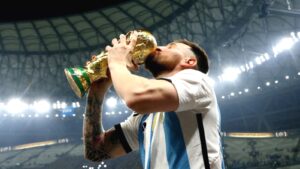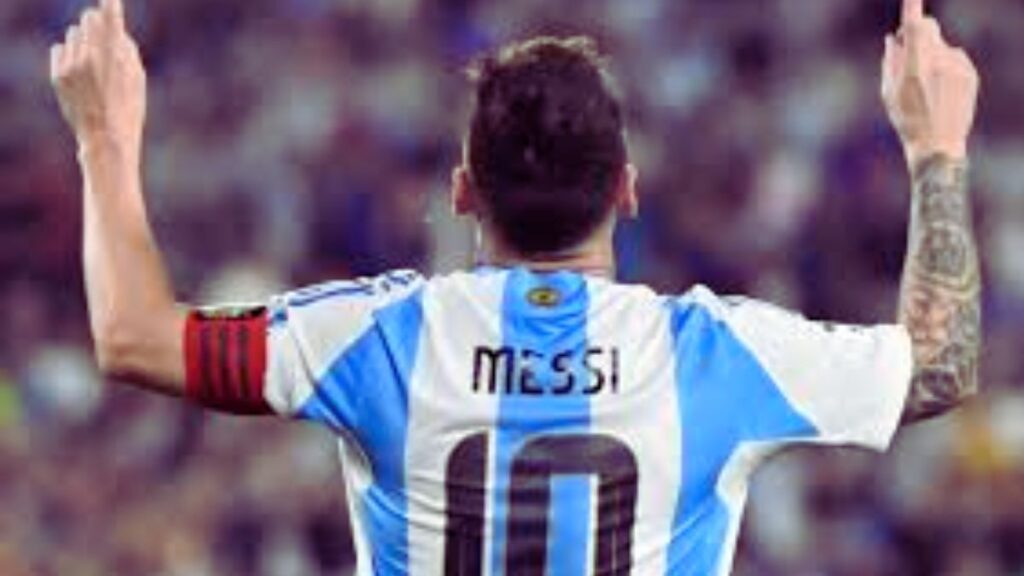
The Golden Boot race at the 2026 FIFA World Cup is heading toward a finish that looks a lot like one of the closest battles in tournament history. Lionel Messi currently sits on top with eight goals and four assists, while Kylian Mbappé sits close behind with eight goals and three assists. Both players are tied on goals, but Messi leads because of FIFA’s official tiebreaker rules, which look at assists first when goals are equal.
Current Golden Boot Standings
Before looking at how FIFA decides ties, it helps to see exactly where things stand right now among the top scorers of the tournament.
| Rank | Player | Country | Goals | Assists |
| 1 | Lionel Messi | Argentina | 8 | 4 |
| 2 | Kylian Mbappé | France | 8 | 3 |
| 3 | Jude Bellingham | England | 6 | 1 |
| 4 | Harry Kane | England | 6 | 1 |
| 5 | Ousmane Dembélé | France | 5 | 2 |
Messi moved into first place after setting up two goals in Argentina’s dramatic 2-1 semifinal win over England. Even though he did not score in that match, his passes helped Enzo Fernández and Lautaro Martínez find the net, and that pushed his assist count to four, one more than Mbappé.
France’s loss in the semifinal has not ended Mbappé’s hopes though. Les Bleus still have one more match left, the third-place playoff against England, and any goals he scores there will still count toward his Golden Boot total. This gives him one last chance to close the gap or even move ahead of Messi before the final. Messi, on the other hand, will get his final chance in the World Cup final itself, where Argentina face Spain.
How FIFA Decides The Golden Boot Winner
Many people assume the Golden Boot simply goes to whoever scores the most goals, and most of the time, that is true. But FIFA has a clear set of rules to follow when two or more players finish level on goals. These rules are applied in order, one after another, until a winner can be separated from the rest.
| Tiebreaker Order | Criteria Used |
| 1 | Most goals scored |
| 2 | Most assists (decided by FIFA’s Technical Study Group) |
| 3 | Fewest minutes played on the field |
So if two players end the tournament with the same number of goals, FIFA looks at assists next. Whoever has more assists wins. If both goals and assists are equal, then FIFA looks at who played fewer minutes to score those goals and assists, and that player is given the award. This exact process is what could decide the fight between Messi and Mbappé if both end the tournament with the same number of goals.
The Famous Four-Way Tie Of 2010
To understand how important these tiebreaker rules can be, it helps to look back at the 2010 World Cup in South Africa. That tournament produced one of the closest Golden Boot races the sport has ever seen. Four different players from four different countries all finished with exactly five goals each.
| Position | Player | Country | Goals | Assists |
| Golden Boot | Thomas Müller | Germany | 5 | 3 |
| Silver Boot | David Villa | Spain | 5 | 1 |
| Bronze Boot | Wesley Sneijder | Netherlands | 5 | 1 |
| Fourth | Diego Forlán | Uruguay | 5 | 1 |
Instead of naming all four players as joint winners, FIFA used its official ranking system. Since all four were level on goals, the next step was to compare assists. Thomas Müller had three assists, while Villa, Sneijder, and Forlán each had only one. That gave Müller the Golden Boot even though all four men scored the same number of goals in the tournament.
With Villa, Sneijder, and Forlán still tied on both goals and assists, FIFA moved to the final tiebreaker: minutes played. Villa had played fewer minutes than the other two, so he was given the Silver Boot. Sneijder had played fewer minutes than Forlán, so he took the Bronze Boot, leaving Forlán in fourth place, even though his goal tally matched everyone else’s.
There is also an interesting twist to that story. Both Müller and Forlán scored one goal each in the third-place playoff match, where Germany beat Uruguay 3-2. Even after that match, Müller’s higher assist count kept him ahead of Forlán and secured his place at the top of the standings.
Why The Third-Place Playoff Still Matters For Stats
Many fans see the third-place playoff as a small, less important match, played only to decide who finishes third and fourth. But as far as official FIFA World Cup records go, it counts exactly the same as any other match in the tournament. Every goal, every assist, and every minute played in that match adds directly to a player’s Golden Boot total.
History has shown more than once how much this match can change the final outcome of the award. Here are two clear examples from past tournaments.
| Year | Player | Country | What Happened In Third-Place Playoff | Final Result |
| 1958 | Just Fontaine | France | Scored four goals against West Germany | Finished with 13 goals, still a single-tournament World Cup record |
| 1998 | Davor Šuker | Croatia | Scored the winning goal in a 2-1 win over the Netherlands | Reached six goals and won the Golden Boot |
Just Fontaine’s four goals in that 1958 third-place playoff against West Germany pushed his tournament total to 13 goals. Even today, more than six decades later, that number remains the highest number of goals scored by any single player in one World Cup tournament.
Forty years later, in 1998, Croatia’s Davor Šuker scored the winning goal in Croatia’s 2-1 victory over the Netherlands in the third-place playoff. That single goal lifted his tournament total to six goals, which was enough to give him the Golden Boot ahead of every other player in that World Cup.
These examples show clearly why Mbappé’s chance in the 2026 third-place playoff against England should not be ignored. If he scores even once or twice, his total could match or pass Messi’s current mark, and the award could once again come down to FIFA’s tiebreaker rules based on assists and minutes played.
Recent Golden Boot Winners At A Glance
Looking at the past several World Cups also shows how often the race for the Golden Boot has come down to small margins between just a few players.
| Year | Winner | Country | Goals | Assists |
| 2022 | Kylian Mbappé | France | 8 | 2 |
| 2018 | Harry Kane | England | 6 | 0 |
| 2014 | James Rodríguez | Colombia | 6 | 2 |
| 2010 | Thomas Müller | Germany | 5 | 3 |
| 2006 | Miroslav Klose | Germany | 5 | 3 |
| 2002 | Ronaldo | Brazil | 8 | 0 |
This table shows that Mbappé already knows what it feels like to win the Golden Boot, having taken the award back in 2022 with eight goals. Now, in 2026, he finds himself in a very similar spot again, tied with Messi on eight goals, but trailing slightly in assists.
What The Numbers Say About This Year’s Race
Putting all the current numbers together, the picture becomes clear. Messi and Mbappé are both level at eight goals each, which is the highest total either player has reached in this tournament. The difference right now comes down to just one single assist, with Messi on four and Mbappé on three.
Behind them, Jude Bellingham and Harry Kane are both on six goals each for England, while Ousmane Dembélé sits on five goals for France. None of these three players are close enough in goals to challenge for the top spot at this stage, but they still remain part of the wider picture of top scorers from this tournament.
With Mbappé playing in the third-place playoff against England, and Messi playing in the final against Spain, both players still have one more match each to add to their totals. If either of them scores again, the goal count could shift, and if both remain tied at the end, the very same tiebreaker rules that decided the famous four-way tie in 2010 could once again come into play. The rules are simple to state: goals first, then assists, then minutes played, but as history has shown from Müller’s win in 2010 all the way back to Fontaine’s record-breaking effort in 1958, these small numbers can end up deciding who lifts one of football’s most respected individual awards.