The FIFA World Cup 2026 is here, and it is bigger than ever. With 48 teams, 104 matches played across the United States, Canada, and Mexico, this tournament gives the world more football, and more chances for young players to step up and make their name on the grandest stage of them all.
Every World Cup produces its breakthrough stars. Pelé was 17 when he lit up the 1958 World Cup. Kylian Mbappé was a teenager when he tormented defenders in Russia in 2018. Thomas Müller and Michael Owen also made their marks as young men on football’s biggest platform. The 2026 edition is no different, and perhaps no edition has ever brought this many exciting young players to the table at the same time.
These are players who watched the 2022 Qatar World Cup on TV, often as schoolboys. Now they are walking into dressing rooms alongside Messi, Ronaldo, and Mbappé. Some of them will shine brightly. Some may struggle with the pressure. But every single one of them is worth keeping an eye on. Here are 10 under-21 players making their World Cup debut in 2026.
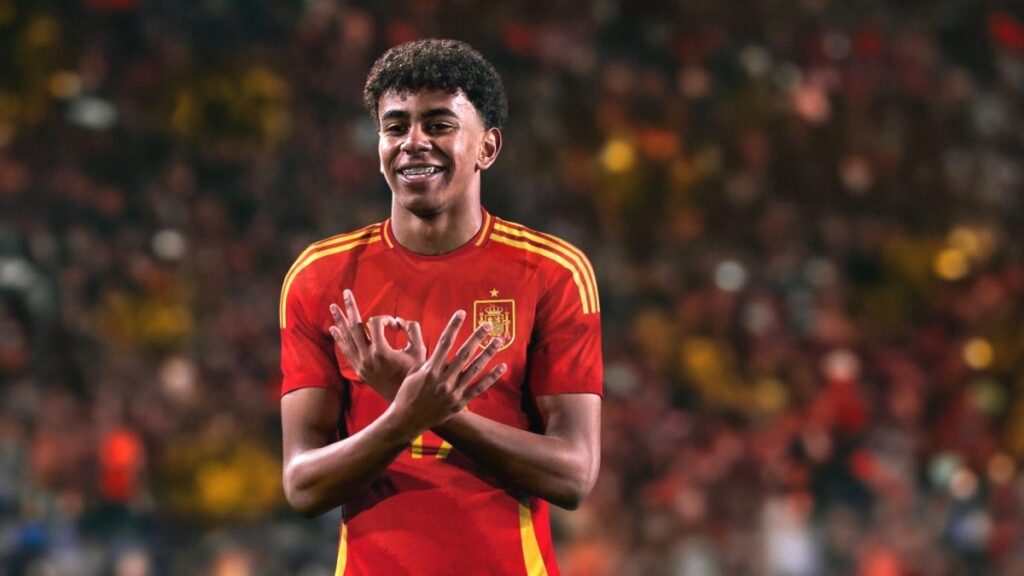
Lamine Yamal, Spain (Age 18, FC Barcelona)
If there is one player in this entire tournament that the world cannot stop talking about, it is Lamine Yamal. The 18-year-old from Barcelona finished the 2025-26 club season with 24 goals and 18 assists in just 48 matches, numbers that most experienced players can only dream of. He helped Hansi Flick’s Barcelona side win La Liga, and he did it playing from the right wing.
What makes Yamal so hard to stop is the way he moves with the ball. He has tight control at full speed, and he knows exactly when to slow down and when to suddenly burst past a defender. Once he gets past the first player, the trouble really starts for the opposition. He can cross, pass through tight spaces, cut inside and hit a powerful left-footed shot, all in the same run. A hamstring injury might keep him out of Spain’s first two group games, but when he steps onto the pitch, the whole world will be watching. Spain are defending European champions and one of the favourites for the title, and Yamal could easily be the difference.
Arda Güler, Turkey (Age 21, Real Madrid)
Arda Güler has been a famous name in football for a while now, but this is his first World Cup, and he is going into it in great form. The Turkish midfielder had a strong 2025-26 La Liga season with Real Madrid, finishing with 14 assists. Turkey will use him as their number 10, a free role just behind the strikers, where he can use his sharp touch and passing to open up defences.
Güler creates 3.1 chances per 90 minutes, which is a very high number even for a creative midfielder. He can see a pass others cannot, and one moment of his brilliance can unlock even the tightest defence. Turkey have always been a team with potential but inconsistent results. If Güler plays well, they have a real chance to go deep into the tournament.
João Neves, Portugal (Age 21, PSG)
At just 21 years old, João Neves has already won the UEFA Champions League twice with PSG. That kind of experience is rare for someone his age. The Portuguese midfielder is not a flashy player, he wins the ball, passes it simply, and keeps the game moving at the right speed. He does the hard work quietly and effectively.
At PSG, he has built a strong midfield partnership with fellow Portuguese player Vitinha. Portugal coach Roberto Martínez is expected to use both of them together at the World Cup as well. In a tournament where the heat and high number of games can wear players down, Neves’ fitness and energy will be a big advantage for Portugal in the knockout rounds.
Désiré Doué, France (Age 20, PSG)
Doué’s name became known around the world when he scored twice in the UEFA Champions League final against Inter Milan last season. He followed that up with 32 goal involvements in 61 matches across all competitions for PSG in 2025-26, including 13 goals. Those are numbers that prove he was not just lucky in that final, he is consistently good.
France already have Mbappé and Ousmane Dembélé up front, which means Doué may not start every game. But he is the kind of player who can change a match in 20 minutes off the bench. He can play anywhere across the front line, including through the middle as a false 9. For France, that kind of flexible attacking option is a real weapon in a knockout tournament.
Pau Cubarsí, Spain (Age 19, FC Barcelona)
Not every important player at this World Cup will score goals or make tricks. Pau Cubarsí is a centre-back, and at just 19 years old, he already plays like a much older, more experienced defender. He reads the game well, wins headers, and carries the ball out from the back with confidence. He does not panic under pressure, which is exactly what a team needs when defending a lead in a knockout game.
Barcelona won La Liga this season partly because their defence was solid, and Cubarsí was a big reason for that. Spain will need their backline to be tight in the later rounds of this tournament, and Cubarsí’s calm and composed style will be key.
Warren Zaïre-Emery, France (Age 20, PSG)
At 20 years old, Warren Zaïre-Emery already has 182 competitive matches for PSG. That is a lot of experience for someone so young. He is a box-to-box midfielder, meaning he works hard at both ends of the pitch, and he rarely makes mistakes. He wins the ball, passes it well, covers ground quickly, and even fills in at right back when needed.
His 5.47 ball recoveries per 90 minutes is a very strong number for a midfielder, showing how much defensive work he puts in. France coach Didier Deschamps values players who do the right thing consistently rather than take big risks, and Zaïre-Emery fits that perfectly.
Endrick, Brazil (Age 19, Real Madrid / Lyon)
Brazil have not won a World Cup since 2002, and the pressure to end that wait is enormous. Endrick is one of the young players carrying that weight. The 19-year-old joined Real Madrid from Brazil to great fanfare, was then loaned to Lyon, and found his best form there. Brazil legend Cafu has tipped him as the breakout star of the entire tournament.
Endrick made his senior Brazil debut against Croatia earlier this year and contributed two assists in just 14 minutes on the pitch. He is unlikely to start regularly, but as a substitute in a tight game, his pace, sharpness, and eye for goal could decide matches. Brazil want their sixth world title, and Endrick coming off the bench in a big moment could be the spark they need.
Yan Diomandé, Ivory Coast (Age 18, RB Leipzig)
Few stories at this World Cup are as remarkable as Yan Diomandé’s. Just four years ago, he was playing high school soccer in Florida. Today, he is an €100 million-rated winger who had a sensational debut season in the Bundesliga with RB Leipzig, 12 goals, 10 assists, and the Bundesliga Rookie of the Year award.
Liverpool, PSG, and Bayern Munich are all reportedly interested in signing him. He is quick, tricky, and direct. He uses short bursts of speed, sharp changes of direction, and a strong desire to get past defenders. He is arguably the most exciting wildcard in the entire tournament and could have a James Rodríguez-style 2014 tournament, where an unknown player stole the show and left the world stunned.
Nico O’Riley, England (Age 21, Manchester City)
Nico O’Riley had a season that nobody expected. The Manchester City full-back appeared in 34 Premier League matches and was named the league’s Young Player of the Season. He scored both goals in the EFL Cup final against Arsenal at Wembley and earned the Man of the Match award. In total, he managed nine goals and six assists this season, extraordinary numbers for a full-back.
England coach Thomas Tuchel called him up ahead of more established names like Cole Palmer and Phil Foden. Tuchel likes to use inverted full-backs who push inside to create overloads in the middle third of the pitch, and O’Riley’s ability to get forward and score goals makes him a perfect fit for that role.
Lennart Karl, Germany (Age 18, Bayern Munich)
The youngest player in Germany’s entire World Cup squad, Lennart Karl has had a debut senior season that most players take years to have. The 18-year-old Bayern Munich attacker scored nine goals and set up eight more for his club. He also scored against Club Brugge in the Champions League, becoming the youngest Bayern player ever to score in that competition at 17 years and 242 days old.
In Germany’s pre-tournament win over Finland, Karl became the youngest player since records began in 2005 to directly set up or score a goal for the German national team. His xG of 0.53 per 90 minutes shows that he gets into good positions consistently. Germany will likely use him off the bench, but even in that role, he can be decisive.
Other Names to Watch
Beyond this top 10, there are more young players making their World Cup debut who could have a big impact. Kenan Yildiz of Turkey, Kobbie Mainoo of England, and Nico Paz of Argentina are all players with big club reputations heading into their first tournament. Kendry Páez of Ecuador, Jorrel Hato of the Netherlands, and Nestory Irankunda of Australia are also players worth following. The youngest player in the entire 2026 World Cup is Gilberto Mora of Mexico. Ibrahim Mbaye of Senegal and Luka Vuskovic of Croatia are also debutants with the tools to make headlines.
The 2026 World Cup is the largest in the history of the game. More teams and more matches mean more opportunities for young players to leave their mark. Some of these names will go on to dominate world football for the next decade. Others will take a little longer to reach their peak. Either way, this is the beginning of something new, and it starts now.