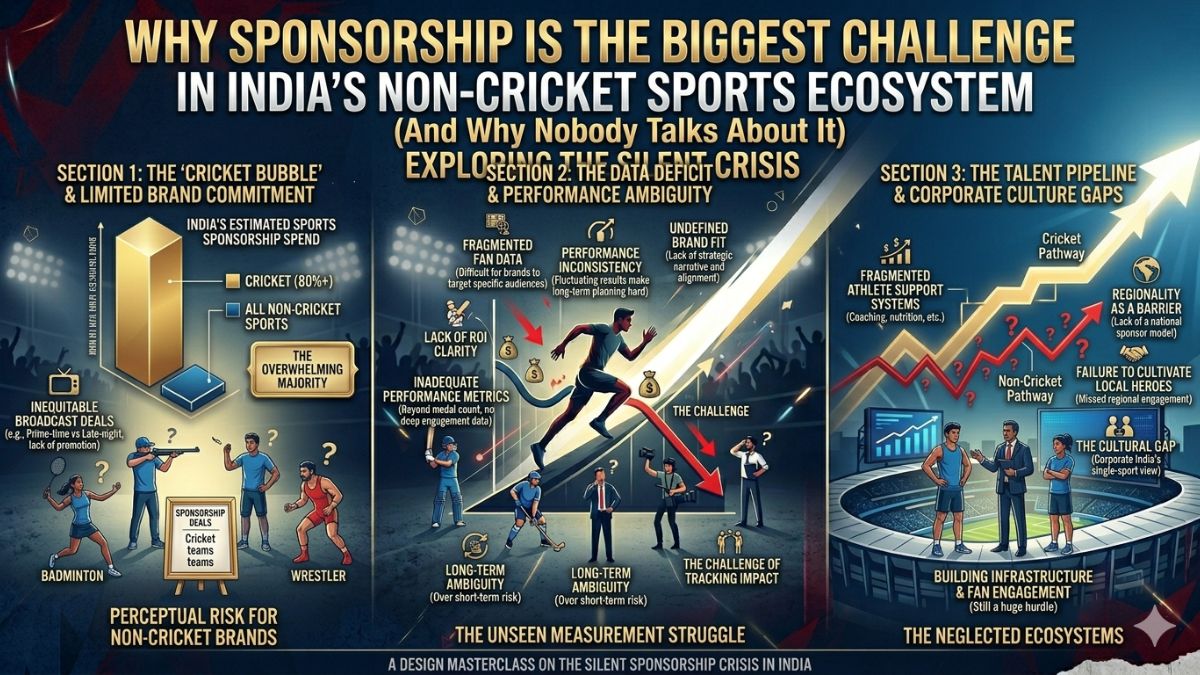
1. Weak League Ecosystems = Weak Brand Confidence
Leagues are the backbone of any sustainable sports economy. They provide continuity, storytelling, and commercial opportunities. But in India, most non-cricket leagues struggle to offer that stability.
Many leagues lack consistent scheduling, long-term vision, and operational continuity. Some start with hype and vanish within a few seasons. Others operate without clarity on calendar or format. For brands, this creates uncertainty—and uncertainty is the biggest deterrent to investment.
Globally, successful sports ecosystems thrive on structure. Predictable seasons, strong franchise systems, and long-term planning allow brands to align their marketing strategies with confidence. In India, however, brands often see non-cricket leagues as short-term experiments rather than long-term assets.
The result? Sponsorship becomes a risk, not an investment.
2. Broken Media & Distribution System
Sponsorship follows visibility. And visibility is driven by media.
One of the harsh realities of non-cricket sports in India is inconsistent and fragmented coverage. Matches are often not broadcast widely, digital streams lack reach, and storytelling is almost non-existent. Without regular content, audiences don’t build emotional connections—and without audiences, sponsors see no value.
In countries like the USA or Australia, sports ecosystems are supported by a powerful content engine. College sports, grassroots competitions, and professional leagues together create a continuous pipeline of stories. Athletes are built into narratives long before they become global stars.
In India, the situation is the opposite. Athletes appear during major tournaments and disappear right after. There is no continuity in storytelling, no build-up, and no follow-through. This breaks the visibility cycle, making it difficult for sponsors to justify investments.
No visibility means no audience.
No audience means no sponsorship.
3. Lack of Measurable ROI for Brands
Brands don’t sponsor sports out of passion—they invest for measurable returns.
In non-cricket sports, one of the biggest gaps is the absence of reliable data. Viewership numbers are often unclear, audience demographics are poorly defined, and engagement metrics are inconsistent. Without this data, brands cannot evaluate the effectiveness of their investments.
A brand manager has to answer a simple question: “What do we get in return?”
In cricket, this answer is backed by numbers—TRPs, digital impressions, fan engagement, and brand recall. In non-cricket sports, however, sponsorship decisions often rely on assumptions rather than analytics.
This lack of measurable ROI turns sponsorship into guesswork. And in today’s data-driven marketing world, brands avoid guesswork.
4. Athlete & Ecosystem Mindset Gap
One of the most overlooked reasons behind sponsorship challenges is mindset.
There is still a widespread belief in India that performance alone will attract sponsorships. While performance is important, it is no longer enough. In global sports ecosystems, athletes are not just performers—they are content creators, personal brands, and media assets.
Top athletes actively engage with their audiences through social media, storytelling, and consistent content. They build narratives around their journeys, making themselves relatable and marketable.
In India, many athletes lack structured content strategies. Social media presence is inconsistent, storytelling is minimal, and personal branding is often neglected. As a result, even highly talented athletes remain commercially invisible.
Sponsors don’t just look for winners—they look for visibility, relatability, and engagement. Without these elements, even top performers struggle to attract brand partnerships.
5. No Integrated Sports Business Model
Perhaps the most fundamental issue is the lack of an integrated ecosystem.
In mature sports markets, every layer is interconnected: grassroots programs feed into college systems, which connect to professional leagues, which are amplified by media, which in turn attract sponsorships. This creates a seamless value chain where talent, visibility, and revenue flow together.
In India, these elements operate in silos. Grassroots development is disconnected from leagues. Leagues are not effectively linked to media. Media fails to build long-term athlete narratives. As a result, the entire ecosystem becomes fragmented.
When the system isn’t connected, value doesn’t compound. And when value doesn’t compound, money doesn’t flow.
Why Nobody Talks About This??
The silence around this issue is not accidental—it’s uncomfortable.
Federations often blame a lack of funding.
Brands point to a lack of visibility.
Athletes highlight a lack of support.
But the real issue lies deeper—in structural misalignment.
Acknowledging this requires long-term thinking, professional execution, and accountability across stakeholders. It’s easier to point fingers than to fix systems.
Final Perspective:
Sponsorship is not the problem.
👉 The ecosystem is.
Until India builds structured leagues, consistent media pipelines, data-driven sponsorship models, athlete-led storytelling, and an integrated sports business framework, sponsorship challenges will persist.
The opportunity is massive. The talent is undeniable. But unless the system evolves, non-cricket sports in India will continue to struggle—not because brands aren’t interested, but because the ecosystem isn’t ready.