“One Biggest Problem Indian Players Face in Pickleball Which No One Will Talk About?”
Let me share it clearly and directly.
You can interview industry experts.
You can speak to league owners.
You can talk to sponsors.
You can sit with academy operators.
You can conduct cumulative research across tournaments and prize pools.
One reality clearly stands out.
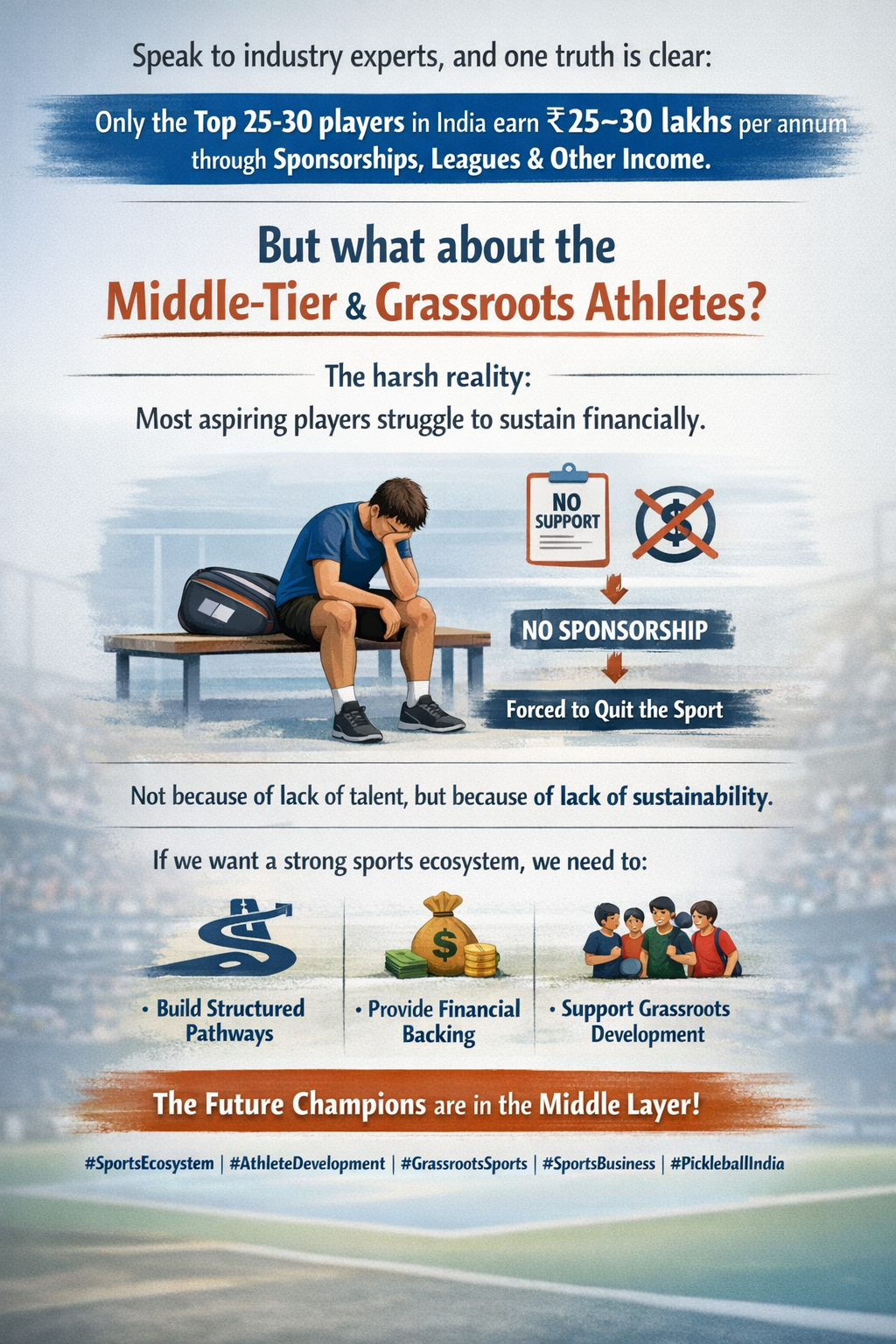
In India, only the top 25–30 players are earning ₹25–30 lakhs per annum through sponsorships, leagues, and other income avenues.
That’s the visible layer.
That’s the celebrated layer.
That’s the layer that gets media attention.
But what about the middle-tier players?
What about the athletes ranked between 30–150 nationally?
What about those consistently reaching quarterfinals and semifinals but not winning titles?
What about the players traveling city to city, paying for flights, accommodation, equipment, coaching, physio, and entry fees — mostly from their own pockets?
And what about the grassroots athletes — 18–24-year-olds trying to build a name, trying to break into that top bracket?
This is where the uncomfortable truth begins.
Most middle-tier and emerging players struggle to sustain themselves financially.
They are not earning enough from prize money.
They are not getting stable sponsorship contracts.
They are not receiving structured developmental retainers.
They are not part of long-term athlete support systems.
They survive tournament to tournament.
And survival is not the same as growth.
Without structured support, consistent sponsorship, or developmental contracts, many are eventually forced to step away from pursuing the sport at a competitive level — not because of lack of talent, but because of lack of sustainability.

That distinction is critical.
This is not a talent gap problem.
This is an economic model problem.
Right now, the ecosystem is top-heavy.
Leagues are emerging.
Announcements are loud.
Investments are visible.
Top players are being marketed.
But an ecosystem cannot survive if the middle layer collapses.
In every successful sporting nation, the middle tier is protected.
Because that middle tier:
• Pushes the top players
• Maintains competitive depth
• Inspires grassroots participation
• Creates future champions
• Builds regional representation
• Ensures long-term continuity
When that layer struggles financially, two dangerous things happen:
-
Talented players quit early.
-
The sport becomes elitist and concentrated among a small group.
In Indian pickleball today, travel costs alone can exhaust a player’s yearly savings. Equipment upgrades are expensive. Professional coaching is expensive. Recovery support is expensive. Even ranking tournaments require consistent participation to maintain visibility.
If a player does not have family backing or personal financial security, sustainability becomes a daily battle.
And here’s another silent issue — brand perception.
Sponsors prefer visibility.
Visibility prefers winners.
Winners are already in the top 20–30 bracket.
So sponsorship money keeps circulating within the same circle.
This creates a compounding effect:
Top players become financially stronger →
They get better training & exposure →
They perform better →
They attract more sponsorship →
The gap widens further.
Meanwhile, the middle tier remains stuck in stagnation.
If this continues, we are not building a pyramid.
We are building a thin pillar.
A sustainable sports ecosystem always follows a pyramid model:
• Wide grassroots base
• Strong middle competitive layer
• Elite top tier
Right now, the base is growing.
The top is shining.
But the middle is fragile.
And that fragility is dangerous.
Because sports history globally shows one pattern:
When financial sustainability is missing at the middle layer, athlete dropout rates increase dramatically between ages 22–28 — precisely the age window when players enter their physical prime.
Imagine losing your most promising generation not due to injuries, not due to lack of passion — but due to financial fatigue.
If we truly want to build a long-term sporting ecosystem, the conversation cannot revolve only around leagues and top stars.
It must include:
• Tiered sponsorship models
• Development contracts for ranked 30–100 players
• Travel grants
• Structured federation support
• Transparent ranking incentives
• Corporate athlete adoption programs
• Regional academy funding
• Performance-based retainerships
Stakeholders — league owners, brands, federation leaders, investors — need to look at this seriously.
Because if middle-tier players continue to struggle, the sport’s depth will suffer.
And when depth suffers:
Competition quality drops.
Viewership plateaus.
Sponsor confidence weakens.
League valuations stagnate.
What looks like growth today can become structural weakness tomorrow.
The biggest struggle in the long run will not be about marketing.
It will not be about launching more leagues.
It will not be about celebrity endorsements.
It will be about retention.
Retention of serious competitive athletes.
Until we address this gap, growth will remain top-heavy and fragile.
And fragile ecosystems don’t survive economic downturns.
They collapse when hype fades.
Indian pickleball has momentum right now.
But momentum without structure is temporary.
The middle layer is not a secondary issue.
It is the foundation of future excellence.
If we want Olympic-level ambition one day…
If we want international podium finishes…
If we want long-term commercial stability…
We must fix sustainability for the middle tier.
Otherwise, the sport risks becoming aspirational for many — but viable for very few.
And that is the biggest problem no one wants to openly talk about.
The Biggest Problem Indian Pickleball Players Face
| Section | Key Points |
|---|---|
| Core Issue | Only the top 25–30 players in India earn ₹25–30 lakhs per annum through sponsorships, leagues, and other income sources. |
| Who Gets Visibility? | • Top-ranked players • League-featured athletes • Players with media attention • Established winners |
| The Overlooked Segment | • Players ranked 30–150 nationally • Regular quarterfinalists & semifinalists • Grassroots athletes (18–24 years) • Emerging competitors trying to break into top tier |
| Financial Reality for Middle Tier | • Limited prize money earnings • No stable sponsorship contracts • No developmental retainers • No structured long-term support |
| Cost Burden on Players | • Flights & travel expenses • Accommodation • Equipment upgrades • Coaching fees • Physio & recovery support • Tournament entry fees |
| Core Problem Type | ❌ Not a talent gap problem ✅ An economic model problem |
| Current Ecosystem Structure | • Leagues emerging • High-visibility announcements • Marketing focused on top stars • Investment concentrated at the top |
| Why Middle Tier Matters | • Pushes elite players • Maintains competitive depth • Feeds future champions • Builds regional spread • Ensures continuity |
| Risks If Ignored | 1. Talented players quit early 2. Sport becomes elitist & concentrated 3. Reduced competitive depth |
| Sponsorship Cycle Issue | Visibility → Sponsors → Winners → More Visibility → More Sponsorship → Gap widens |
| Structural Imbalance | Instead of a pyramid (broad base, strong middle, elite top), we risk building a thin pillar (weak middle layer). |
| Age Risk Zone | Dropout risk increases between 22–28 years (prime athletic age) due to financial fatigue. |
| Long-Term Consequences | • Competition quality drops • Viewership plateaus • Sponsor confidence weakens • League valuations stagnate |
| What Sustainable Ecosystem Requires | • Tiered sponsorship models • Development contracts (Rank 30–100) • Travel grants • Federation-backed support • Transparent ranking incentives • Corporate athlete adoption • Regional academy funding • Performance retainerships |
| Biggest Long-Term Challenge | Athlete retention — not marketing, not leagues, not celebrity endorsements. |
| Core Warning | Growth will remain top-heavy and fragile if middle-tier sustainability is not fixed. |
| Final Thought | Pickleball risks becoming aspirational for many — but financially viable for very few. |
Related posts: