Global sports markets usually evolve in phases. A new sport enters through recreation, builds community adoption, attracts infrastructure investment, and eventually matures into a commercial and professional ecosystem. Pickleball in India is currently sitting at this exact inflection point. While countries like the United States pioneered the sport, India is now shaping up to be the most scalable pickleball market globally by 2031, driven by numbers, demographics, cost efficiency, and cultural readiness.
One of the strongest signals of India’s potential is participation growth. Over the last three years, pickleball participation in India has grown by an estimated 275 percent. What started as a niche recreational activity has rapidly transformed into a mainstream lifestyle sport. The simplicity of the game, short learning curve, and ability to be played across age groups has accelerated adoption at a pace rarely seen in emerging sports within the country.
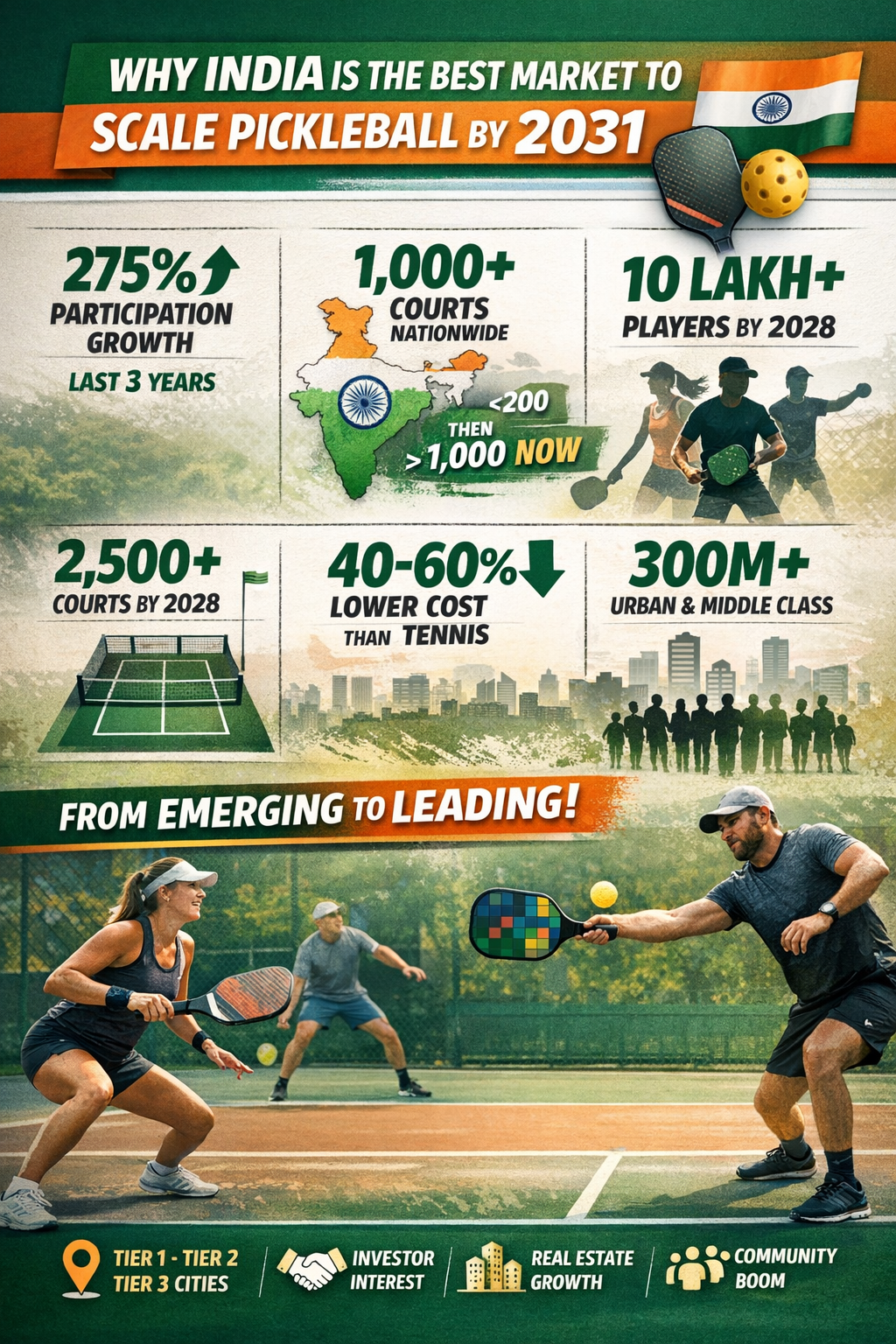

Infrastructure growth further reinforces this momentum. India already has more than one thousand operational pickleball courts, compared to fewer than two hundred courts just a few years ago. This exponential rise highlights how quickly the ecosystem is being built. Projections suggest the number of courts could reach two thousand five hundred by 2028, setting a strong base for nationwide participation well before 2031.
A key advantage India holds is the cost of infrastructure. Pickleball courts require forty to sixty percent lower investment than traditional tennis courts. This makes them extremely attractive for real estate developers, private clubs, schools, academies, and recreational centers. Lower setup costs allow faster deployment, quicker returns, and reduced financial risk, enabling rapid expansion even in non-metro cities.
India’s demographic profile makes the opportunity even stronger. The country has an urban youth and middle-class population of more than three hundred million people. This group actively seeks fitness activities that combine social interaction, accessibility, and entertainment. Pickleball fits perfectly into this lifestyle shift, offering a sport that is competitive yet inclusive, recreational yet structured.
Unlike many emerging sports that remain limited to metropolitan areas, pickleball in India is gaining traction across Tier One, Tier Two, and Tier Three cities. Smaller cities offer lower land costs, growing disposable incomes, and a strong appetite for community-driven sports. Residential societies, local clubs, and schools are increasingly adopting pickleball courts, ensuring that growth is decentralized and sustainable.
Real estate adoption is becoming one of the most important growth drivers. Developers are integrating pickleball courts into residential complexes, gated communities, townships, and hospitality projects. The compact size of the court and minimal maintenance requirements make it an ideal amenity. This integration transforms pickleball from a destination sport into an everyday recreational habit.
From a commercial perspective, brand and investor interest is steadily increasing. Pickleball presents opportunities across equipment manufacturing, apparel, court construction, academies, leagues, sponsorships, and digital content. As participation scales, organized competitions and professional leagues naturally follow, opening long-term monetization avenues.
India’s broader sports ecosystem is also evolving in favor of emerging disciplines. The success of non-cricket leagues has proven that Indian audiences are open to new sports when they are engaging and accessible. Pickleball aligns with this shift, offering both participation-driven growth and spectator-friendly formats.
By 2028, India is expected to cross ten lakh active pickleball players, with exponential upside by 2031. At that scale, India will no longer be considered an emerging pickleball nation. It will be a market that influences global participation trends, league structures, and commercial strategies.
The most critical takeaway is timing. Early movers in infrastructure, media, training, and brand building will define the rules of the ecosystem. Late entrants will face higher costs, stronger competition, and limited differentiation. Pickleball in India is not just a passing trend. It is a scalable sports economy in the making, and by 2031, India is positioned to lead the global pickleball conversation.
Another important factor supporting India’s dominance is the cultural adaptability of the sport. Pickleball does not require elite athletic backgrounds, expensive coaching, or specialized equipment to begin. This makes it particularly suitable for Indian households where sports participation is often driven by convenience and social value rather than professional ambition. Families can play together, seniors can remain active, and young professionals can treat it as both fitness and networking, creating multi-generational appeal.
Education institutions are also beginning to play a role in long-term growth. Schools and colleges are exploring pickleball as part of physical education programs due to its safety, minimal injury risk, and inclusive nature. Once embedded at the academic level, sports tend to create lifelong participation habits, ensuring consistent player pipelines for decades.
Digital influence cannot be ignored either. India’s massive social media user base creates an ideal environment for pickleball content, tutorials, grassroots stories, and league highlights to go viral. As content creators, athletes, and brands collaborate, visibility will scale much faster than traditional sports ever did. This digital acceleration will help pickleball leapfrog developmental stages that other sports took decades to achieve.
All these factors combine to form a rare opportunity window. India offers scale, affordability, enthusiasm, and long-term sustainability in one ecosystem. By 2031, pickleball will not be asking for attention in India. It will command it.
For global stakeholders, India represents the rare chance to build, shape, and lead an entire sport economy from its foundation, not as followers, but as pioneers defining standards, culture, and commercial success for the next generation across markets worldwide by 2031.
| Aspect | Key Insight on Pickleball in India |
|---|---|
| Market Evolution Stage | Pickleball in India is at a critical inflection point, transitioning from recreation to a structured commercial and professional ecosystem |
| Global Positioning | While the United States pioneered pickleball, India is shaping up to be the most scalable global market by 2031 |
| Participation Growth | Pickleball participation in India has grown by approximately 275% over the last three years |
| Nature of Adoption | The sport has evolved from a niche activity into a mainstream lifestyle sport |
| Accessibility Factor | Simple rules, short learning curve, and suitability for all age groups have accelerated adoption |
| Current Infrastructure | India has more than 1,000 operational pickleball courts nationwide |
| Historical Comparison | Court count has increased from fewer than 200 courts just a few years ago |
| Infrastructure Projections | Number of courts expected to reach 2,500 by 2028 |
| Infrastructure Cost Advantage | Pickleball courts cost 40–60% less to build than traditional tennis courts |
| Investment Appeal | Lower costs attract real estate developers, private clubs, schools, academies, and recreational centers |
| Expansion Speed | Lower setup costs enable faster deployment and quicker returns |
| Geographic Reach | Growth is visible across Tier-1, Tier-2, and Tier-3 cities |
| Tier-2 & Tier-3 Advantage | Smaller cities offer lower land costs, rising incomes, and strong community-driven sports demand |
| Grassroots Adoption | Residential societies, local clubs, and schools are actively adding pickleball courts |
| Demographic Strength | India has an urban youth and middle-class population exceeding 300 million |
| Lifestyle Alignment | Target demographic seeks fitness options combining social interaction, accessibility, and entertainment |
| Real Estate Integration | Pickleball courts are being added to residential complexes, gated communities, townships, and hospitality projects |
| Infrastructure Efficiency | Compact court size and low maintenance make pickleball an ideal real estate amenity |
| Cultural Adaptability | Pickleball does not require elite athletic background, expensive coaching, or specialized equipment |
| Multi-Generational Appeal | Families, seniors, and young professionals can participate together |
| Education Sector Role | Schools and colleges are exploring pickleball in physical education programs |
| Safety Factor | Low injury risk and inclusive nature make it suitable for academic institutions |
| Long-Term Player Pipeline | Early exposure in education creates lifelong participation habits |
| Commercial Opportunities | Equipment, apparel, court construction, academies, leagues, sponsorships, and digital content |
| Investor Interest | Brand and investor attention is steadily increasing |
| League Development | Organized competitions and professional leagues expected as participation scales |
| Sports Ecosystem Shift | Indian audiences are increasingly open to non-cricket sports |
| Format Advantage | Pickleball supports both participation-driven growth and spectator-friendly formats |
| Player Projections | India expected to cross 10 lakh active players by 2028 |
| Long-Term Outlook | Exponential growth expected by 2031 |
| Global Influence | India will influence global participation trends, league structures, and commercial strategies |
| Timing Advantage | Early movers will define ecosystem rules and standards |
| Late Entry Risk | Late entrants face higher costs, stronger competition, and limited differentiation |
| Digital Acceleration | Social media enables rapid spread of tutorials, grassroots stories, and league highlights |
| Content Ecosystem | Creators, athletes, and brands amplify visibility faster than traditional sports |
| Market Advantage Summary | India offers scale, affordability, enthusiasm, and sustainability in one ecosystem |
| 2031 Positioning | By 2031, pickleball in India will command attention rather than seek it |
| Global Opportunity | India offers stakeholders a chance to build and lead a sport economy from the ground up |
| Leadership Potential | Early stakeholders can define global standards, culture, and commercial success |
Related posts: